How to Remove Hard Water Spots From Car Glass Safely
Remove hard water spots from car glass by starting with pH-neutral car wash soap, then a 1:1 vinegar-and-water wipe; if the spot still catches a fingernail or stays after polishing, it’s likely etched glass and needs polishing compound, not more acid. Scrubbing with the wrong pad can leave fine scratches, deepen the stain line, and burn time. This guide shows how to tell film from etching and the safest step-up method for each severity level.
What you’ll need
- pH-neutral car wash soap
- White distilled vinegar
- Clean water
- Spray bottle
- Soft towel
- Sponge
- Fresh lemon juice
- Traditional glass cleaner
- Toothpaste
- Microfiber drying towel
- Optional: Aquapel or another water repellant
Start here: film or etching
Fresh film wipes away and does not change the glass. Bonded spots feel stubborn, look chalky or ring-shaped, and may need acid or polish. Likely etching stays visible after cleaning and may catch a fingernail. That last case is where more vinegar usually stops helping.
Fresh film
This is the easiest level. The glass looks hazy after drying, but the mark softens with a damp wipe and a normal cleaner.
Bonded spots
These are mineral deposits from calcium and magnesium, often mixed with limescale and other deposits. They bond more tightly after repeated wetting, sprinkler exposure, or slow evaporation.
Likely etching
If the mark remains after careful cleaning, the surface may already be etched. Acid can clear residue on top, but it will not rebuild glass that has been changed by the deposit.
Water spot decision table
| Severity level | Safest starting method | Dwell time | What to avoid | When to escalate |
|---|---|---|---|---|
| Fresh film | Wash with pH-neutral soap, then wipe with a light vinegar mix in a spray bottle | 30 to 60 seconds | Dry scrubbing, abrasive pads, and repeated passes on tinted edges | Escalate if the haze stays after one gentle pass and a glass-cleaner finish |
| Visible hard spots | Use white distilled vinegar mixed 1:1 with water; follow with traditional glass cleaner | 1 to 2 minutes | Letting acid dry on the glass or flooding seals and trim | Escalate to a stronger vinegar ratio or a lemon-juice test spot |
| Bonded spots | Use a higher vinegar concentration for severe spots, then try toothpaste mixed with water | 2 to 3 minutes | Heavy pressure, razor blades, and repeated acid cycles without rinsing | Escalate to glass polish if the ring still outlines the mark |
| Likely etching | Stop acids and move to glass polish on a test spot only | Follow product directions | More vinegar, more scrubbing, and any attempt to “wear it off” | Get professional help if the defect remains across multiple test spots |
How do you remove fresh film?
Start with a gentle wash, then a light vinegar wipe. Fresh film should lift without pressure, and the safest finish is a traditional glass cleaner and a dry wipe. If the mark remains after one cycle, move up one step rather than scrubbing harder.
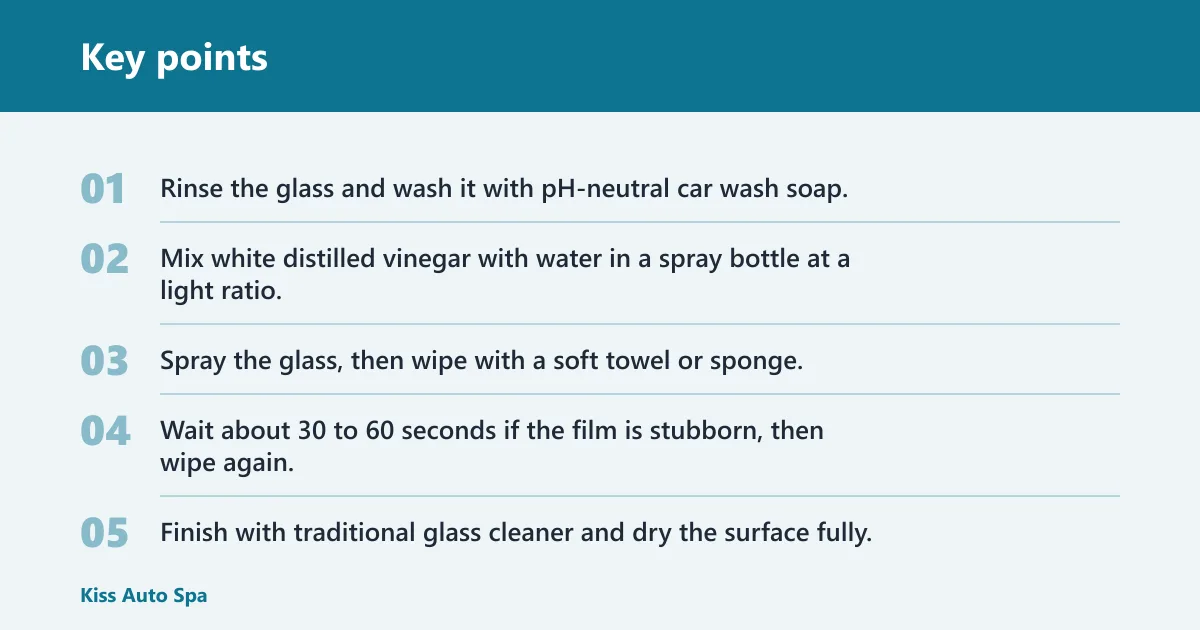
- Rinse the glass and wash it with pH-neutral car wash soap.
- Mix white distilled vinegar with water in a spray bottle at a light ratio.
- Spray the glass, then wipe with a soft towel or sponge.
- Wait about 30 to 60 seconds if the film is stubborn, then wipe again.
- Finish with traditional glass cleaner and dry the surface fully.
Picture a windshield after one sprinkler pass in a covered driveway. If the haze is still recent, the first wipe usually matters more than the cleaner strength. Pressure should stay light enough that the towel glides, not drags.
How do you remove visible hard spots?
Use a stronger vinegar-to-water mix and give it a little more dwell time. If the spot is still there after a careful wipe, test fresh lemon juice on one small area. Toothpaste is the next cautious step, but only on a small section.
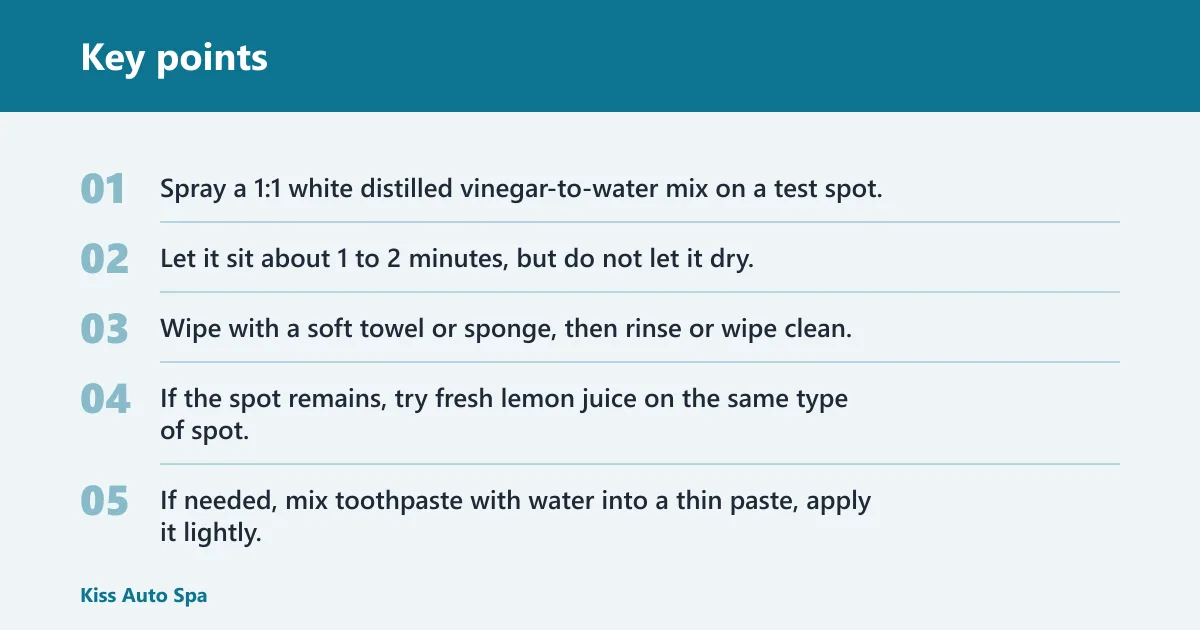
- Spray a 1:1 white distilled vinegar-to-water mix on a test spot.
- Let it sit about 1 to 2 minutes, but do not let it dry.
- Wipe with a soft towel or sponge, then rinse or wipe clean.
- If the spot remains, try fresh lemon juice on the same type of spot.
- If needed, mix toothpaste with water into a thin paste, apply it lightly, then remove it completely and finish with glass cleaner.
Say your side window has white rings from a hose sprinkler. A stronger acid mix may clear the outer film, while a toothpaste step can help on a single stubborn ring. Keep the test spot small, because more product does not make the process safer.
When do spots need glass polish?
Glass polish is the next step when the deposit is bonded or the mark still outlines after acid cleaning. If a fingernail catches, if the spot still looks like a shadow after drying, or if the same area resists two careful attempts, stop household cleaners and switch to polish or professional help.
- Clean one small area with vinegar first and dry it fully.
- Inspect it in direct light from different angles.
- Try glass polish on a test spot if the defect remains.
- Stop if the area still shows a fixed halo after polishing.
- Book professional glass correction when the mark looks etched across a larger panel.
If that didn’t work, do not repeat acid over and over. Repeated exposure can waste time and leave residue around seals, tint edges, and aftermarket coatings.
Will vinegar damage car glass or window tint?
Vinegar is the usual first DIY cleaner for mineral spots, and it is generally aimed at the glass, not the trim. The risk rises when it sits too long, dries on the surface, or gets pushed into tint film, rubber seals, or painted trim. Use controlled dwell time.
Keep the spray on the glass, not the edges. Wipe before it dries. If the car has aftermarket tint, use the mildest mix first and avoid soaking the film.
Safe application rules
- Use a spray bottle and target only the spotted area.
- Keep contact time short on tinted windows.
- Wipe the edge nearest rubber seals first.
- Follow with traditional glass cleaner to remove residue.
Can lemon juice or toothpaste really remove hard water spots from car windows?
Yes, but only in the right case. Fresh lemon juice is another acidic option and is best used fresh rather than bottled. Toothpaste is a mild abrasive step, so it can help with stubborn spots that acid only partly loosens. Neither one fixes etched glass.
- Apply fresh lemon juice with a spray bottle or rub it on directly with a soft towel.
- Let it dwell briefly, then wipe and inspect.
- If needed, make a thin toothpaste-and-water paste and apply it sparingly.
- Allow it to sit briefly, then remove it fully.
- Finish with traditional glass cleaner and dry the glass completely.
Common mistakes
Too much pressure can leave fine marks that look like new spots. Long dwell times can dry acid on the glass and leave a smear. Skipping trim and tint protection can move residue where it does not belong. Leaving cleaner behind can make the next rainstorm look worse.
- Do not scrub with abrasive pads or steel wool.
- Do not let vinegar dry on the glass.
- Do not flood window tint, rubber seals, or painted trim.
- Do not keep reapplying acid when the mark no longer changes.
- Do not skip the final traditional glass cleaner step.
How do you prevent hard water spots from coming back after washing your car?
Dry the glass as soon as you finish washing. Remove resting water from the windshield, park in a covered area when you can, and consider a water repellant like Aquapel after the glass is clean. Those steps reduce how long minerals sit on the surface.
- Dry the windshield and side glass after each wash.
- Wipe any standing water from mirrors, trim lines, and cowl edges.
- Park under cover during sprinkler hours or after a wash.
- Apply Aquapel or another water repellant to the windshield after cleaning.
Suppose a car sits near sprinklers every night. The difference between a clean windshield and a spotted one is often not the soap. It is the drying time and the parking spot.
Frequently asked questions
How do I remove hard water spots from car glass without scratching it?
Wash first with pH-neutral soap, then use a soft towel or sponge with a light vinegar mix. Wipe gently, do not scrub, and finish with traditional glass cleaner. If the mark still catches a fingernail, move to polish instead of pressing harder.
When do water spots need glass polish instead of a household cleaner?
Use glass polish when acid and careful wiping leave a ring, haze, or fixed halo. That usually means the deposit is bonded or the glass is already etched. Test one small section first; if the mark does not change, stop home treatment.
How long should I let a water spot remover sit on the glass?
Keep the dwell short. A light mix can sit about 30 to 60 seconds, while a stronger vinegar mix can sit 1 to 2 minutes. Do not let it dry. If the area starts to haze or streak, wipe it off right away.
Will vinegar damage car glass or window tint?: glass usually handles a brief?
Glass usually handles a brief vinegar wipe well, but tint film, rubber seals, and painted trim need care. Keep the mix off those surfaces as much as possible, use short dwell times, and wipe before the solution dries. If tint is delicate, test a hidden corner first.