Best Detailing Brushes for Car Interior Cleaning
The best detailing brushes for car interior cleaning are surface-specific: soft boar-hair or flagged nylon for plastics, ultra-soft for screens and piano black, firmer trim-safe nylon for fabric, and a crevice brush for seams. Using one generic soft brush can haze gloss trim, spread grit, and leave debris in seams. This guide shows which brush to buy for each interior surface, with each tool matched to a specific job and finish.
How to choose a safe bristle stiffness and head size
The top pick is a soft bristle brush with a secure ferrule and an ergonomic handle. It covers dashboards, vents, and dust-prone trim with light pressure and better control. Some detailing suppliers list soft-bristle brushes for dashboards and vents, leather-cleaning brushes for delicate surfaces, drill brush attachments for carpets and mats, and detailing brushes as part of a full interior tool kit.
The right choice depends on the surface. Soft bristles handle dust and light grime on trim. Narrow heads reach vents. A crevice profile fits seams and rails. For cloth and floor mats, a drill brush attachment belongs in the kit, but not on gloss plastic or touchscreens.
What makes the top pick safe for interior use
Safe interior use depends on three things: bristle softness, head size, and control. A brush should move dust out of pores and seams without dragging grit across the surface. A secure ferrule matters too, because loose bristles can shed into switches, stitching, and vent vanes.
Brush material matters as well. Synthetic bristles usually come in more predictable stiffness levels, while natural or boar’s hair options can feel softer and hold dust well. The key is fit, not marketing language. A brush that is too stiff can mark gloss trim, and a brush that is too large can leave dirt behind in narrow gaps.
Quick picks by interior task
Choose the brush by job, not by color or brand claims. Dashboards and vents need soft bristles. Seats, seams, and buttons need a smaller brush or crevice shape. Carpets and mats can take a drill brush attachment. Delicate trim, piano black, and touchscreens often need a microfiber swab or towel instead of a brush.
Best for dashboards and vents
Soft bristle brush. Look for a soft head that will not mar plastics, a slim profile for vent slats, and bristles long enough to reach into recessed trim. This is the brush for dusting dashboards, center stacks, and HVAC vents.
Best for seats, seams, and buttons
Crevice brush. Choose a narrow profile that can fit seat rails, stitched seams, console edges, and the gaps around buttons. A shorter, controlled head gives more precision than a large, fluffy brush in these tight zones.
Best for carpets and mats
Drill brush attachment. Use it on floor mats and carpet fibers where agitation helps lift dirt. Keep it away from trim, piano black, touchscreen borders, and stitched leather. It is a carpet tool first.
Best for delicate trim and gloss surfaces
Ultra-soft brush or microfiber swab. Piano black, piano-finish trim, and glossy controls scratch easily. A very soft brush may still be too much if the surface already has dust or grit, so a microfiber swab or towel is often safer.
Interior brush decision table
This table gives a surface-by-surface buying system. Start with the surface, then match brush head size, bristle softness, and material. If the surface is listed as red-flag, treat a brush as optional and test only with the softest tool you have.
| Surface | Brush head size | Bristle softness | Recommended material | Red-flag surfaces |
|---|---|---|---|---|
| Dashboard | Medium, 20–30 mm head | Soft | Flagged nylon or soft boar’s hair | Piano black trim, touchscreens |
| HVAC vents | Small, narrow head | Soft to ultra-soft | Flagged synthetic bristles | Fragile vent fins, glossy vent bezels |
| Buttons and switch panels | Small, compact head | Ultra-soft | Soft synthetic | Gloss piano black, backlit icons |
| Leather seats | Small to medium, rounded head | Gentle | Leather cleaning brush with fine bristles | Stitched seams, perforations, coated gloss leather |
| Piano black trim | Very small, soft tip | Ultra-soft | Microfiber swab or the softest synthetic | Any stiff nylon, drill brush, abrasive dust |
| Touchscreens | None or very small | Ultra-soft | Microfiber swab or microfiber towel | All stiff brushes, hard nylon, boar’s hair |
| Seat rails | Narrow crevice head | Firm enough to move debris, not stiff | Crevice brush, synthetic | Leather side bolsters, exposed trim |
| Console seams | Narrow crevice head | Soft to medium | Crevice brush with fine tips | Soft-touch coating, piano black edges |
| Cupholders | Small rounded head | Soft | Soft synthetic or short boar’s hair | Gloss rings, painted trim |
| Carpet edges | Medium, dense head | Medium to firm | Trim-safe nylon or drill brush attachment | Plastic sills, leather, door scuffs |
| Floor mats | Large, dense head | Firm | Drill brush attachment | Interior plastics, stitched trim |
| Stitched trim | Small | Soft | Soft synthetic or microfiber swab | Hard nylon, drill brush, stiff boar’s hair |
How to read the table
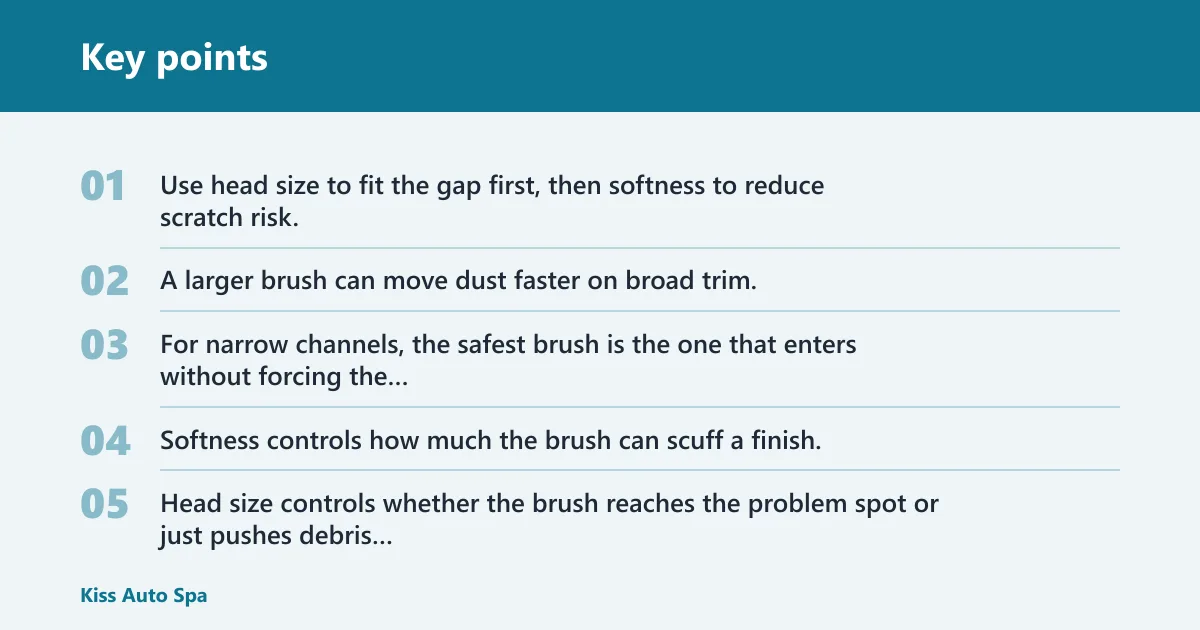
Use head size to fit the gap first, then softness to reduce scratch risk. A larger brush can move dust faster on broad trim, but it will miss seams and can touch adjacent gloss surfaces. For narrow channels, the safest brush is the one that enters without forcing the bristles against nearby edges.
Why bristle softness and head size matter
Softness controls how much the brush can scuff a finish. Head size controls whether the brush reaches the problem spot or just pushes debris around it. On interior trim, the wrong combination usually fails in one of two ways: it scratches a sensitive surface, or it leaves grit packed where your hand cannot see it.
What should you use on vents and tight crevices?
Use a detailing brush for vents with a small head that can slip between slats and reach deep into HVAC openings. For seat rails, seams, and console gaps, a crevice brush works better because its narrow profile fits tight channels without crowding adjacent trim. If the area is delicate or glossy, switch to a microfiber swab.
Detailing brush size for vents
Vents need a brush that is small enough to enter the slats and long enough to reach deep inside the vents. A short, wide brush often only cleans the visible edge. A smaller head with soft, flagged bristles can lift dust without bending the fins or rubbing the bezel.
Crevice brush use in seat rails and console gaps
A crevice brush is the better choice for seat rails, seams, and the narrow gaps around buttons and consoles. Its value is control. It reaches where a round dust brush cannot, and it keeps the bristles aligned in a tight channel instead of spreading across nearby trim.
When a microfiber swab is safer
Choose a microfiber swab when the surface is high gloss, highly visible, or easy to mark. That includes piano black, touchscreen borders, and polished switch panels. A brush can still be the wrong tool if the dust is sitting on a finish that scratches before the dirt even moves.
Which brush is safest for dashboards, buttons, and piano black?
Soft bristle brushes are better for dashboards because they remove dust without dragging grit across plastic grain. Buttons and piano black trim need even more caution. On those surfaces, use the softest brush available only if the surface is clear of abrasive debris; otherwise a microfiber towel or swab is safer.
Soft bristle brushes for dashboards
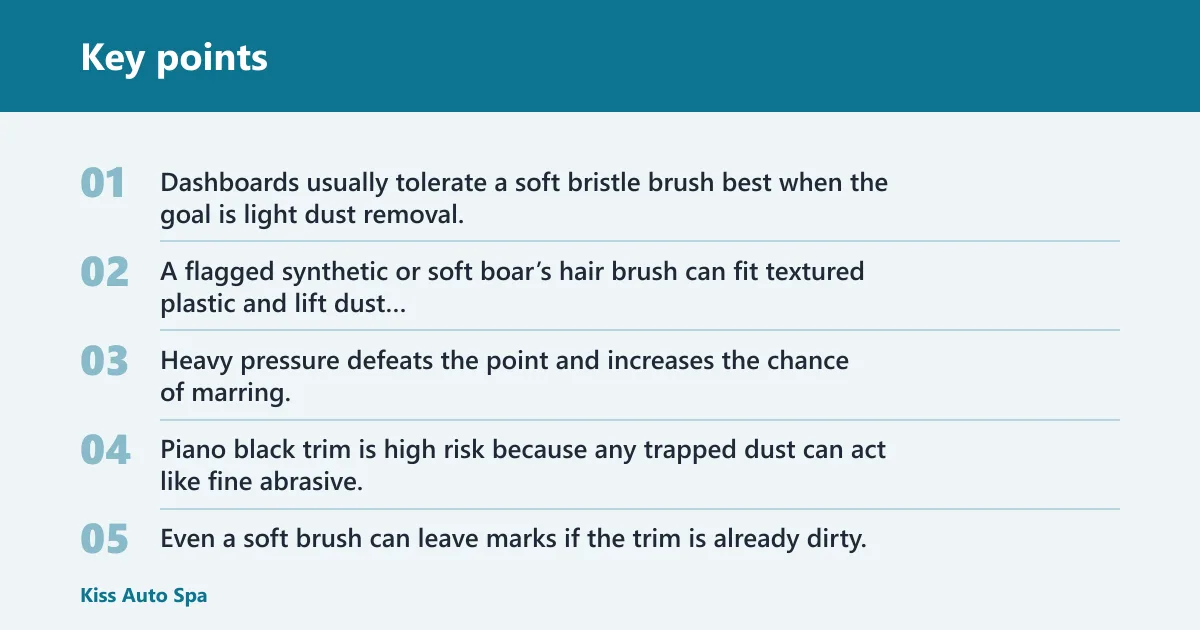
Dashboards usually tolerate a soft bristle brush best when the goal is light dust removal. A flagged synthetic or soft boar’s hair brush can fit textured plastic and lift dust from grain lines. The key is light contact. Heavy pressure defeats the point and increases the chance of marring.
Piano black trim and other high-scratch surfaces
Piano black trim is high risk because any trapped dust can act like fine abrasive. Even a soft brush can leave marks if the trim is already dirty. Use the cleanest, softest tool available, and avoid dry scrubbing. If the area is heavily dusted, a microfiber towel or swab reduces the chance of visible haze.
Brushes to avoid on touchscreens and glossy controls
Avoid stiff nylon, hard trim brushes, and drill brush attachments on touchscreens and glossy control panels. These surfaces do not need aggressive agitation. They need controlled removal of dust and fingerprints. If a brush is likely to touch a display edge or glossy bezel, it is the wrong tool.
Say your center console has glossy black trim around the shifter and two small climate buttons beside it. A medium brush may clean the buttons, but its edges can touch the gloss and leave fine marks. In that case, a smaller ultra-soft brush or microfiber swab gives better control.
What brush do you need for leather seats?
Leather seats need a leather cleaning brush with gentle bristles and controlled pressure. The goal is to lift residue from grain and stitching without scuffing the coating or pulling at seams. For perforated or heavily stitched leather, a softer tool or microfiber towel is often safer than any brush.
Leather cleaning brush bristle feel and pressure control
Choose a brush that feels gentle at the tips and does not collapse into a stiff point under pressure. The brush should move cleanser or loosened soil, not scrub hard. Controlled pressure matters because leather often has a coating that can show brush trails if the strokes are too forceful.
Stitched leather and perforated leather precautions
Stitched leather, perforated leather, and bolstered side panels deserve extra care. A brush can catch thread, work dirt into holes, or push liquid into seams. Use short strokes, light pressure, and a small head. If stitching looks exposed or fragile, a microfiber towel around a fingertip may be safer than a brush.
When to switch to microfiber instead of a brush
Switch to microfiber when leather is coated, glossy, or near delicate trim. Microfiber is less likely to snag stitching or leave visible brush marks on smooth leather. It is also the better call for quick wipe-downs after the brush has already loosened the soil.
How do you choose the right brush material and build?
Synthetic versus natural or boar’s hair matters because the fibers change both scratch risk and dust pickup. Softer synthetic bristles are predictable and common in trim brushes. Boar’s hair can be very effective on dust and grain, but the brush still needs to be soft enough for the surface. Handle shape and ferrule quality matter just as much.
Synthetic versus natural or boar’s hair
Synthetic bristles usually give more consistent stiffness from brush to brush, which helps when you need repeatable control around buttons and vents. Natural or boar’s hair often has a softer feel and can grab dust well on textured plastics. The right choice is the one that matches the surface, not the one that sounds more premium.
Brush handle shape for control
An ergonomic handle helps you keep the bristles light on the surface. That matters when you are working around trim edges, emblems, and switches. A handle that slips in your hand often leads to extra pressure, and extra pressure is where scratches begin.
Why a secure ferrule matters
A secure ferrule keeps the head tight and reduces bristle shedding. Loose ferrules can wobble, shed fibers into seams, and make the brush feel less precise. For interior cleaning, that matters because a stray bristle can end up in a vent, a switch cluster, or a stitched seam you cannot easily reach again.
Should you use a drill brush inside the car?
Use a drill brush attachment only for carpets and mats. Detail King lists drill brush attachments for carpets and mats, and that is the safe place for them. They are too aggressive for most interior trim, especially piano black, touchscreens, soft-touch plastics, stitched leather, and gloss bezels.
Where drill brush attachments fit best
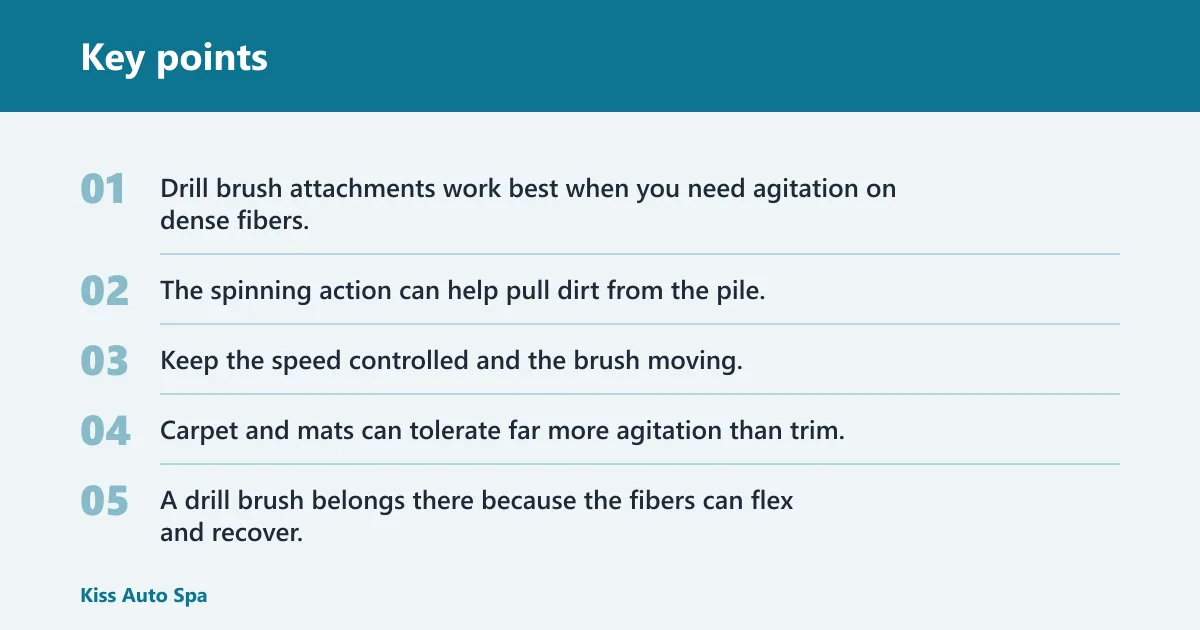
Drill brush attachments work best when you need agitation on dense fibers. That means floor mats and carpeted sections. The spinning action can help pull dirt from the pile, but only on surfaces built to take it. Keep the speed controlled and the brush moving.
Carpet and mat use only
Carpet and mats can tolerate far more agitation than trim. A drill brush belongs there because the fibers can flex and recover. On rigid or glossy interior parts, the same motion can leave visible marks or fling dirt into adjacent seams.
Interior surfaces to keep away from drill brushes
Keep drill brushes away from dashboards, vents, buttons, cupholder surrounds, leather, and piano black. Those surfaces need touch control, not powered scrubbing. If the area sits next to a soft-touch edge or a glossy panel, hand tools are safer.
Picture a floor mat with packed salt and sand near the heel area. A drill brush can help lift that debris from the carpet fibers. Now picture the same brush near a gloss center console edge. The risk changes immediately, and the drill brush is no longer the right tool.
How do you avoid scratching interior surfaces with brushes?
Avoid scratches by matching the brush to the finish, keeping the brush clean, and choosing the smallest head that can do the job. Wipe or vacuum loose grit first. Use gentle pressure. If a surface is glossy, coated, or screen-like, switch to microfiber instead of forcing a brush to work.
- Vacuum loose dust and grit before brushing.
- Pick the smallest head that reaches the area.
- Use soft bristles on trim, vents, and dashboards.
- Reserve firmer agitation for carpets and mats only.
- Use a microfiber swab or towel on piano black and screens.
- Check for shedding or loose ferrules before use.
A common first-timer mistake
A common first-timer mistake is using one soft brush across the whole cabin because it feels safe. That can still haze piano black, miss seat rails, and pack dust into seams. A better approach is to keep a soft trim brush, a crevice brush, and a microfiber swab in the same kit.
Frequently asked questions
What are the best detailing brushes for car interior cleaning?
The best detailing brushes for car interior cleaning are the ones matched to the surface: soft bristle brushes for dashboards and vents, a crevice brush for seams and rails, a leather cleaning brush for seats, and a drill brush attachment for carpets and mats. One brush cannot safely cover every material.
Can I use a detailing brush on piano black trim?
Only with extreme caution, and only if the brush is ultra-soft and perfectly clean. Piano black trim scratches easily, so even a soft brush can leave marks if dust is trapped in the bristles. A microfiber towel or swab is usually the safer choice for these surfaces.