How Long Does Paint Sealant Last on a Car?
Most paint sealants last 4-6 months. A daily driver in strong sun, road salt, or frequent machine washes should be checked at about 3 months. Garaged cars washed by hand can often go about 6-12 months before reapplication. Calendar time helps, but water behavior, slickness, and exposure usually tell the real story first.
Paint sealant bonds to clear coat, so its life depends on both the product and the surface underneath. A clean, decontaminated panel gives the coating a better chance to hold, while old wax, road film, and poor cure time shorten the result fast.
Manufacturer claims versus actual conditions
What the label means versus real use
Product claims usually describe ideal conditions, not a hard limit. A bottle that says “up to 8 months” may reach that only on a garaged vehicle with careful prep, gentle washing, and low exposure to salt and UV. In normal driving, about 3-6 months is a safer planning range.
That is why one car can lose protection in a season while another still beads well after several months. Mileage, parking, weather, and wash method matter more than a single printed range.
Paint sealant reapplication table
Use the table as a decision rule, not a promise. Check the paint sooner if beading drops off, the finish feels less slick, or the car has had a rough season of salt, heat, or tunnel washes.
| Vehicle type | Check interval | Likely reapplication window | Top two warning signs |
|---|---|---|---|
| Garage-kept weekend car | Every 3-4 months | 6-12 months | Beading becomes large and lazy; slickness fades after washing |
| Daily driver | Every 6-8 weeks | 3-6 months | Water sheets instead of beads; dirt sticks more after rain |
| Winter salt car | Monthly during winter | 2-4 months | Beading collapses after snow or salt spray; surface feels grabby |
| Outdoors-kept commuter | Every 2 months | 3-5 months | UV dulls the finish; water spots linger and rinse-off slows |
Garage-kept weekend car
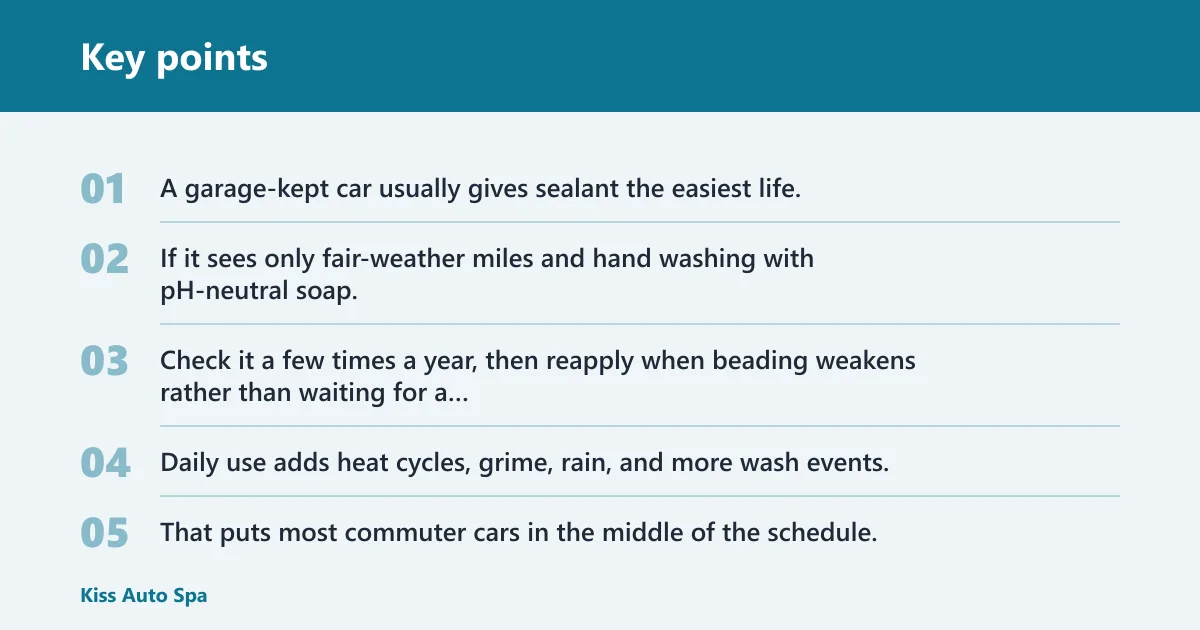
A garage-kept car usually gives sealant the easiest life. If it sees only fair-weather miles and hand washing with pH-neutral soap, a quality product can last toward the long end of its range. Check it a few times a year, then reapply when beading weakens rather than waiting for a fixed date.
Daily driver
Daily use adds heat cycles, grime, rain, and more wash events. That puts most commuter cars in the middle of the schedule, with reapplication around 3-6 months. If the car sits outside and gets frequent automatic washing, lean closer to the 3-month mark.
Winter salt car
Salt is hard on any surface protectant. Repeated slush, brine spray, and cold-weather washing shorten life faster than summer use, so winter cars often need earlier checks and faster refreshes. Once water behavior weakens after a storm cycle, reapply instead of stretching the old layer through another month.
Outdoors-kept commuter
Full-time outdoor parking adds UV, heat, rain, and dust. That combination breaks down protection more quickly than garage storage, even if the car is not driven far. For this use case, a 3-5 month window is more realistic than an ideal-condition claim.
What shortens sealant life fastest?
UV, heat, rain, snow, and road salt shorten sealant life the most. Frequent washing matters too, especially when the car goes through brush tunnels or gets harsh chemicals. Poor prep also cuts durability because sealant cannot bond well to dirty, oily, or contaminated paint.
Weather and road exposure
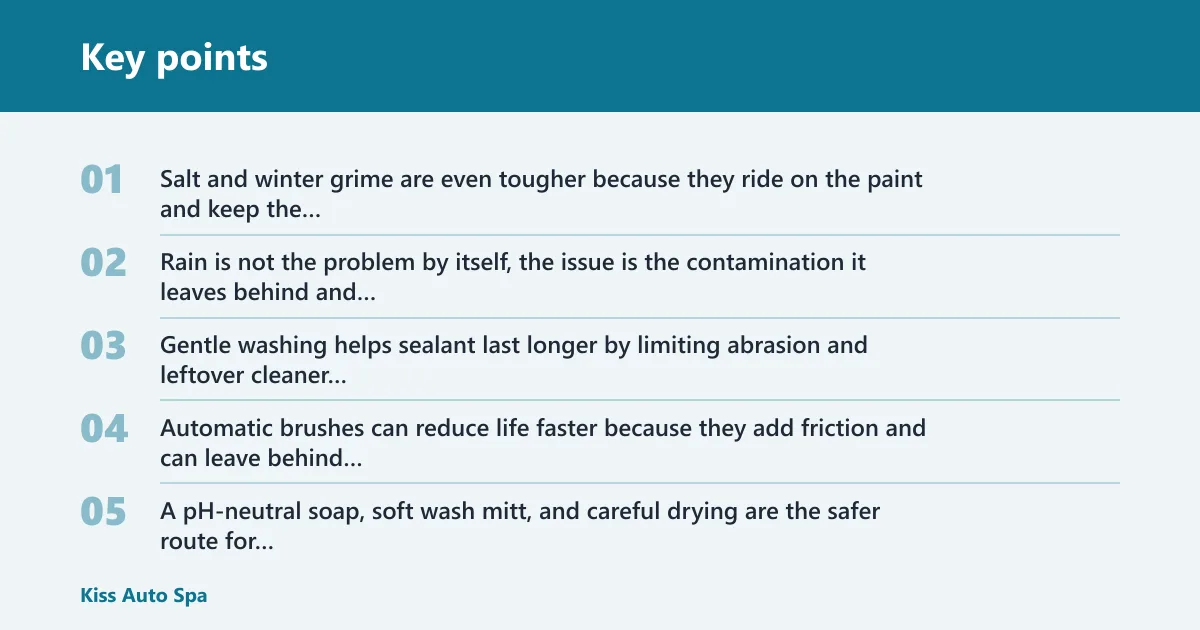
Sun and heat dry out protection over time. Salt and winter grime are even tougher because they ride on the paint and keep the surface dirty between washes. Rain is not the problem by itself, the issue is the contamination it leaves behind and the extra washing it forces.
Frequent washing and brush tunnels
Gentle washing helps sealant last longer by limiting abrasion and leftover cleaner residue. Automatic brushes can reduce life faster because they add friction and can leave behind cleaners that strip protection. A pH-neutral soap, soft wash mitt, and careful drying are the safer route for maintaining the layer.
Poor prep, contamination, and old wax
Sealant should go on clean, decontaminated, fully dry paint. If old wax, bonded grime, or iron fallout stays on the clear coat, the sealant has less chance to grip evenly. Polishing may be needed first if the paint is oxidized, rough, or covered in old residue.
Suppose a sedan is sealed in March, then washed every week through a snowy commute and a brush tunnel. Even a good product may need attention by late spring, because the real wear comes from salt, friction, and repeat cleaning, not just the calendar.
A common first-timer mistake is sealing over a panel that still feels gritty after washing. The result can look fine for a short time, then fade early because the protectant bonded to contamination instead of clear coat.
Which sealant type lasts longest?
Paste sealant generally lasts longest among consumer formats, with liquid sealant in the middle and spray sealant at the short end. Ceramic-infused sealants sit in their own category: they may hold up longer than a quick spray topper, but they are not the same as a true ceramic coating.
Spray sealant
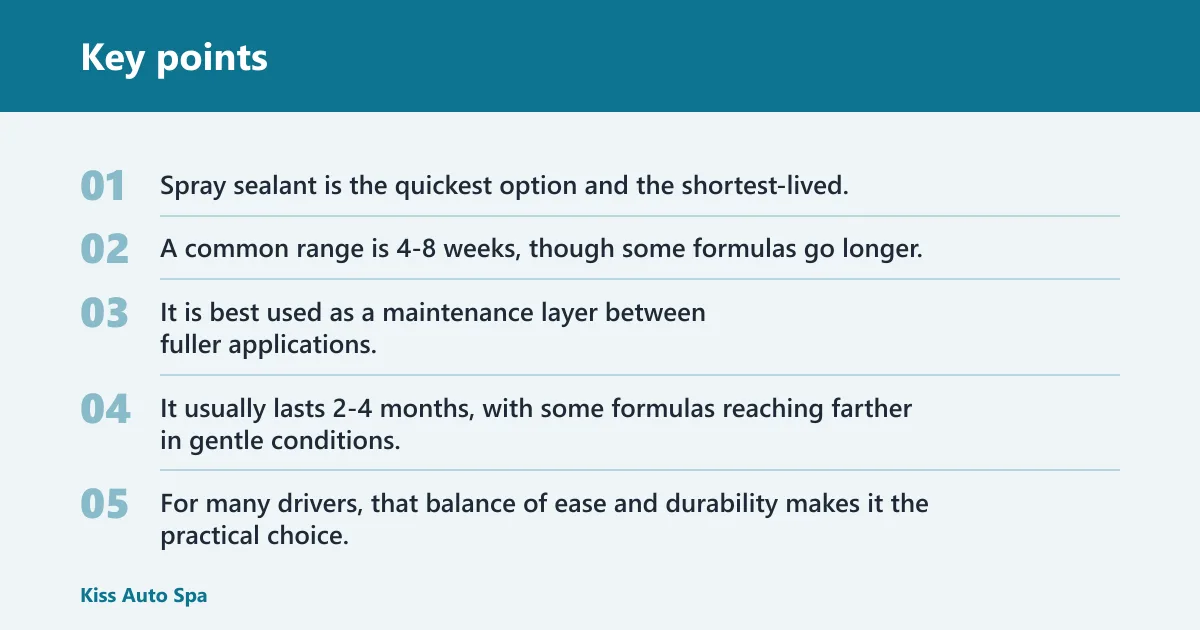
Spray sealant is the quickest option and the shortest-lived. A common range is 4-8 weeks, though some formulas go longer. It is best used as a maintenance layer between fuller applications, not as the main shield for a car that faces harsh weather.
Liquid sealant
Liquid sealant is the middle ground. It usually lasts 2-4 months, with some formulas reaching farther in gentle conditions. For many drivers, that balance of ease and durability makes it the practical choice.
Paste sealant
Paste sealant usually asks for more application effort, but it often lasts about 4-6 months and is often reported as the longest-lasting consumer format. If you want fewer reapplication cycles and do not mind the extra work, it is often the best fit.
Ceramic-infused sealant
Ceramic-infused sealants contain SiO2 and are often marketed as longer-lasting than basic spray products. Many hold up around 3-6 months, and some claim more, but they are still not the same as a true ceramic coating. Treat them as a hybrid maintenance product, not a permanent layer.
How do you know it is wearing off?
The clearest signs are weaker water beading and less slickness after washing. As sealant thins, water stops forming tight beads and starts sitting flatter or draining unevenly. The paint can also feel less crisp to the touch, and dirt may cling more than it did before.
Water beading changes
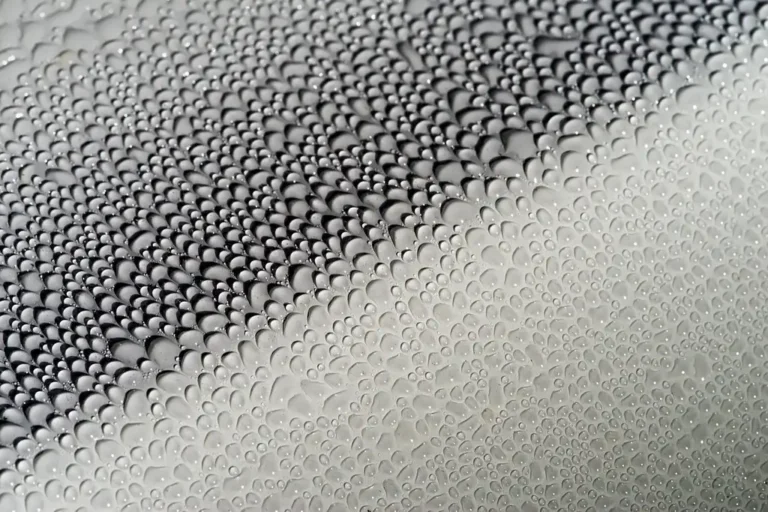
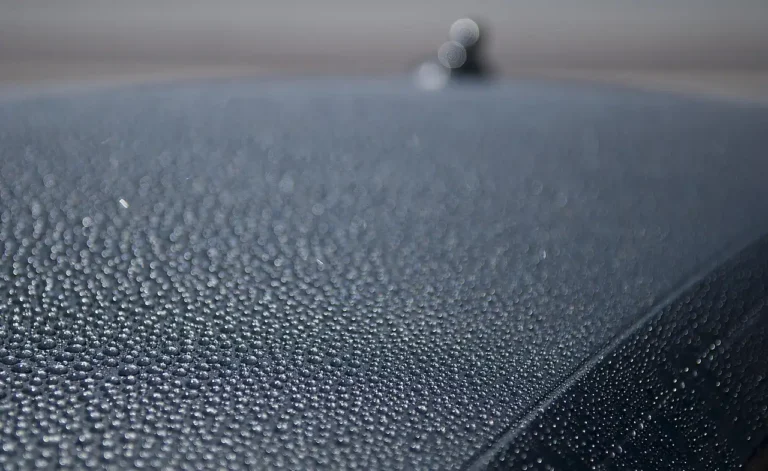
Fresh sealant usually sends water into tight beads that roll off quickly. As protection fades, those beads grow larger, flatten out, or disappear into slow sheets. That is one of the simplest practical signs that reapplication is due.
Slickness fades
Slickness matters because it helps rinse water and grime move off the panel. When the surface starts to feel grabby after a wash, the protection is usually thinning. Do not wait for bare paint to appear; waiting that long only makes cleanup harder.
Good prep and gentle maintenance do most of the work. Wash with pH-neutral soap, dry the paint fully before sealing, and remove bonded contamination before application. If the clear coat is rough or dull, polishing can help the sealant bond more evenly.
- Wash the car with pH-neutral soap.
- Decontaminate the paint so the clear coat feels smooth.
- Dry every panel fully before applying sealant.
- Polish if the surface has oxidation, haze, or old residue.
- Reapply sooner after winter salt, heavy rain cycles, or frequent machine washes.
Think in exposure, not just months. A garaged car in mild weather may keep protection much longer than the same product on a car that sits outside and runs through salty slush all winter.
How does paint sealant compare with wax and ceramic coating?
Paint sealant usually lasts longer than carnauba wax and far less time than a ceramic coating. Carnauba wax often lasts 4-8 weeks, while professional ceramic coatings can last 2-5 years and high-end coatings can reach 10 years or more. Sealant sits in the middle on cost, effort, and durability.
Wax
Wax gives a short-term layer of protection and a warm finish, but it wears faster than synthetic sealant. It makes sense when you want a quick refresh and do not mind frequent reapplication.
Ceramic coating
True ceramic coating is a different product category. It is not the same as ceramic-infused spray sealant, and it lasts much longer when installed and maintained correctly. That longer life usually comes with more prep and a higher commitment to surface care.
Frequently asked questions
How long does car paint sealant last?
Most paint sealants last 4-6 months in real-world use, with some products stretching closer to 8 months and a few synthetic formulas listed at 4-12 months. Daily drivers, winter use, and machine washing pull that number down faster than garage storage and gentle hand washing.
How often should you reapply paint sealant on a car?
Check it every 6-8 weeks on a daily driver, every 3-4 months on a garage-kept weekend car, and monthly in winter salt season. Reapply when beading weakens, slickness drops, or washing no longer feels easy, even if the calendar says the sealant should still be active.
Does a daily driver need paint sealant more often?
Yes. Daily drivers face more UV, grime, rain, and wash cycles than stored cars, so protection usually wears down sooner. A 3-6 month reapplication window fits most commuters, while harsh climates and tunnel washes can push that closer to 3 months.
What shortens paint sealant life the fastest?
Frequent brush washing, winter salt, strong sun, and poor prep shorten life fastest. Sealant that was applied over dirty paint, old wax, or contamination will usually fail early because it never bonded well in the first place.
How do you know paint sealant is wearing off?
Watch for weaker beading, slower rinse-off, and a less slick surface after washing. Those are the most useful signs that the protective layer is thinning. If water begins to sheet flat and dirt clings more easily, it is time to reapply.
Can a ceramic spray sealant last as long as a traditional sealant?
Sometimes, but not always. Ceramic spray sealants are often listed at 3-6 months, while spray sealants in general can be much shorter lived. A traditional paste or quality liquid sealant usually gives more consistent durability than a quick spray topper.