What Causes Water Spots on Car Glass?
Water spots on car glass usually come from mineral deposits left by dried hard water; if the mark wipes off, it’s residue, if it resists a cleaner, it’s bonded mineral, and if it stays after polishing, it’s etching. Treating the wrong type can waste time and can scratch glass with harsher methods. This guide shows how to tell residue from mineral buildup and etching, then choose the safest next step.
What water spots on car glass
Water spots on glass are usually the dried leftovers from water that carried dissolved minerals. On car glass, the mark may be a light film, a crusty deposit, or a faint etched haze. The first question is not “what cleaner works?” It is “what type of mark is this?”
Fresh residue versus bonded mineral deposits
Fresh residue sits on top of the glass. It often looks chalky, wipes partly with a damp microfiber, and may respond to glass cleaner right away. Bonded mineral deposits are different. They have dried, stuck to the surface, and can feel slightly gritty or sharp under a fingertip.
Hard water is the main source of this spotting. It contains dissolved minerals such as calcium and magnesium, and those minerals remain after the water evaporates. Tap water, hose water, wash water, and sprinkler water are the usual repeat offenders.
Why glass behaves differently from paint
Glass is smooth, hard, and easy to read by touch, so spotting on it often looks cleaner than the same problem on paint. Paint and clear coat can hold residue too, but those surfaces also scratch more easily. That matters because a method that is acceptable on glass may be too aggressive for painted panels, trim, or coatings.
That is why this article keeps the diagnosis glass-specific. A white mark on the hood may be water spotting, residue, or damage to the clear coat. A white mark on the windshield has a different safest next step.
What causes water spots on car glass?
Water spots on car glass come from water that leaves minerals behind after it dries. Hard water minerals like calcium and magnesium are the main cause, and repeated exposure makes the deposits more visible. Rain, sprinklers, hose water, and wash runoff are common sources, but the exact culprit depends on what hit the glass and how fast it dried.
Hard water, calcium, and magnesium
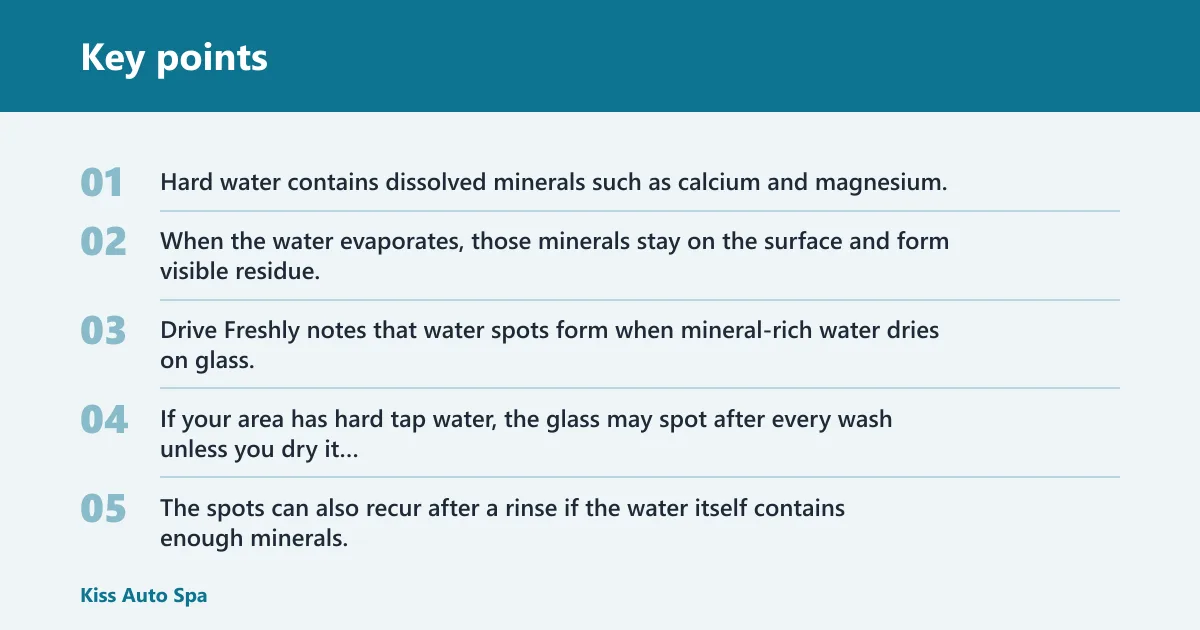
Hard water contains dissolved minerals such as calcium and magnesium. When the water evaporates, those minerals stay on the surface and form visible residue. Drive Freshly notes that water spots form when mineral-rich water dries on glass, and names calcium and magnesium as the minerals that bond to the glass.
If your area has hard tap water, the glass may spot after every wash unless you dry it promptly. The spots can also recur after a rinse if the water itself contains enough minerals.
Sprinklers, hose water, and wash runoff
Sprinkler water is a common trouble source because it keeps hitting the car in repeat cycles. It may be recycled, mineral-heavy, or both. Hose water can do the same thing, especially if the supply is hard. Wash runoff can leave a trail of minerals when water drains across side glass and then dries in bands.
Longer contact with water makes spots more visible. A car parked overnight under a sprinkler line has a very different risk from a car that gets a quick rinse and immediate drying.
Rainwater, silica, and road contamination
Rain is not always the main culprit. Clay & Coat notes that rain is comparatively soft water and leaves less behind, but local contamination still matters. SG Keeper says rainfall can contain dissolved minerals including calcium, magnesium, and silica. Road grime, dust, and runoff can also add contamination that dries into a crusty film.
So yes, rain can leave spots on glass. It is more likely when the rain carries dissolved minerals or when dirty road spray mixes into the water film.
Why heat makes spots worse
Direct sunlight and heat speed up evaporation, so minerals dry faster and bond more firmly to the glass. That is why a spot left in the sun can become harder to remove than the same water left to dry in shade. On hot glass, the water disappears before you can wipe or rinse it away.
Direct sunlight and fast evaporation
High temperatures and direct sunlight speed up spot formation. F1 states that water spots form when water evaporates and leaves behind mineral deposits, and F3 says heat and sun make that happen faster. The same droplet that might wipe clean in a shaded driveway can bake on in full sun.
Clay & Coat recommends cool glass and working one window at a time. That advice matters because cool glass slows the flash-dry effect and gives your cleaner more time to loosen residue.
Why windshield glass can bake on deposits
A windshield has a large, open surface and often sits at the same angle that catches sprinkler spray, wash runoff, and sun. The glass warms quickly. The result is a repeated cycle: wet glass, fast evaporation, mineral deposit, more heat, harder deposit.
Suppose a sedan is parked by a lawn sprinkler for 20 minutes each morning. The windshield can collect a thin mineral film every day, and sunlight can dry it before the owner gets back outside. That repeat pattern is much more likely to leave bonded spots than a one-time splash from rain.
How do you tell residue from etching?
The roughness test is a common way to distinguish fresh residue, bonded mineral, and etched glass. Run a clean fingertip or microfiber gently across the spot. If it feels smooth and wipes off, you are probably dealing with residue. If it feels gritty or resists cleaning, the deposit is more likely bonded. If the mark remains after proper cleaning and polishing, the glass may be etched.
The roughness test
Clean the glass first so dirt does not confuse the result. Then feel the mark with a clean fingertip or a folded microfiber. A rough, crusty edge points to bonded mineral. A smooth mark that only appears in certain light may be light residue or an optical stain from dried water.
Do not press hard. The test is about texture, not force.
Clues that point to bonded mineral
Bonded mineral often sits where water pooled: the lower edge of a windshield, the top arc of a side window, or around mirror housings and trim edges. It may survive a round of glass cleaner and then soften only after a dedicated water spot remover. A recurring white outline after every wash also points to mineral buildup rather than dirt alone.
Signs the glass is etched
Etching is the stage where the surface itself has changed. The mark often survives regular cleaning, bonded-spot removal, and even a clay treatment. It may look like a permanent cloudy patch, a rainbow haze, or a ghost image of the old water spot. At that point, glass polishing is the next step to consider.
Glass water spots diagnostic table
This table gives you a one-page diagnosis before you choose a cleaner, remover, or polish. Start with the symptom, confirm with the roughness test, and stop when the safest next step is clear. If the mark is on paint, trim, or a coated surface nearby, slow down before using any abrasive method.
| Symptom | Likely cause | Safest next step |
|---|---|---|
| Light haze that wipes off with a damp microfiber | Fresh residue from dried water | Use glass cleaner first. Stop if the mark disappears. |
| White dots that feel slightly gritty | Bonded mineral deposit from hard water | Move to a water spot remover after cleaner fails. |
| Repeated spotting after every sprinkler cycle | Mineral-heavy sprinkler water | Clean, then dry immediately; use a remover if spots remain. |
| Cloudy patch that survives cleaner and remover | Possible etching | Test carefully, then consider glass polishing. |
| Spot feels rough under a clean fingertip | Bonded deposit or early etching | Stop with gentle cleaning and escalate only on glass. |
| Clear mark that returns after every wash | Water source still carrying minerals | Change water quality and drying habit before repeating treatment. |
What should you try first on glass?
Start with glass cleaner for light residue, then move up only if the mark stays put. If a cleaner fails on bonded mineral spots, a dedicated water spot remover is the next step. For glass only, 0000-grade steel wool, clay bar, and glass polishing have specific jobs, and each one belongs later in the process.
Glass cleaner for light residue
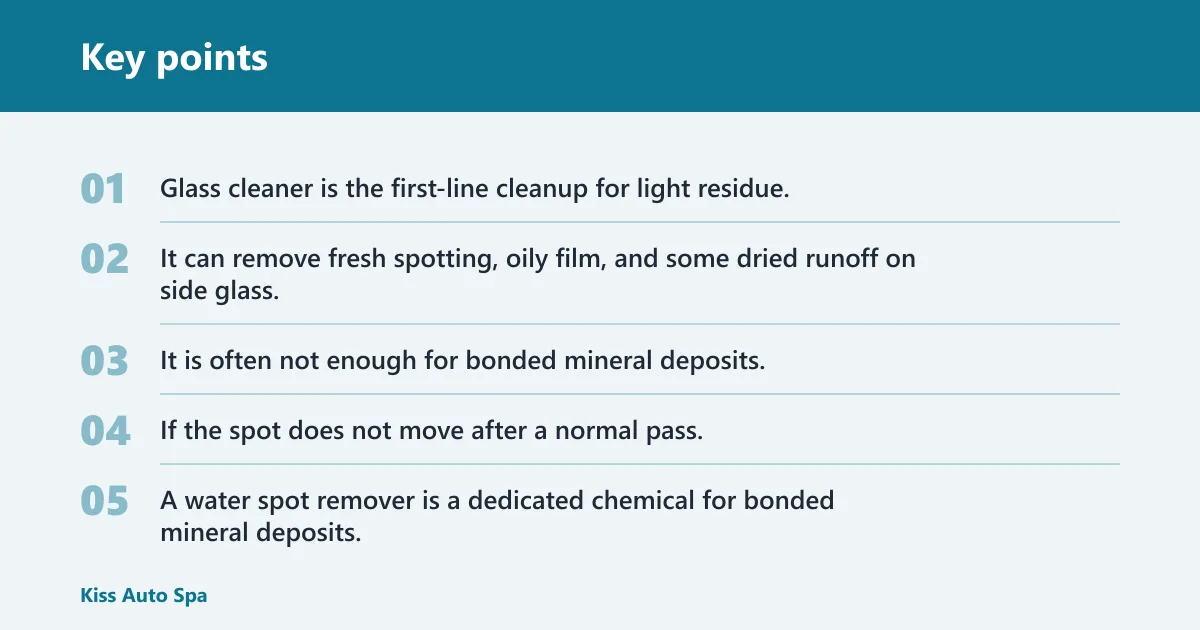
Glass cleaner is the first-line cleanup for light residue. It can remove fresh spotting, oily film, and some dried runoff on side glass. It is often not enough for bonded mineral deposits, especially on windshields that have been parked in heat.
Use a clean towel and work small sections. If the spot does not move after a normal pass, stop and change tactics rather than scrubbing harder.
Water spot remover for bonded deposits
A water spot remover is a dedicated chemical for bonded mineral deposits. It can break down residue that standard cleaner leaves behind. Some versions are gels for vertical glass, which helps them cling to a windshield or side window long enough to work.
If the remover cuts the spot but does not fully clear it, repeat the application only as directed by the product. If the glass still shows haze after that, the problem may be more than mineral residue.
0000-grade steel wool, clay bar, and glass polishing
0000-grade steel wool is an ultra-fine grade often used on glass only, and it should be used with soapy water for lubrication. It is not for paint. On glass, it can help remove stubborn bonded contamination that survives normal washing and chemical cleaning.
A clay bar can also remove bonded contamination from glass when used with plenty of lubrication. It is best for mineral grime and other stuck-on debris, not for etched glass. If the mark remains after those steps, glass polishing is the mechanical fix for etched spots. That is the point where chemical cleaning no longer does enough.
A common first-timer mistake is attacking a white ring on the side window with an abrasive pad meant for painted panels. The safer move is to confirm the surface first, then stay on glass-only methods.
How do you stop water spots from coming back?
Dry the car promptly after washing, reduce repeat exposure to mineral-heavy water, and use distilled or filtered water when possible. Those three habits matter more than any single cleaner. If the same source keeps hitting the glass, the spots will return no matter how well you remove them today.
Dry the car promptly after washing
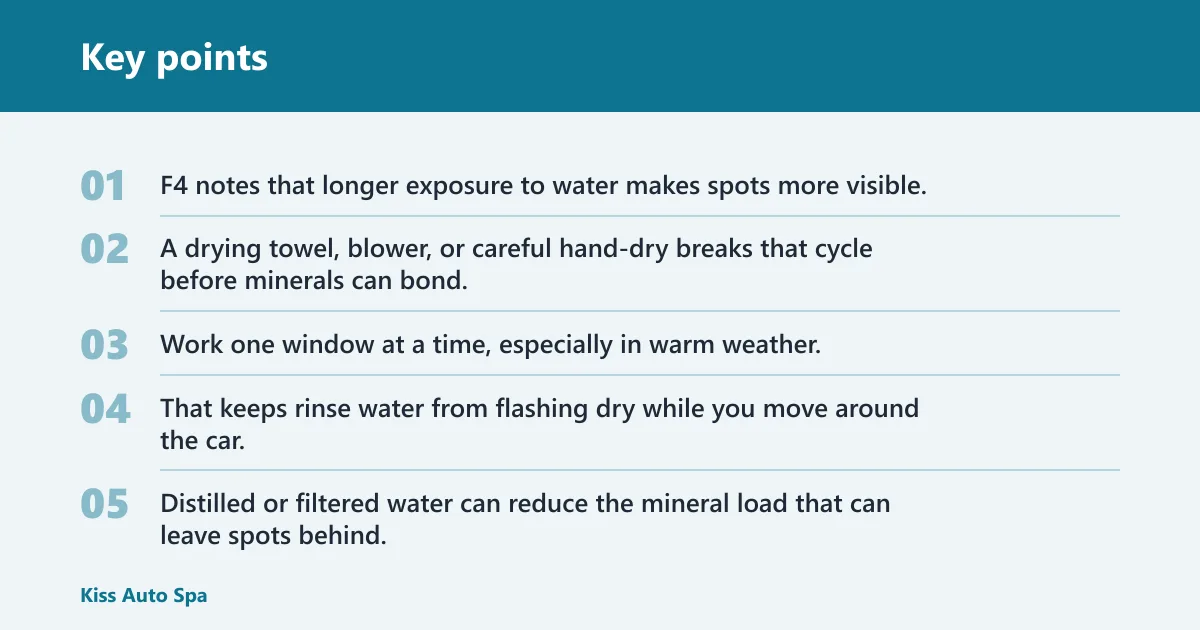
Do not let wash water air-dry on glass. F4 notes that longer exposure to water makes spots more visible, and F1 explains why: evaporation leaves minerals behind. A drying towel, blower, or careful hand-dry breaks that cycle before minerals can bond.
Work one window at a time, especially in warm weather. That keeps rinse water from flashing dry while you move around the car.
Use filtered or distilled water when possible
Distilled or filtered water can reduce the mineral load that can leave spots behind. That matters most if your tap water is hard or if you rinse in an area with visible mineral deposits. It will not fix etching, but it can cut down on new buildup.
Reduce repeat sprinkler and runoff exposure
If sprinkler water keeps hitting the glass, move the car, redirect the spray, or change parking position. Sprinkler water is often recycled or mineral-heavy, so repeated exposure can lead to repeat spotting. The same warning applies to hose water and wash runoff that pools at the lower edge of the glass.
Direct sun makes a bad water source worse. A wet windshield in hot afternoon light is the fastest way to turn fresh residue into a stubborn mineral mark.
Frequently asked questions
What causes water spots on car windows?
Water spots on car windows are usually mineral deposits left after water dries. Hard water is the main source, with calcium and magnesium doing most of the visible damage. Tap water, hose water, sprinkler water, and wash runoff are common causes, and heat makes the deposits set faster.
What causes water spots on glass?
Water spots on glass happen when dissolved minerals stay behind after evaporation. Calcium and magnesium are the common minerals in hard water, and silica can also contribute in some rain or local water conditions. If the spot feels rough, it is more likely bonded mineral than simple dust.
What causes water spots on a car?
On a car, water spots can form on glass, paint, trim, and coated surfaces, but the fix is not the same for each. This article is about glass. On windows, the usual cause is mineral-rich water that dried in place, often faster because of sun and heat.
Why do I have water spots on my car?
You usually have water spots because water dried before it could be removed, and it left minerals behind. If your car sits under sprinklers, gets washed with hard water, or dries in direct sun, spotting can come back often. The repeat pattern matters more than one isolated rinse.
Are water spots on car glass just mineral deposits?
Not always. Many are mineral deposits, but some are bonded deposits that resist simple cleaning, and some are true etching in the glass surface. The roughness test helps separate them. If cleaner fails, move to a remover; if polishing is still needed, the mark may be etched.
Can rain or sprinkler water cause spots on windshield glass?
Yes. Rain can leave spots if it carries dissolved minerals or road contamination, though it is usually softer than tap or irrigation water. Sprinkler water is a more common cause because it is often mineral-heavy. On a hot windshield, both sources can dry into visible marks quickly.
How do you tell if a water spot is etched into glass?
If the mark remains after glass cleaner, a water spot remover, and careful glass-only cleaning, etching becomes more likely. Etched spots often look like a haze or ghost image rather than a surface film. They do not usually wipe away, because the damage is in the glass itself.
Why do water spots come back after washing the car?
They come back when the same mineral source is still present. Hard water, sprinkler spray, and wash runoff can all re-deposit calcium, magnesium, and other minerals every time the glass gets wet. Drying the car promptly and changing water quality reduce the repeat cycle.
Does hard water cause water spots on car windows?
Yes. Hard water is the main cause of water spots on car windows. It contains dissolved minerals such as calcium and magnesium, and those minerals remain when the water evaporates. The more often the glass gets wet with hard water, the more likely the spotting becomes.
Can washing in direct sun cause water spots on glass?
Yes. High temperatures and direct sunlight speed evaporation, so minerals do not stay wet long enough to rinse or wipe away. That can bake spots onto the glass faster, especially if the water itself is hard. Shade, cool glass, and prompt drying reduce that risk.