How to Use Rinseless Wash on a Car Safely, Step by Step
Use a rinseless wash by pre-soaking a panel, wiping in straight lines with a plush towel, then stopping and swapping towels as soon as dirt loads up. Keep using a loaded towel, and grit can drag across the paint and leave marring. This guide shows the step-by-step workflow, towel-swap points, and how to change technique for light, medium, or heavy contamination.
What a rinseless wash is and when it fits
A rinseless wash cleans paint with a lubricated solution and towels instead of a running-water rinse. It fits light dust, light road film, and maintenance washing, especially where hoses are restricted or winter conditions make a traditional wash awkward. It is not for caked mud, heavy salt crust, or gritty buildup.
How rinseless wash differs from a hose wash
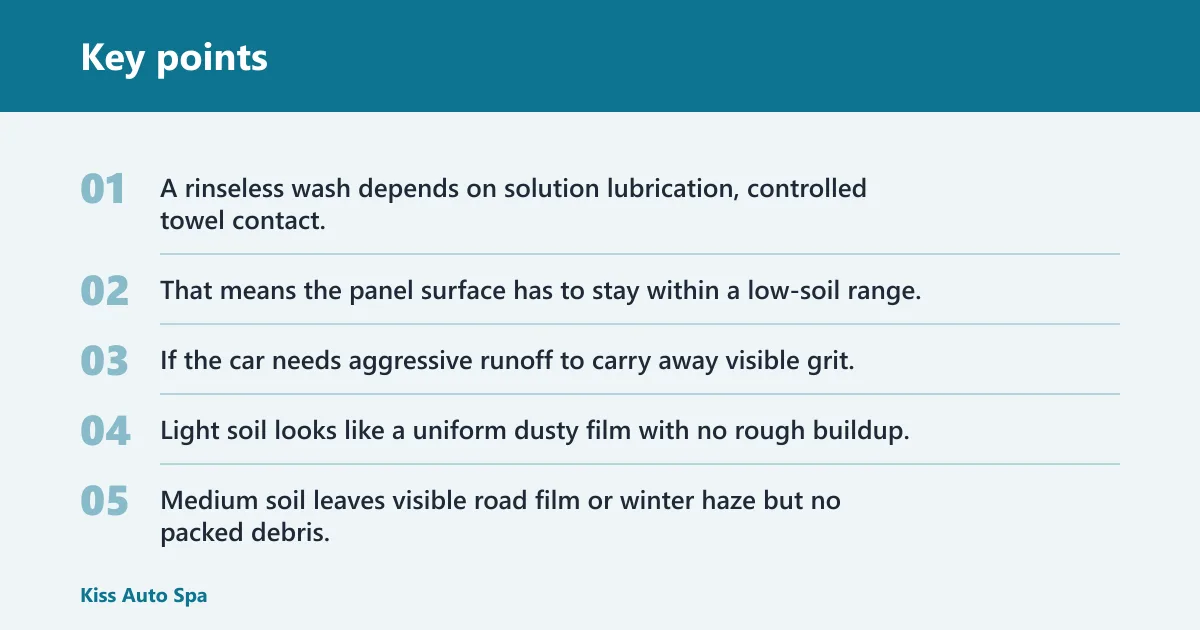
A hose wash flushes loose grit away first. A rinseless wash depends on solution lubrication, controlled towel contact, and fast towel turnover. That means the panel surface has to stay within a low-soil range. If the car needs aggressive runoff to carry away visible grit, stop and use a traditional wash.
What light, medium, and heavy soil look like
Light soil looks like a uniform dusty film with no rough buildup. Medium soil leaves visible road film or winter haze but no packed debris. Heavy soil means mud spatter, salt chunks, tar-like grime, or sand that can be felt before wiping. Heavy soil crosses the line for rinseless washing.
When to stop and choose a traditional wash instead
Stop when the paint has sticky grime, thick winter salt, or grit that loads the towel after one pass. A rinseless wash can handle maintenance dirt. It should not be turned into a rescue wash for a neglected, heavily contaminated vehicle.
📊 Walmart lists Optimum – No-Rinse Wash & Shine V6 as a 128oz option. Source: Rinseless Car Wash in Car Wash.
What you’ll need before you start
Set out the full wash system before touching the paint. Rinseless washing depends on enough solution, enough towels, and a place to park dirty textiles away from clean ones. For a typical rinse-free setup, use a rinseless wash concentrate, microfiber towels, a drying towel, a spray bottle, a bucket, and an optional rinseless wash sponge.
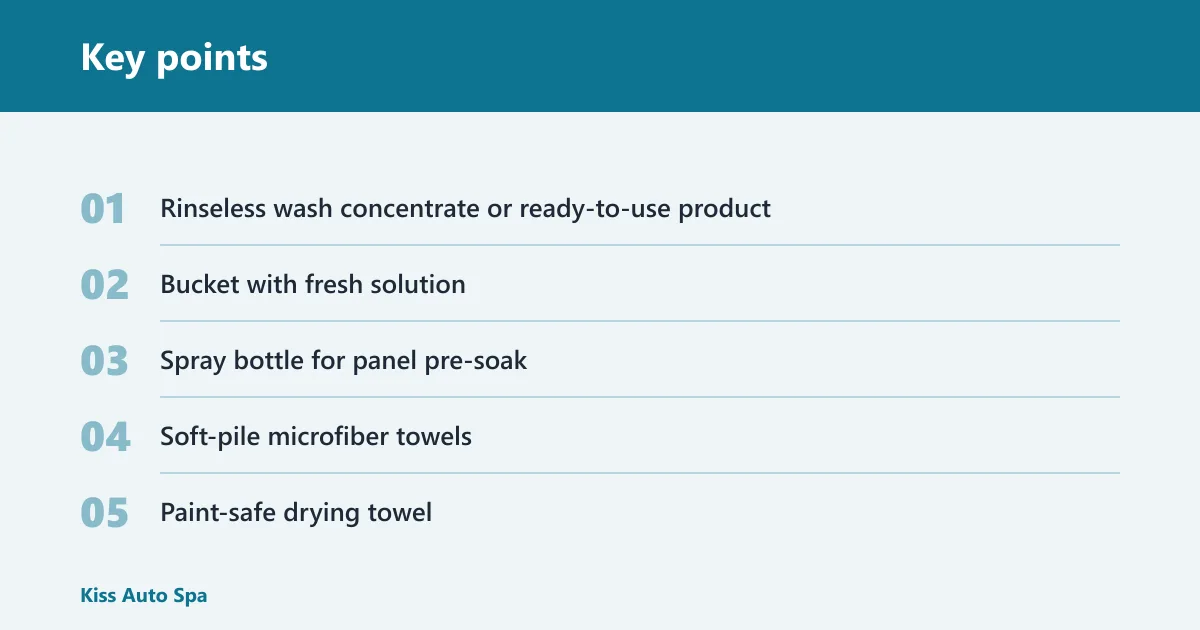
- Rinseless wash concentrate or ready-to-use product
- Bucket with fresh solution
- Spray bottle for panel pre-soak
- Soft-pile microfiber towels
- Paint-safe drying towel
- Optional rinseless wash sponge with controlled grip shape
- Separate towel pile for dirty towels
Rinseless wash concentrate and dilution ratio
Most concentrates are mixed into water for bucket washing and often a lighter mix for a spray bottle. A common working ratio is around 1 ounce of concentrate per 2 gallons of water for the wash bucket, with a somewhat lighter pre-soak in the spray bottle if the label allows it. Use the label first. Ready-to-use products skip dilution and suit small maintenance jobs.
Microfiber towels, drying towel, and spray bottle
Use soft-pile microfiber towels, not rough shop rags. Soft pile holds lubrication and can be folded into multiple clean faces. A drying towel should be highly absorbent and paint-safe so it can lift remaining solution without dragging. A spray bottle helps pre-soak one panel at a time and spot-treat dusty areas before wiping.
Bucket setup and optional rinseless wash sponge
The bucket holds your working solution and keeps the workflow organized by panel. A rinseless wash sponge can work when it has a stable grip shape and enough surface control to stay flat without pressing hard. Keep the sponge and towels separate in use. Do not let either one stay loaded with grit.
| Vehicle size | Suggested towel count | Panel swap pace |
|---|---|---|
| Small car | 6–8 microfiber towels | 1 towel per 1–2 panels |
| Mid-size sedan or crossover | 8–10 microfiber towels | 1 towel per panel on dirtier sections |
| SUV or pickup | 10–12 microfiber towels | 1 towel per panel, more on lower panels |
How to use rinseless wash step by step
Mix the solution correctly, pre-soak one panel, wipe in straight lines, and dry before moving on. The whole method is contamination control. You are not trying to scrub the vehicle clean with one towel. You are trying to move dirt off the paint and into a towel before it can be rubbed back across the clear coat.
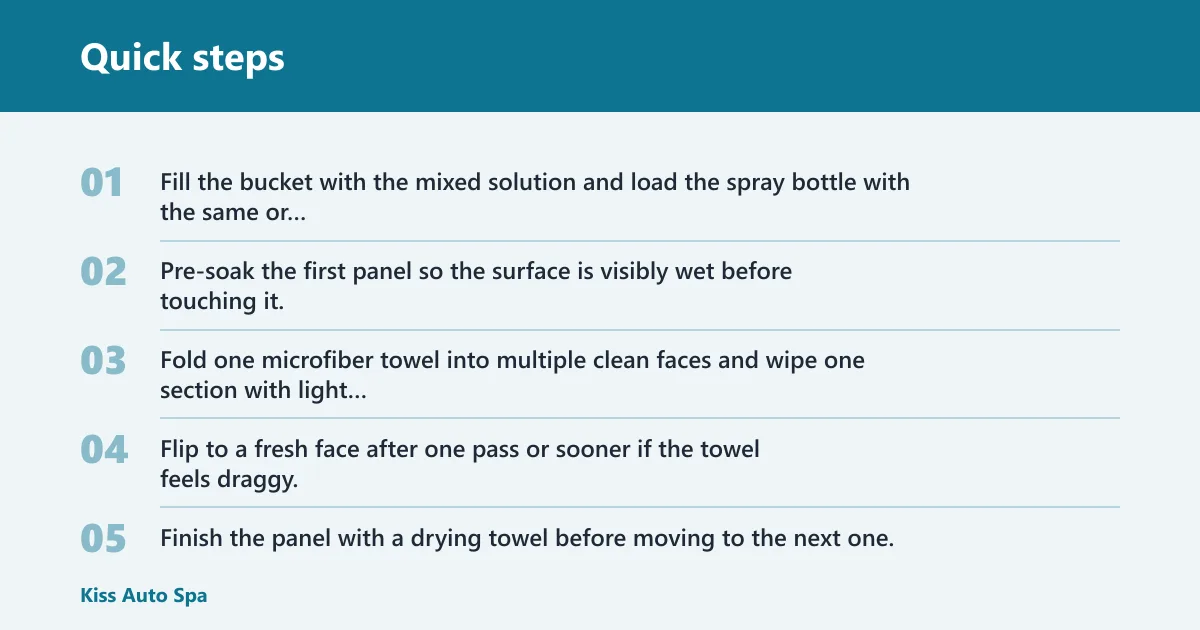
- Fill the bucket with the mixed solution and load the spray bottle with the same or label-approved lighter mix.
- Pre-soak the first panel so the surface is visibly wet before touching it.
- Fold one microfiber towel into multiple clean faces and wipe one section with light pressure.
- Flip to a fresh face after one pass or sooner if the towel feels draggy.
- Finish the panel with a drying towel before moving to the next one.
- Move from upper panels to lower panels, then save the dirtiest areas for last.
- Replace the towel at the first sign of grit load, streaking, or loss of glide.
Panel order and stop points
Start on the roof, glass, hood, and upper doors. Then move to lower doors, bumpers, and rocker areas. Stop and re-soak if the panel flashes dry before you finish. Stop and change towels if you feel grit. One loaded towel can turn a safe wipe into a risky one.
How to wash one panel at a time
Work one panel, one clean towel face, one dry finish. The panel should stay wet enough that the towel glides instead of drags. Suppose a compact sedan has dusty doors and a slightly grimy rear bumper. Clean the roof and hood first, then reserve fresh towels for the bumper area, where contamination is usually higher.
Should you use a microfiber towel or sponge?
Microfiber towels are usually the safer beginner choice because they give you more clean faces, more visible dirt transfer, and more control over when to stop. A rinseless wash sponge can work well on lightly soiled paint, but it demands careful reload and rinse-out habits. Either tool fails if you keep wiping after it loads with grit.
When microfiber towels make more sense
Choose microfiber when the car has varying soil levels, when you want one-towel-per-panel control, or when you are still learning the pressure needed for clear coat safety. The soft pile helps keep dirt away from the paint surface and makes towel flipping simple.
When a sponge makes sense
Choose a rinseless wash sponge when panels are lightly dusty and you want a flatter contact patch. The grip shape helps control hand pressure. Rinse or reload often, and do not use the sponge like a scrub pad. If it picks up visible grit, stop and clean it before continuing.
The contamination-control checklist
Use this checklist to plan the job before you touch the paint. It turns rinseless washing into a controlled workflow instead of a guess-and-wipe routine. The right towel count, panel order, and stop points matter more than the bottle label.
- Confirm the car is within light to moderate soil limits.
- Set out 6–12 microfiber towels based on vehicle size.
- Keep one bucket of solution and one spray bottle ready.
- Pre-soak every panel before wiping it.
- Change or fold to a fresh towel face after each section.
- Stop if the towel feels gritty, the panel dries out, or road film smears instead of lifting.
- Move lower-body panels to the end of the wash.
- Dry each panel with a paint-safe drying towel before leaving it wet.
Can you use rinseless wash in winter?
Yes, if temperatures and contamination stay within safe limits and you can keep solution from freezing on the panel. Winter rinseless washing is often used in a garage or in a mild outdoor window when water access is restricted. It is much less suitable for icy panels, frozen towels, or salt-caked lower bodywork.
Garage vs outdoor washing
A garage helps because it reduces freeze risk and slows evaporation. Outdoors, work faster and avoid washing in freezing wind. If the panel or towels are freezing, stop. Cold paint still needs lubrication, and a half-frozen towel can drag instead of glide.
Cold-panel and road-salt limits
Winter road salt can sit in a rough, gritty layer. That pushes the car closer to the too-dirty-for-rinseless line. If the salt is crusted onto rocker panels, wheel arches, or bumpers, use a traditional wash or a pre-rinse before any rinseless pass.
Common mistakes to avoid
The biggest mistake is treating a rinseless wash like a full-debris removal wash. The second is letting towels get loaded and then using them again. A third is wiping a dry panel, which removes lubrication and raises scratch risk on clear coat. Heavy contamination needs a different method.
A common first-timer mistake is using one towel on a full SUV and then wondering why the paint feels grabby by the rear doors. Another is trying to power through winter slush on rocker panels. In both cases, the fix is the same: stop earlier, swap sooner, or switch methods.
- Do not reuse a towel face once it feels rough or shows visible debris.
- Do not wipe a panel after the solution has flashed dry.
- Do not reduce solution below label directions to “save product.”
- Do not treat mud, heavy salt, or caked road film as if it were dust.
Prevention: keep a clean towel stack on one side of the bucket and a dirty towel pile on the other so loaded towels never return to paint.
Frequently asked questions
what is a rinseless car wash
It is a wash method that uses a lubricated cleaning solution and towels instead of a running-water rinse. The method is built for low to moderate dirt, not packed mud or salt crust, and it depends on controlled towel contact to protect clear coat.
what do you need for a rinseless wash
You need a rinseless wash concentrate or ready-to-use formula, a bucket, microfiber towels, a drying towel, and a spray bottle. An optional rinseless wash sponge can help on lightly dirty paint, but it should not replace good towel rotation and panel control.
how much rinseless wash should I dilute
Use the product label first. A common bucket mix is 1 ounce of concentrate per 2 gallons of water, with a label-approved lighter mix for a spray bottle if needed. Ready-to-use products skip dilution and are simpler for small maintenance jobs.
is a rinseless wash safe on a dirty car
Only if “dirty” means dusty or lightly filmed. Mud, heavy salt, caked road film, and gritty winter grime are too abrasive for a simple rinseless workflow. If the towel picks up visible grit right away, stop and switch to a traditional wash or a pre-rinse.
can rinseless wash replace a traditional wash
It can replace a hose wash for maintenance cleaning in the right conditions, especially on lightly soiled vehicles or where water use is limited. It should not replace a traditional wash after heavy contamination, because the contamination-control window is narrower.