What Cleans Car Glass Without Streaks? A Quick Guide
Use an ammonia-free automotive glass cleaner with a clean, tight-weave microfiber glass towel, then finish with a second dry towel; greasy interior film usually needs two passes. Streaks leave haze, cut night visibility, and can hide smears when you need a clear view. This guide explains how contamination and fast evaporation cause streaking, then matches the right cleaner-and-towel setup to each failure case.
Why car glass streaks in the first place

Streaks usually come from two things: residue left behind and cleaner that flashes before it can be wiped away. Oils, dust, old dressings, washer-fluid film, hard water spots, and lint all interfere with a clean finish. Hot glass and direct sun make the problem worse because cleaner can evaporate too fast.
Contamination versus evaporation: the two main causes
Contamination is the film you are trying to remove. Evaporation is what happens when the liquid disappears before the towel can lift that film away. If the towel is dirty, the product is too heavy, or the glass is warm, residue gets spread around instead of removed.
Cleaning in direct sunlight can cause streaking almost instantly. Chemical Guys also notes that direct sunlight makes cleaners evaporate too fast. That is why a cool panel, light spray, and a dry finishing towel matter more than a flashy label.
Common residues that leave haze on glass
Interior haze often contains skin oils, smoke film, AC residue, and off-gassing from trim or protectants. Exterior haze often comes from road film, dried washer fluid, tar mist, or water spotting. Household cleaners can leave their own film, which is why residue behavior matters more than “streak-free” marketing.
Why interior glass often looks worse than exterior glass
Interior glass collects a thin film that is hard to see except in bright light, when it turns into a dull veil across the windshield. That film often benefits from a second buffing pass, since the first wipe can loosen contamination and the next wipe can help remove what remains.
📊 3D SiO2 Ceramic Glass Cleaner adds light ceramic protection. Source: 7 Best Car Window Cleaners in 2026 That Leave No Streaks.
What cleans car glass without streaks?
An ammonia-free automotive glass cleaner with a clean microfiber glass towel is often a good default for most automotive glass. It lowers residue risk, works on interior and exterior glass, and is the right choice for tinted windows. For greasy film, a second clean pass and a separate dry buff towel are often needed.
Ammonia-free glass cleaner as the default choice
Ammonia-free formulas are often a practical baseline because they are generally safer around tint and less likely to leave a harsh odor or residue. That matters on side glass, rear glass, and the inside of the windshield, where film often builds up from touch points and dashboard vapors.
Chemical Guys recommends a streak-free glass cleaner that is ammonia-free and tint-safe. Chemical Guys CLD30016 is described as safe for tinted windows and ammonia-free. That combination is the right starting point when tint safety and residue control both matter.
Tint-safe cleaner for side glass and rear glass
If the car has aftermarket tint, choose a tint-safe, ammonia-free cleaner. Old tint can be more sensitive around adhesive edges and can react poorly to aggressive household sprays. A low-odor automotive glass cleaner reduces the chance of softening edges or leaving a cloudy film on the film itself.
When a dedicated automotive glass cleaner beats a household spray
Dedicated automotive glass cleaners are often made to flash cleanly and may leave less residue on glass than all-purpose household sprays. That matters when the problem is haze, not dirt alone. Invisible Glass is described as delivering consistent streak-free results, which is exactly the residue control the job needs.
The towel and spray setup that prevents residue
The best cleaner can still streak if the towel is wrong or overloaded. A waffle weave microfiber towel or dedicated microfiber glass towel gives low-lint wiping and low residue transfer. Pair it with a second dry towel so the first towel lifts contamination and the second removes what remains.
Why a waffle weave microfiber towel works well on glass
Waffle weave microfiber towels are often used for glass work because the texture can help grab moisture and residue without shedding much lint. A dedicated glass weave is better than a general-purpose plush towel, which can leave fibers behind or smear product across a thin interior film.
Why you should keep separate cleaning and buffing towels
A separate clean, dry towel is recommended for buffing. The cleaning towel does the dirty work; the buffing towel finishes the surface and removes the last trace of cleaner. This two-towel method also reduces cross-contamination from old grime moving back onto the glass.
How much product to use without soaking the surface
Use just enough cleaner to dampen the working area, not enough to run down trim or pool at the lower edge. A soaked windshield tends to smear because the towel moves liquid around faster than it can lift contamination. Light, controlled application is easier to manage and easier to buff dry.
Should you spray the glass or the towel?
For interior glass, spraying the towel instead of the glass is usually the cleaner approach because it limits overspray on switches, vents, and trim. A light mist on the glass can work on exterior panes, but the goal is always the same: control product, reduce runoff, and keep the cleaner where the towel can pick it up.
When spraying the towel reduces overspray and streaking
Spraying the towel is recommended for interior glass. It keeps liquid off speaker grilles, dash seams, and tint edges, and it makes the towel do the spreading instead of flooding the surface. That helps especially on the inside of the windshield, where excess moisture can reappear as haze.
When a light mist on the glass is fine
A light mist on the glass is fine for exterior panes when the panel is cool and out of sun. The key is light application, not coverage at all costs. Too much product increases the chance of dragging residue, especially on hot glass or on panels with old washer-fluid film.
How to keep product out of switchgear, seals, and tint edges
Work in small sections and aim the spray away from seams, buttons, and edge seals. If tint is present, keep the spray light around the top and sides of the glass. A folded towel edge is useful near tight corners because it gives more control than a flat, wet face.
Decision table: match the cleaner, towel, and wipe method to the problem
Different glass failures need different corrections. Road film needs lift. Interior haze needs decontamination and a dry finish. Tint-safe cleaning needs low residue and low odor. Lint transfer points to towel choice. Hot-glass flashing calls for cooler conditions and less product.
| Problem | Cleaner type | Towel type | Spray method | Wipe direction |
|---|---|---|---|---|
| Road film and dried traffic residue | Ammonia-free automotive glass cleaner | Waffle weave microfiber towel, then a dry buff towel | Light mist on the towel or a light mist on the glass | Straight passes, vertical on exterior glass |
| Interior windshield film and oily haze | Tint-safe, ammonia-free glass cleaner | Dedicated microfiber glass towel plus a second dry towel | Spray the towel to control overspray | Straight passes, horizontal on interior glass |
| Tint-safe cleaning on side and rear glass | Ammonia-free cleaner labeled tint-safe | Clean, dry microfiber glass towel | Very light application, especially near edges | Straight passes from top to bottom |
| Lint transfer from the wrong towel | Any low-residue automotive glass cleaner | Dedicated glass towel with low-lint weave | Minimal product, enough to dampen | Straight passes, then a dry final buff |
| Hot-glass flashing in sun or warm weather | Fast-flashing automotive glass cleaner used sparingly | Dry buff towel ready before spraying | Work in shade; avoid heavy spraying | Short straight passes, then immediate buffing |
Road film and dried traffic residue
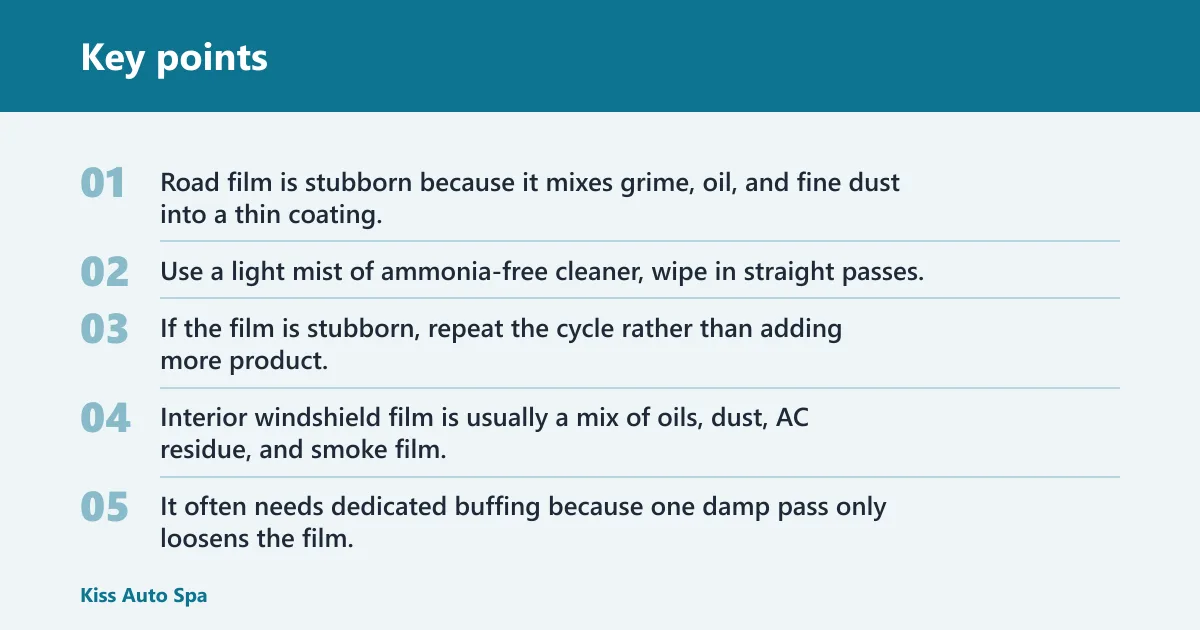
Road film is stubborn because it mixes grime, oil, and fine dust into a thin coating. Use a light mist of ammonia-free cleaner, wipe in straight passes, then follow with a dry towel. If the film is stubborn, repeat the cycle rather than adding more product.
Interior windshield film and oily haze
Interior windshield film is usually a mix of oils, dust, AC residue, and smoke film. It often needs dedicated buffing because one damp pass only loosens the film. Work in two light rounds instead of one heavy one, and keep the second towel dry.
Tint-safe cleaning on side and rear glass
Old aftermarket tint can react badly to harsh products and excess liquid near the edges. Use an ammonia-free cleaner labeled tint-safe, spray lightly, and avoid saturating the top edge where adhesive issues are more likely to appear. That approach lowers haze and protects the film.
Lint transfer from the wrong towel
If lint keeps appearing, the towel is part of the problem. Use microfiber glass towels, keep them separate from interior trim towels, and store a clean dry towel only for final buffing. Separate colors can help prevent confusion between the cleaning step and the finish step.
Hot-glass flashing in sun or warm weather
Hot glass can flash cleaner too quickly, which may leave marks before the towel can finish the job. Shade or cool-glass working conditions are the fix. If shade is unavailable, wait for the glass to cool before cleaning; direct sun is the enemy of a clean finish.
How to clean windshield and windows step by step
Start with cool glass, a clean glass towel, and a second dry buff towel. Clean one section at a time. Use straight passes instead of circles, then inspect from different angles before moving on. For most cars, the exterior windshield and side glass should be handled as separate tasks.
- Park in shade or wait for the glass to cool.
- Fold a clean microfiber glass towel into a working pad.
- Lightly mist the towel for interior glass or lightly mist the glass for exterior work.
- Wipe in straight passes with moderate pressure.
- Flip to a clean side of the towel if residue appears.
- Follow immediately with a separate dry towel.
- Inspect from inside and outside the car.
Exterior glass cleaning sequence
For exterior glass, start with the upper half of the windshield and work down in straight vertical passes. That direction helps keep track of what has been covered. If the lower edge is dirty, finish there last so contaminated runoff does not touch already-clean sections.
Interior glass cleaning sequence
For interior glass, spray the towel rather than the pane, then wipe in straight horizontal passes. This is especially useful on the windshield, where dashboards, vents, and electronics sit below the work area. A second dry towel should follow right away to remove the last trace of moisture.
Final buffing and inspection from multiple angles
Inspection from multiple angles matters because streaks hide in reflected light. Check both the interior and exterior viewpoints, then look again in sunlight and indirect light. A smear that disappears from one seat angle can still be obvious at night from the driver’s position.
Say your sedan has a hazy windshield at 7 a.m., right after the cabin cools down. The glass can look acceptable from the passenger seat but show a broad smear from the driver’s view. A second dry buff, checked from both sides, usually reveals the fix.
What to avoid if streaks keep coming back
If streaks keep returning, the issue is usually too much product, dirty towels, hot glass, or a one-towel routine that re-deposits residue. Correct the process before buying another bottle. Most repeat streaking is a cleaning workflow problem, not a missing miracle product.
Too much product
Over-spraying leaves too much liquid for the towel to remove cleanly. The result is haze at the edges, wet seams, and marks that reappear after drying. Use only what the towel can manage in one section.
Dirty or fabric-softened towels
Towels that have absorbed wax, fabric softener, or interior dressing can smear glass instead of cleaning it. Keep separate towels for glass only, wash them without softener, and retire any towel that starts shedding lint or dragging residue.
Cleaning in direct sun or on hot glass
Heat speeds evaporation and makes streaking almost instant. Shade or cool-glass working conditions are a practical requirement, not a preference. If the glass feels warm to the touch, wait. The cleaner needs time on the surface before it flashes away.
Using one towel for every step
One towel can clean, but it cannot clean and finish as well as two separate towels. The first towel picks up grime. The second dry towel removes the last film. That split is why the two-towel method remains the most reliable way to reduce haze.
Frequently asked questions
what cleans car windows without streaks
An ammonia-free automotive glass cleaner and a clean microfiber glass towel are the safest starting point. Use one towel to clean and a second dry towel to buff. Straight passes work better than circles, and cool glass helps the cleaner stay workable long enough to lift residue instead of flashing early.
what is best to clean car windows without streaks
The best setup is a tint-safe, ammonia-free glass cleaner paired with a waffle weave microfiber towel and a separate dry buff towel. That combination controls residue, limits lint, and works on interior and exterior glass. For greasy film, repeat the process lightly rather than soaking the panel.
what to use to clean car windshield without streaks
Use an automotive glass cleaner that is ammonia-free, plus two microfiber glass towels. For the inside of the windshield, spray the towel instead of the glass to avoid overspray on the dash. Wipe in straight lines and finish with a dry towel so the last haze is removed.
how to clean car windows without streaks
Work in shade, use a small amount of cleaner, wipe in straight passes, then buff with a second clean dry towel. Clean the glass in sections and inspect from both inside and outside the car. If the window still looks hazy, the problem is usually residue or towel contamination.
how to clean windshield without streaks
Clean the windshield with a cool surface, a microfiber glass towel, and a second dry towel for buffing. Use horizontal passes inside and vertical passes outside if you want a consistent pattern. Avoid heavy spray, especially in warm weather, because hot glass can flash cleaner too quickly.