Can You Hand Wash a Car in Direct Sunlight?
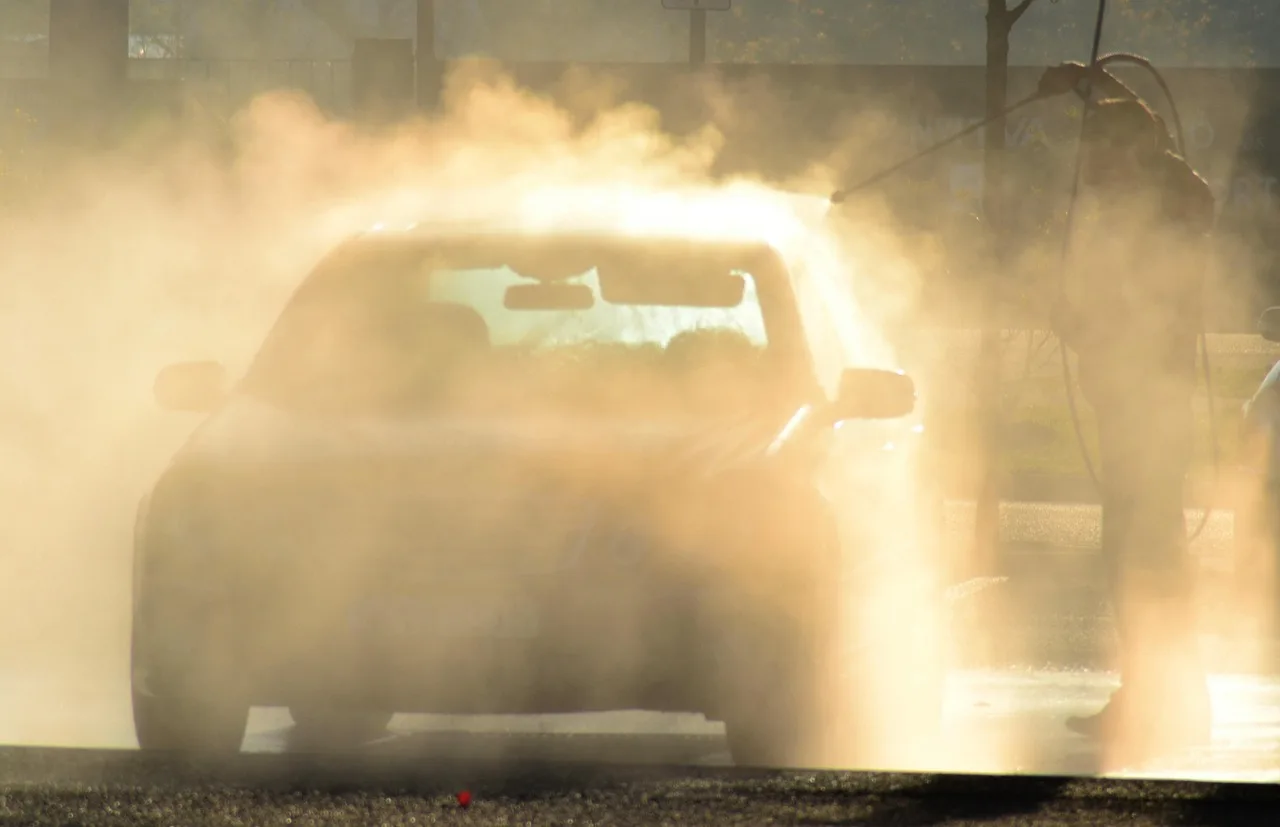
Yes, but only if the panels stay cool and you rinse, wash, and dry one section at a time. If the paint is hot enough to flash-dry soap or water, wait. Sun-baked residue leaves spots and streaks that can force a redo. This article explains when direct sunlight is workable, when it is risky, and how to cut spotting with no shade.
When sunny-day washing is safe
Yes, but only under limited conditions. Direct sunlight heats the panel and speeds evaporation, so rinse water, shampoo, and dissolved minerals can dry before you remove them. That is where the risk starts: spots, streaks, and residue on clear coat. For background on paint-system heat and finish care, see clear coat care and hard-water spots.
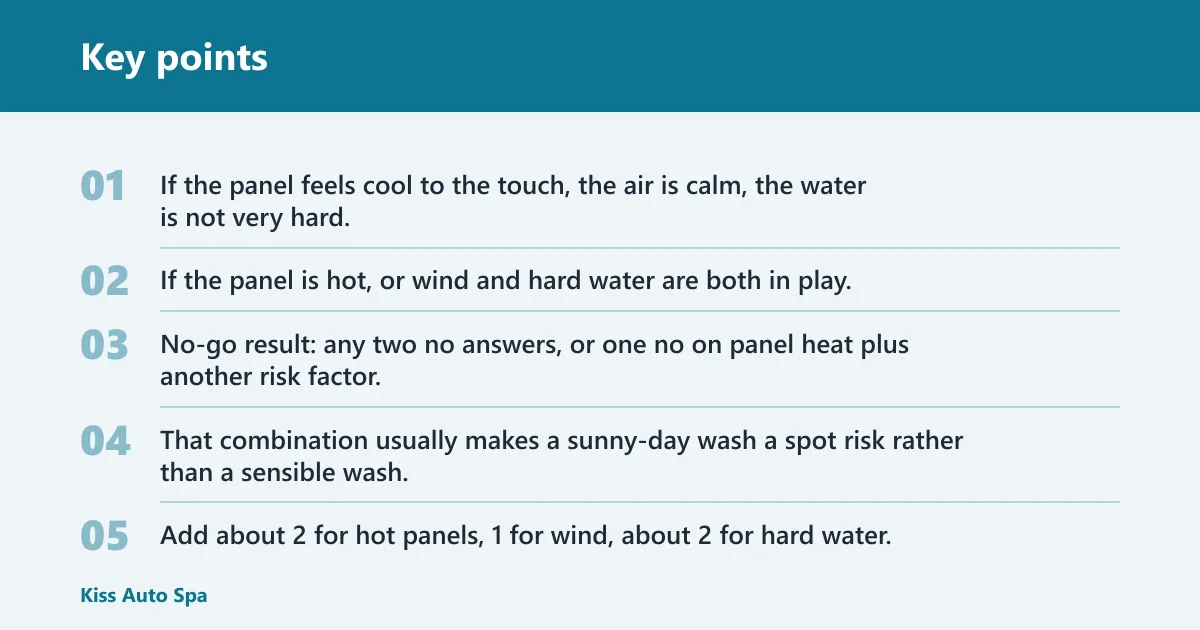
The practical rule is simple. If the panel feels cool to the touch, the air is calm, the water is not very hard, and you can dry each section right away, a sunny-day wash is workable. If the panel is hot, or wind and hard water are both in play, wait for shade or a cooler time.
Sunlight wash decision checklist
| Gate | Yes | No | What it means |
|---|---|---|---|
| Panel heat | Panel feels cool or only slightly warm | Panel feels hot enough that water flashes off fast | Hot panels are the biggest trigger for spots and soap residue. |
| Wind | Still air or only a light breeze | Steady wind moves water across the panel or speeds drying | Wind can turn a manageable wash into a fast-drying wash. |
| Water hardness | Soft or moderately hard water | Very hard water with visible mineral content | Hard water leaves more minerals behind when it dries. |
| Drying capacity | You have a clean microfiber drying towel and can dry panel by panel right away | You cannot dry quickly or only have one damp towel | Without fast drying, spots can form before you finish. |
Go result: all four yes. No-go result: any two no answers, or one no on panel heat plus another risk factor. That combination usually makes a sunny-day wash a spot risk rather than a sensible wash.
Spot-risk score: start at 0. Add about 2 for hot panels, 1 for wind, about 2 for hard water, and 1 if you cannot dry immediately. A score of 0-1 is generally low risk, 2-3 is moderate risk, and 4-6 is high risk.
Comparison: shade vs direct sun vs early morning/evening
| Condition | Risk | Speed | Spot likelihood |
|---|---|---|---|
| Shade | Lowest | Moderate | Lowest |
| Direct sun | Highest | Fastest if you rush, but least forgiving | Highest |
| Early morning/evening | Low to moderate | Moderate | Lower than midday sun |
Why sun causes spots and streaks
Direct sun heats paint and clear coat. That heat speeds evaporation on the surface, so rinse water disappears before it can be wiped away. Any minerals left in the water stay behind as deposits, and soap residue can dry into streaks on clear coat. The effect is especially noticeable on hot, dark panels, where surface temperatures can rise quickly. For more on the finish itself, see clear coat care.
Clear coat is thin enough that repeated mineral deposits are worth avoiding, especially on dark paint where dried marks can stand out more. The issue is usually not immediate damage. It is the extra work needed to remove spots and residue later.
Technical sources consistently note that clearcoat and painted surfaces can be harmed by prolonged heat and that mineral-laden water leaves visible spotting as it evaporates. See: CAWA on hard-water spots, NHTSA car-care guidance, and 3M on auto-detailing microfiber use.
How heat changes the result
Panel heat matters more than the clock alone. A cool panel at noon can be safer than a dark hood in late afternoon if that hood has been baking for hours. Sunlight is a problem when it drives the surface temperature up, not simply because the sky is bright.
Humidity, wind, and water quality change the result too. Dry air and wind pull moisture off faster. Low humidity can make soap film dry into streaks. Hard water raises the chance that dried droplets leave visible mineral spots. The EPA notes that water chemistry affects mineral content, which is why local water hardness matters so much in sunny conditions.
Why hard water is worse
Hard water contains more dissolved minerals, usually calcium and magnesium. When the water evaporates, those minerals stay on the paint. Light spotting may wipe off with a proper wash, but heavier deposits can bond more tightly and become harder to remove.
Very hard water also raises the chance of etched deposits if the spots sit too long on a hot panel. That is why a sunny wash with hard water deserves extra caution, even if the car looks clean at first.
When is it safe enough?
A sunny-day wash is most workable when the panels are cool, the air is calm, and the car can be dried immediately. Early morning and late evening are usually the better windows because panels have had time to cool and evaporation is slower than it is under strong midday sun. A shaded area, a garage, or a covered area is still the better choice when you have it.
Conditions that make a sunny wash workable
- The hood, roof, and doors are cool to the touch.
- There is only light wind.
- You have enough clean towels to dry one section right away.
- The water is not very hard.
- You can work in small sections instead of letting the whole car stay wet.
Paint color and climate change the risk. Dark colors usually heat up faster than light colors. In a hot, dry climate, a wash that would be fine on a mild morning can turn spot-prone by late morning. In a humid climate, evaporation is slower, so the wash may be more forgiving, though wind can still speed drying on the panel surface.
Picture a black sedan parked in full sun on a 90-degree afternoon. The hood feels hot, and a light breeze keeps moving across the paint. Even if the soap mix is correct, the combination of heat and wind makes water flash off too fast, so the car should wait for shade or a cooler time.
Go/no-go recommendation
Go: use direct sunlight only when the panels are cool, wind is light, your water is not very hard, and you can dry each section immediately. No-go: if the panel is hot, the wind is steady, or you cannot dry fast enough, wait for shade or a cooler time. Final recommendation: if you are not sure, treat it as a no-go and wash later.
How do you hand wash a car on a sunny day without spots?
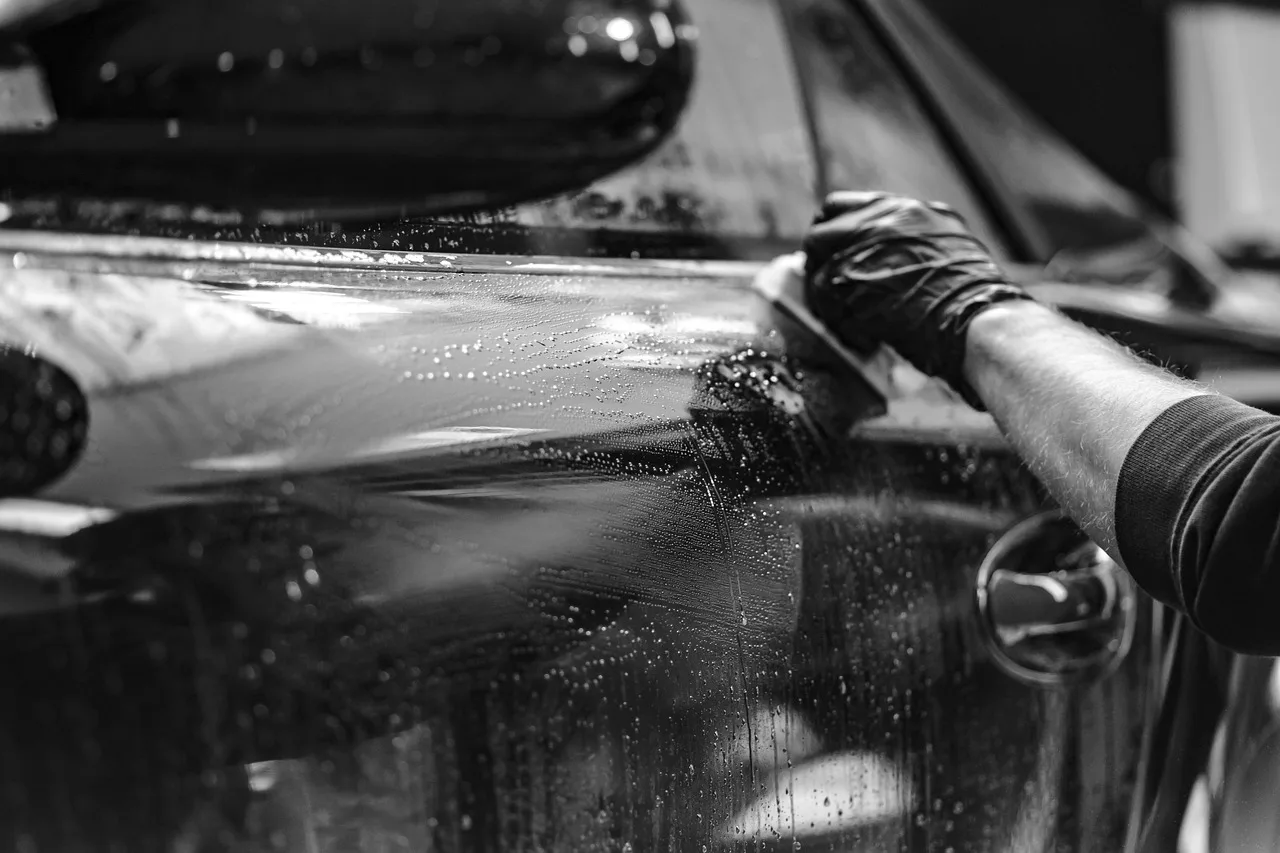
Wash one panel at a time, rinse it right away, and dry it before moving on. That sequence shortens the time water sits on hot paint. It also reduces the chance that shampoo residue or dissolved minerals dry on the clear coat. For adjacent technique, see two-bucket method and microfiber drying.
- Start with the coolest panel you can reach first, usually the roof or a shaded side.
- Pre-rinse the section to lift loose dirt and reduce rubbing.
- Wash with a mitt dipped in the wash bucket, then rinse the mitt in the rinse bucket before reloading it.
- Rinse that section completely.
- Dry immediately with a clean microfiber towel.
- Move to the next panel only after the first is dry.
Use a two-bucket method
Use one bucket for wash solution and one bucket for rinse water. A grit guard at the bottom of each bucket helps keep dirt away from the mitt after you rinse it. That lowers the chance of dragging grit across clear coat while you work fast in the sun.
In bright conditions, speed matters, but cleanliness matters too. A dirty mitt can scratch paint while you chase spots later. The two-bucket method reduces that risk while you keep the wash moving.
Mix shampoo for easy rinseability
Use a pH-balanced car shampoo and follow the label dilution ratio. A common bottle direction is about an ounce or two per gallon, but the label is the correct reference because formulas vary. You want enough lubrication for the mitt and enough rinseability so the soap does not cling to hot paint.
A product that leaves heavy residue is a poor fit for direct sunlight. Residue becomes more visible when the panel dries too quickly.
Suppose a compact hatchback has only one sunny side and one shaded side. Wash the sunlit side first only if the panel is still cool enough to stay wet for a few minutes. If the door skin is already hot, switch to the shaded side, then return when the sun moves.
What soap, water, and towel should you use?
Use a pH-balanced shampoo, clean rinse water, and a high-absorbency microfiber drying towel. Waffle-weave and plush towels both work well because they pull water off the panel instead of pushing it around. Low-lint fabric matters because you want fewer streaks after the rinse. For towel specifics, see microfiber drying.
What rinseability means in direct sun
Rinseability is the shampoo’s ability to wash off cleanly. In direct sunlight, that matters more than usual because any leftover film can dry fast and leave streaks. A slick shampoo that rinses clean is easier to manage than a heavy product that hangs on the panel.
How water hardness changes the result
If your water is hard, the final rinse should be as complete as possible before drying. Hard water does not just leave a few dots. It can leave visible mineral marks that stand out on dark paint and on horizontal panels such as the hood and roof.
If the water is very hard, a sunny-day wash becomes more dependent on immediate drying. That is where a clean microfiber towel is not optional. It is the main defense against spots. For more detail, see hard-water spots.
Why the towel choice matters
A waffle-weave towel tends to pull water away quickly, while a plush towel can give more cushion on delicate finishes. Either can work if it is clean, dry, and large enough to blot and drag water off the panel without much pressure. Do not use a rough towel or a towel that has picked up grit.
Microfiber works best when it is clean, dedicated to drying, and not overloaded with water. A damp towel loses efficiency fast, so keep extra towels on hand if you plan to wash in the sun.
What if spots already formed?
If spots form, stop and dry the surface first. If the panel is still wet, rinse the area again and dry it immediately with a clean microfiber towel. If the marks remain after the panel cools, use a spot remover made for mineral deposits, then follow the label directions carefully.
Do not scrub a hot panel with a dry towel. That can grind residue into the finish and make the fix harder. If the deposit looks etched rather than sitting on top of the clear coat, a quick wipe may not be enough.
Failure-case walkthrough
A common first-timer mistake is finishing the wash, stepping away for a minute, and returning to a hood full of chalky dots. If the water dried first, re-wet that section, rinse it clean, and dry it right away. If the spots are still visible after cooling, treat them as mineral deposits rather than soap film.
When deposits do not wipe off, the panel may need a dedicated spot remover or a more careful decontamination step. The longer hard-water spots sit, the more effort they can take to remove.
Frequently asked questions
Can you hand wash a car in direct sunlight?
Yes, but only when the panels stay cool, the wind is light, and you can rinse and dry each section right away. Direct sun is less about the calendar and more about surface heat. Hot panels, hard water, or slow drying make spots and streaks much more likely.
Is it bad to wash your car in direct sunlight?
It is not always bad, but it is higher risk than washing in shade. The main problem is fast evaporation on hot paint, which leaves behind minerals and soap residue. If the panel is cool and you work fast, the risk drops. If the panel is hot, wait.
Should you wash your car in direct sunlight?
Only if you have no better option and the conditions are favorable. Early morning or late evening is usually better because panels are cooler and water does not flash off as quickly. A shaded area, a garage, or a covered area is still the cleaner choice when available.
Can you wash your car in the sun?
Yes, but treat it as a controlled wash, not a casual one. Work one panel at a time, keep the soap mix rinseable, and dry immediately with microfiber. If wind is pushing water around or the paint feels hot, the sun is working against you.
How hot is too hot to wash a car?
If the panel feels hot enough that rinse water starts drying almost as soon as it lands, that is too hot for a relaxed hand wash. The better test is touch, not time. A cool or only slightly warm panel is workable; a hot panel is a no-go.