Do No-Scrub Wheel Cleaners Really Work?
No-scrub wheel cleaners can work for light maintenance cleaning, but they may still need agitation on heavy brake dust, baked-on grime, or delicate finishes. Skip that step and you can leave contamination behind or risk scrubbing too hard later. This opening explains what these cleaners can and cannot do, plus when to add a brush anyway.
Where spray-and-rinse cleaning works best
The product is commonly used when wheels have light to moderate dust and it is used as directed. The spray loosens surface grime, and a rinse carries much of it away. It is less reliable on bonded contamination, thick brake dust, or neglected wheels that need mechanical help.
Where the spray-and-rinse promise holds up
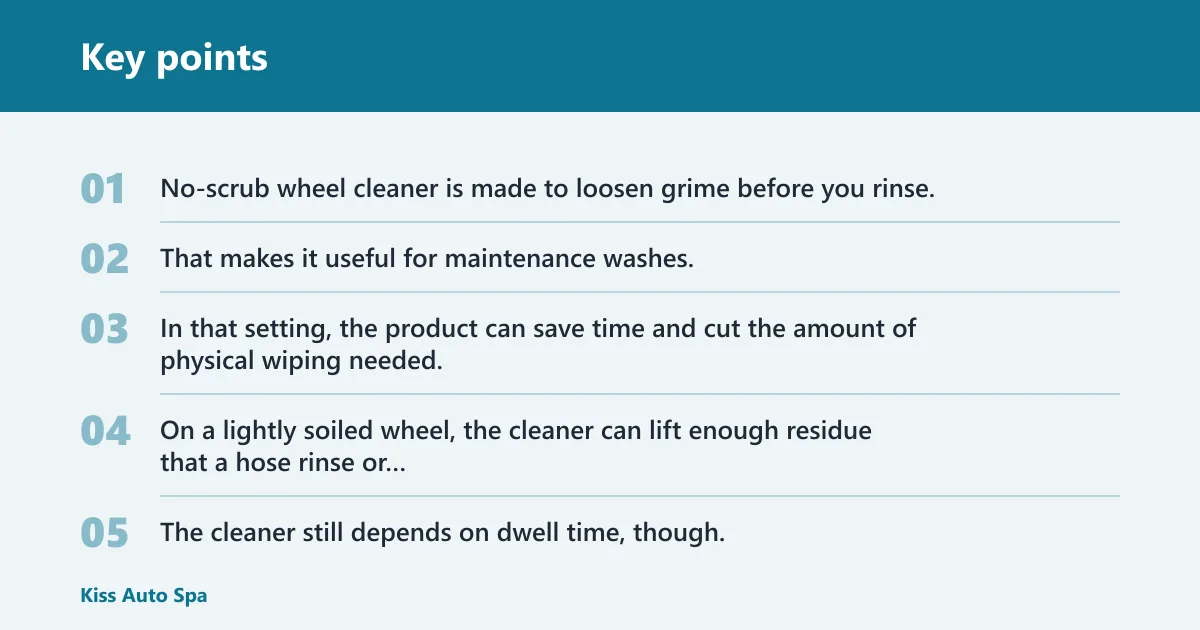
No-scrub wheel cleaner is made to loosen grime before you rinse. That makes it useful for maintenance washes, especially when the wheels are cleaned often and the soil has not had time to bake on. In that setting, the product can save time and cut the amount of physical wiping needed.
Brake dust is the main target. On a lightly soiled wheel, the cleaner can lift enough residue that a hose rinse or pressure rinse removes most of it. The cleaner still depends on dwell time, though, so a quick spray and immediate rinse usually leaves more behind than the label promises.
Where results usually fall short
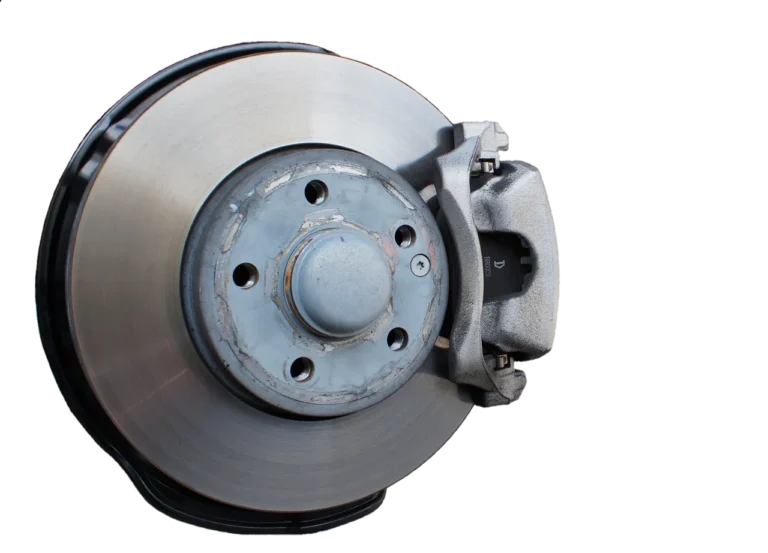
Heavy brake dust may contain ferrous particles that bond to the wheel face and barrel. Once that buildup hardens, a spray alone may only soften the top layer. You usually still need a wheel brush, detail brush, or a different chemical such as an iron remover to finish the job.
Finish also matters. A product that is acceptable on clear-coated alloy may not be the safest choice for polished aluminum, and even chrome can react differently depending on plating quality and age. “Safe on all wheels” is marketing language, not a substitute for checking the label and matching the product to the finish.
How no-scrub wheel cleaner works
No-scrub wheel cleaner uses chemistry to loosen road film, brake dust, and grime so the rinse can carry it away. It is not a vacuum. It works best when contamination is thin, the wheel finish is compatible, and the product stays wet long enough to react before you rinse.
What the spray is designed to loosen
Most products in this category target the film on the wheel surface: dust, traffic grime, and fresh brake residue. Some formulas also target iron particles, but a basic no-scrub wheel cleaner is usually less aggressive than a dedicated iron remover.
Why dwell time matters
Dwell time is the minutes the cleaner stays on the wheel before rinsing. Too short, and the cleaner cannot soften the soil enough. Too long, and the product can dry, spot, or leave residue on sensitive finishes. The right window is the one the label gives you.
Suppose a wheel has a light gray dusting after a week of commuting. A spray that sits for the recommended dwell time may rinse clean with little effort. If that same wheel has a thick brown-black ring near the spokes, the same spray usually needs help from a brush or an iron remover.
Why rinsing still matters
Rinsing removes the loosened residue. A hose rinse works for light contamination, while a pressure rinse can help move loosened grime out of lug recesses and spoke edges. A waterless wipe-down is a poor match for heavy wheel contamination because it can smear residue instead of flushing it away.
When no-scrub wheel cleaner is enough
No-scrub cleaner is enough when the contamination is light, the finish is stable, and the rinse can physically remove what the spray has loosened. It is a maintenance product first. Once the wheel has heavy buildup or bonded residue, the odds shift toward agitation or a stronger chemical step.
| Condition | Expected outcome | Agitation still needed? | Safer product category |
|---|---|---|---|
| Light dust | Most residue lifts with spray, dwell time, and rinse | No, usually not | No-scrub wheel cleaner |
| Moderate dust | Good results on the face, less complete in crevices | Sometimes, for corners and lug areas | No-scrub wheel cleaner or iron remover |
| Baked-on grime | Partial softening only; visible film often remains | Yes | Traditional wheel cleaner plus brush, or iron remover |
| Delicate finishes | Only use if label explicitly allows that finish | Usually yes, but gently | Finish-safe wheel cleaner, tested on the exact finish |
Light dust
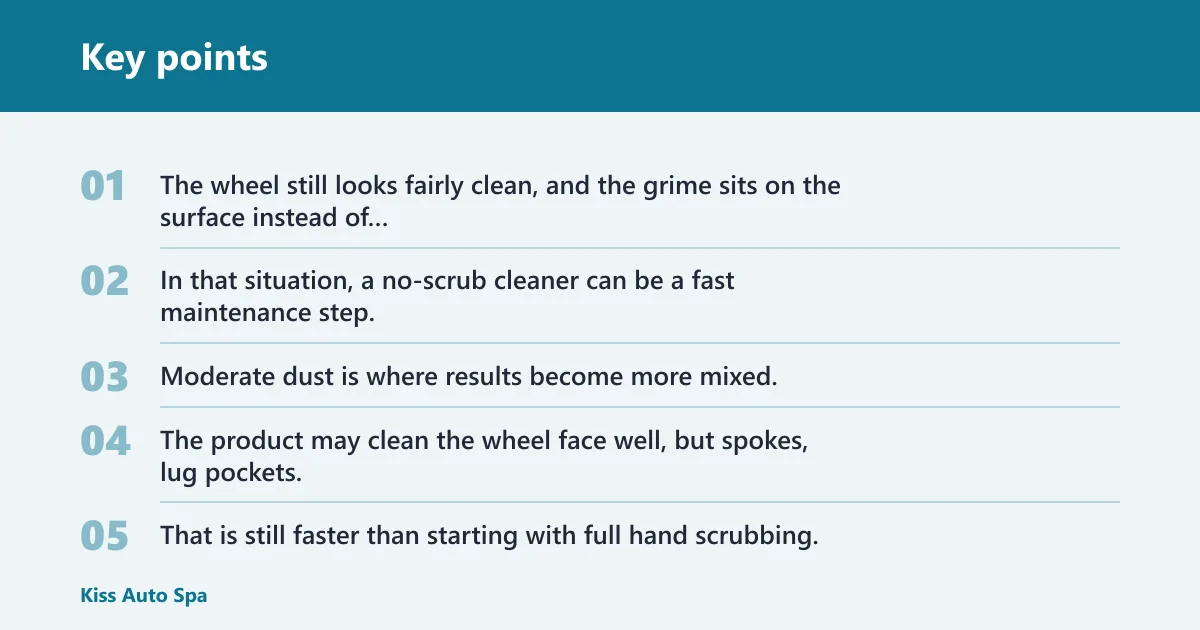
Light dust is the best case. The wheel still looks fairly clean, and the grime sits on the surface instead of clinging in layers. In that situation, a no-scrub cleaner can be a fast maintenance step, especially if you wash often.
Moderate dust
Moderate dust is where results become more mixed. The product may clean the wheel face well, but spokes, lug pockets, and barrel edges may still need a quick pass with a brush. That is still faster than starting with full hand scrubbing.
Baked-on grime
Baked-on grime usually needs more than spray and rinse. Heat, age, and brake dust can bond contamination to the surface, and no-scrub formulas often cannot break that bond fully. If the wheel has a dark film that does not move after dwell time, plan on agitation.
Delicate finishes
Delicate finishes need caution first. Polished aluminum, older chrome, and some specialty coatings can react badly to the wrong cleaner. Even if a product says no-scrub, that does not mean it is safe on every wheel. Compatibility matters as much as cleaning power.
When do you still need a brush?
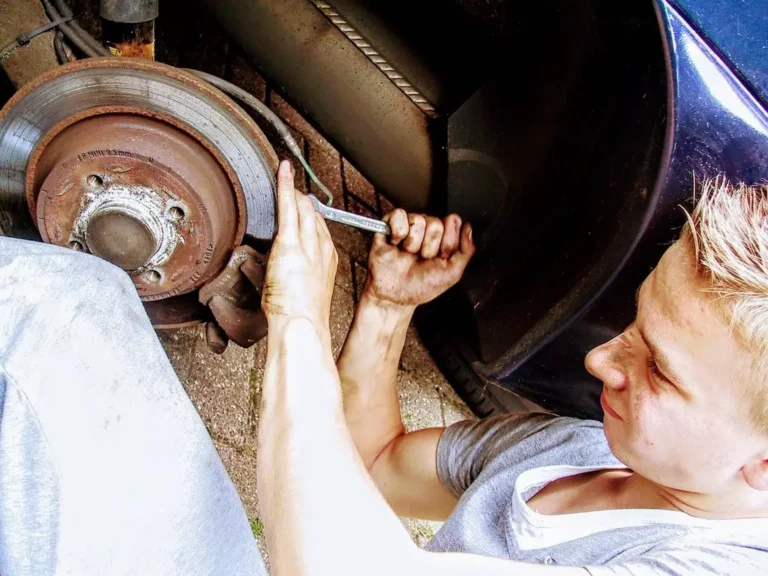
You still need a brush when the contamination is bonded, trapped in corners, or left behind after the rinse. A no-scrub product can loosen soil, but it cannot always reach recessed lug areas, spoke backs, or textured surfaces without help from a wheel brush or detail brush.
Bonded brake dust and road film
Bonded brake dust is the main reason to keep a brush nearby. Once particles are stuck to the surface, the spray may soften them but not remove them completely. That is where a brush, microfiber towel, or mitt can finish the job without forcing you to scrub hard later.
Crevices, spokes, and lug areas
Deep spokes and tight lug recesses collect residue the rinse stream misses. Even a strong cleaner can leave dirt in those areas if it never gets physical contact. A small detail brush is often the simplest fix, especially on wheels with many edges and cutouts.
Why agitation still saves time on neglected wheels
A common first-timer mistake is to keep spraying the same neglected wheel, hoping the label promise will do all the work. On a wheel that has gone months without cleaning, a brief brush step usually saves time because it removes what the chemical can only loosen.
Say your compact car has front wheels covered in dark dust after a long highway commute. A spray-only approach may improve the face, but the inner barrel still looks gray after rinsing. One pass with a brush often removes what a second spray would not.
Should you use iron remover instead?
Use iron remover when the main issue is ferrous brake dust that has bonded to the wheel. A basic wheel cleaner handles general soil, while iron remover is built for metal particles. It often works better on embedded contamination, especially when the wheel has repeated heavy brake dust.
How iron remover differs from a basic wheel cleaner
Iron remover is a chemical decontaminant aimed at ferrous particles. Many formulas change color as they react, which helps show where contamination is present. That reaction is useful, but it does not replace the need to rinse thoroughly or avoid letting the product dry.
When a color-change reaction helps
The color change gives a clue that the product is contacting iron particles. That matters on wheels with stubborn brake dust because the visible film may be more than dirt. If the cleaner stays the same color and the wheel still feels gritty after rinsing, a brush step is still a good next move.
When iron remover is the better choice for brake dust
Choose iron remover when the wheel has repeated brake dust buildup, a rough feel after rinsing, or dark spots that do not lift with a regular wheel cleaner. It can outperform a basic no-scrub spray on embedded contamination, though it still may need agitation on the worst areas.
Wheel finish and safety
Wheel finish changes both safety and performance. Clear-coated alloy and painted wheels are usually the easiest match for wheel cleaners, while chrome and polished aluminum need more caution. A safe result depends on the exact finish, the age of the wheel, and the label instructions.
Clear-coated alloy and painted wheels
These are the most forgiving finishes for routine cleaning. Most wheel cleaners are designed with them in mind, so a no-scrub product often works well here if the contamination is not heavy. Even then, dwell time and rinsing still matter.
Chrome wheels
Chrome can tolerate many wheel cleaners, but not all. Older chrome or damaged plating may be more sensitive to harsh formulas, strong acids, or long dwell time. A milder cleaner and a short test spot are the safer starting point.
Polished aluminum and other sensitive finishes
Polished aluminum is the finish where caution matters most. Some cleaners can stain, haze, or dull the surface if the chemistry is too strong or left on too long. For these wheels, choose a product that names polished aluminum as compatible and follow the dwell time closely.
What to check on the label before spraying
Read the label for finish compatibility, dwell time, and rinse instructions. “No-touch” and “no-scrub” are claims about use, not guarantees for every wheel. Also look for warnings about uncoated aluminum, matte finishes, or hot surfaces.
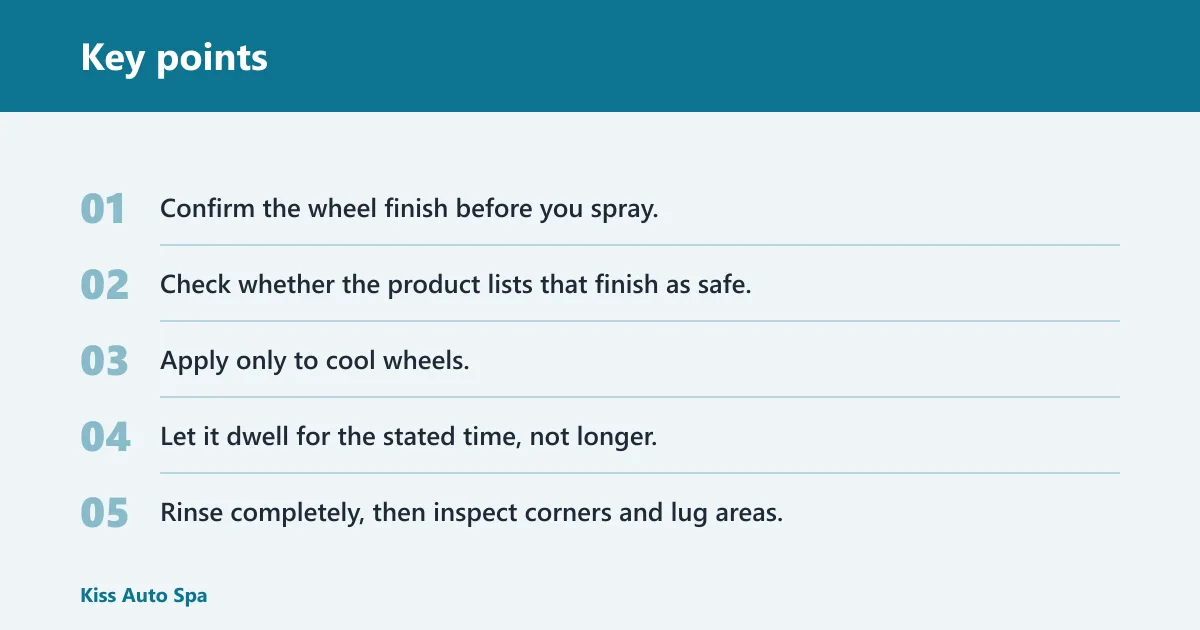
- Confirm the wheel finish before you spray.
- Check whether the product lists that finish as safe.
- Apply only to cool wheels.
- Let it dwell for the stated time, not longer.
- Rinse completely, then inspect corners and lug areas.
- Add a brush only where residue remains.
Is no-scrub better than soap?
For wheels, a dedicated wheel cleaner is usually better than soap when brake dust is the main soil. Soap can handle light dirt and maintenance washing, but it is not built to break down metallic brake residue as effectively. Soap is fine when the wheels are already fairly clean.
Soap as a maintenance cleaner
Wheel soap works when contamination is light and you want a gentle wash step. It is a reasonable choice for regularly cleaned wheels, especially if the finish is sensitive. It is also cheaper per wash in many cases.
Why dedicated wheel cleaners can perform better on brake dust
Dedicated wheel cleaners are formulated for the kind of grime wheels collect. Brake dust is the key difference. Soap can move loose dirt, but it often leaves more embedded residue behind than a wheel cleaner or iron remover, especially on front wheels.
When soap is enough
Soap is enough when the wheel only has a light film, the car is washed often, and the finish needs a softer approach. If the wheel still looks dull after washing, or you can feel grit on the surface, step up to a wheel cleaner or iron remover.
Frequently asked questions
Do no-scrub wheel cleaners really work?
Yes, for light maintenance cleaning and some moderate dust. They work by loosening grime so rinsing removes it. They are much less reliable on baked-on brake dust, bonded residue, or wheels with deep crevices that trap soil.
What is wheel scrub?
Wheel scrub is the act of using a brush, mitt, towel, or similar tool to agitate contamination on a wheel. It is the physical step that helps lift residue a spray did not fully remove.
What is scrubs on wheels?
“Scrubs on wheels” is not a standard detailing term, but it usually means contamination or residue that needs a scrubbing step. In plain terms, it points to grime that spray alone did not remove and that now needs a brush.
Can you use an auto scrubber?
An auto scrubber is generally not the right tool for vehicle wheels. It is meant for larger floor-cleaning jobs, not delicate wheel faces, spokes, or lug areas. For wheels, a small brush or microfiber tool is the safer match.
How long does no-scrub wheel cleaner need to dwell?
Use the dwell time listed on the label. Many products call for a short wait, often around one to five minutes, though the exact time varies. Too little time reduces cleaning; too much can dry the product and leave spots.
Are no-touch wheel cleaners safe on all wheel finishes?
No. Some are safe on clear-coated alloy and painted wheels, while others are too strong for polished aluminum, older chrome, or specialty finishes. “Safe on all wheels” should be treated as a claim to verify, not a rule to trust blindly.
When do you still need a brush with a no-scrub wheel cleaner?
You still need a brush when brake dust is heavy, contamination is bonded, or residue remains in corners after rinsing. A brush also helps on lug holes, spoke backs, and textured surfaces where spray cannot reach evenly.
Which wheel cleaners work best without scrubbing?
The best no-scrub results usually come from products matched to light soil, correct dwell time, and a finish the label approves. On embedded brake dust, an iron remover often outperforms a basic wheel cleaner, but even then a brush may still be needed.