How to Polish Glass Water Spots Off a Windshield
Polish a windshield only after you confirm the spots are etched: if they do not wipe off with glass cleaner, diluted vinegar, or a razor-safe test area, you may need a glass polish. If you polish residue instead of mineral etching, you waste time and can haze the glass. This guide shows how to tell deposits from etching and how to polish the windshield safely when polishing is the right fix.
What you need
- Automotive glass cleaner
- White distilled vinegar
- Distilled water
- Clean microfiber towel
- Detailing clay
- Clay lubricant or a wet glass-safe lubricant
- Glass polish or a cerium-oxide glass compound
- Dual-action polisher or rotary polisher, if the etched area is larger
- Clean water for rinse and final wipe
How do you tell if the spots are etched?
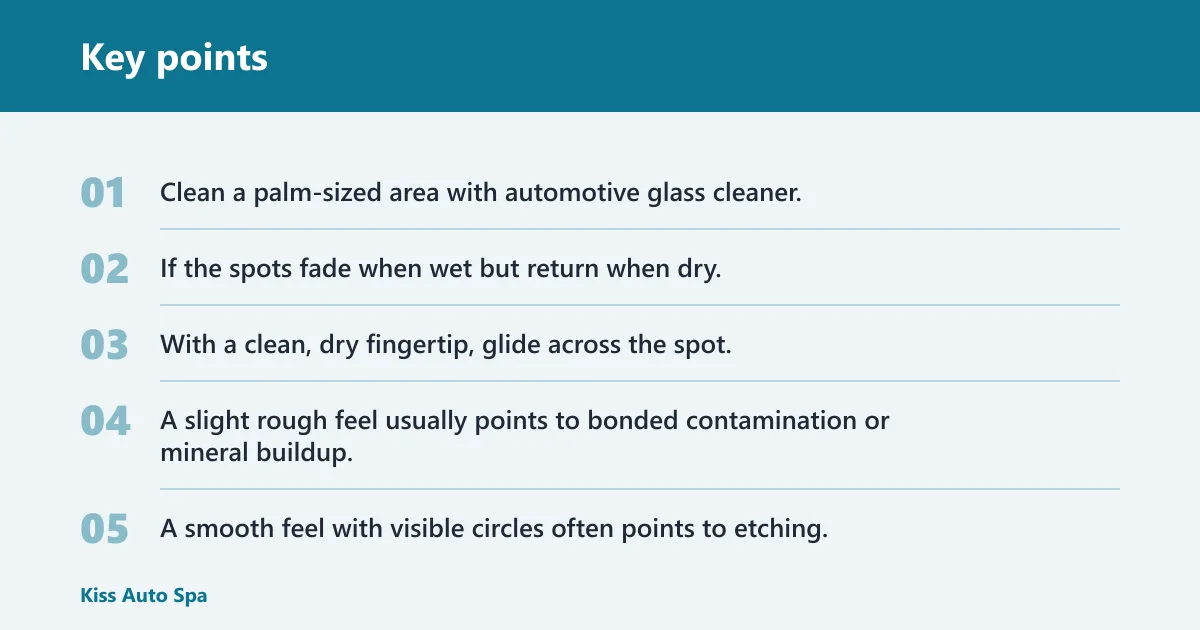
Use the wet-versus-dry check first. If the marks fade when wet and return after drying, they are usually on the surface or etched into it. If the same rings or dots stay visible after cleaning and drying, the glass may need polishing.
Use the wet-versus-dry check
Clean a palm-sized area with automotive glass cleaner, then dry it with a clean microfiber towel. Mist that same area with distilled water. If the spots fade when wet but return when dry, you are likely dealing with mineral deposits or etched rings, not loose grime.
Feel the spots with a fingertip
With a clean, dry fingertip, glide across the spot. A slight rough feel usually points to bonded contamination or mineral buildup. A smooth feel with visible circles often points to etching, which is where a glass polish becomes more useful than cleaning alone.
Look for dull rings that stay after cleaning
After cleaning, look at the glass at an angle in bright shade. Dull rings, halo shapes, or cloudy dots that remain in the same place after repeated wiping are stronger signs of etching. A ragged ring pattern often means a hard-water droplet dried and attacked the surface.
Say your windshield has pale spots across the lower passenger side. If they vanish while the glass is wet but reappear dry after a cleaner wipe, that is the kind of clue that separates surface residue from etched marks.
How do you remove water spots step by step?
Start with the mildest fix, then move up only if the marks stay. Clean first, use diluted vinegar for light mineral deposits, then clay for bonded residue, and move to glass polish only if the marks remain. That order limits haze and keeps you from polishing dirt into the glass.
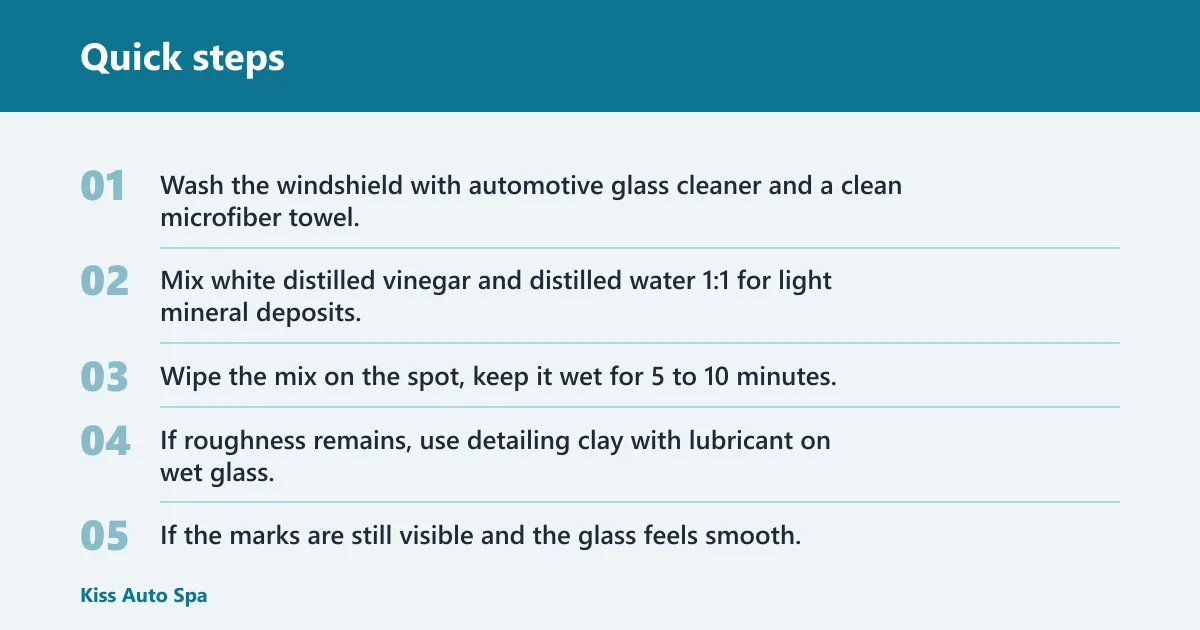
- Wash the windshield with automotive glass cleaner and a clean microfiber towel.
- Mix white distilled vinegar and distilled water 1:1 for light mineral deposits.
- Wipe the mix on the spot, keep it wet for 5 to 10 minutes, then rinse with distilled water.
- If roughness remains, use detailing clay with lubricant on wet glass.
- If the marks are still visible and the glass feels smooth, move to glass polish or cerium oxide.
Step 1: Clean loose film first
Use automotive glass cleaner before anything stronger. It removes loose grime, road film, and wiper haze, which keeps those layers from hiding the real problem. Dry the glass with a clean microfiber towel that is not shared with wheel, tire, or interior work.
Step 2: Treat light mineral deposits with vinegar mix
For light hard-water marks, use white distilled vinegar mixed about 1:1 with distilled water. Apply it to the spot, let it dwell for 5 to 10 minutes, then wipe and rinse with distilled water. Do not let vinegar dry on the glass, because dried acid can leave more cleanup behind.
Step 3: Use detailing clay for bonded residue
If the windshield feels gritty after cleaner or vinegar, detailing clay can pull off bonded contamination. Keep the surface wet with lubricant and glide the clay lightly. If it starts to feel smooth and the marks shrink, stop there. If roughness remains, the issue is likely below the surface.
Step 4: Polish etched spots by hand or machine
Use a glass polish when the spots remain after cleaning and claying, or when the rings are clearly etched. Many products for this job are reported to contain cerium oxide. A glass-specific product can polish a windshield, and cerium oxide glass polish is commonly used for etching and light scratches.
When should you switch to glass polish?
Switch to polish when cleaning, vinegar, and clay no longer change the marks. If the spots still show in dry daylight, feel smooth, and stay in the same place after rinsing, they are likely etched. That is the point where a glass-specific polish is worth the extra step.
Use polish when vinegar and clay stop working
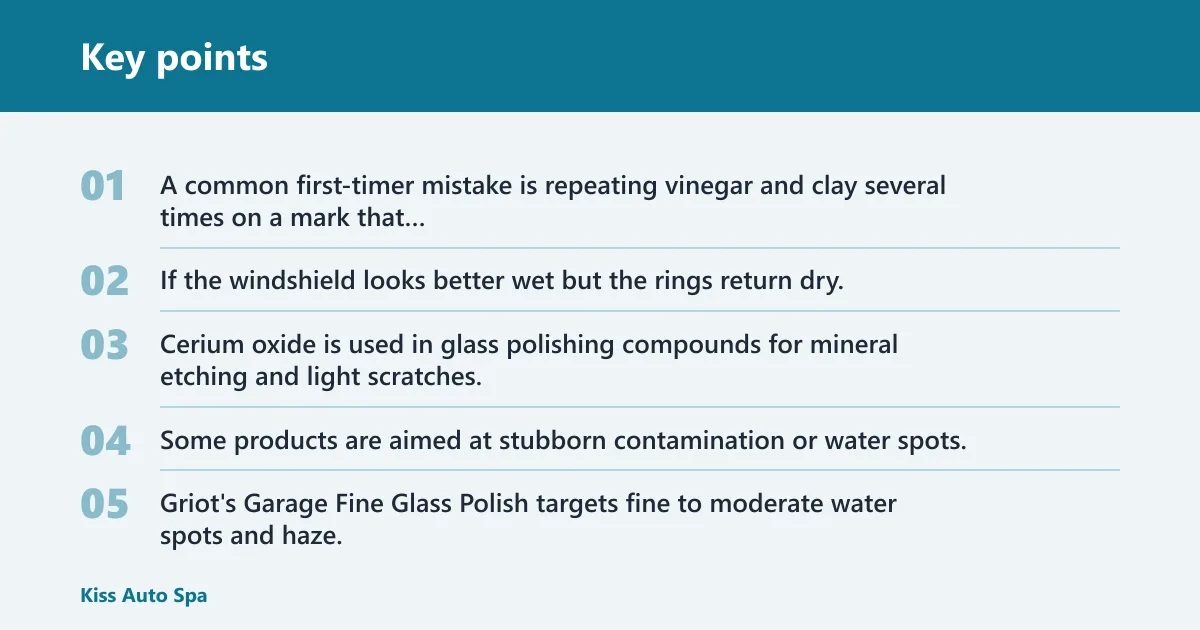
A common first-timer mistake is repeating vinegar and clay several times on a mark that is already etched. That wastes time and can add haze. If the windshield looks better wet but the rings return dry, move to polish instead of escalating cleaner strength again.
Choose cerium-oxide products for etched mineral marks
Cerium oxide is used in glass polishing compounds for mineral etching and light scratches. Some products are aimed at stubborn contamination or water spots; others are made for harder etched marks. Griot’s Garage Fine Glass Polish targets fine to moderate water spots and haze, while CarPro CeriGlass is for hard water and acid rain spots.
Keep the pad moving and the glass cool
Use a dual-action or rotary polisher only if the area is large or the etching is widespread. Sonax specifies rotary polishing at about 600 to 1,000 rpm and says to allow at least 30 minutes per windshield. Mirka limits glass to 158°F during reconditioning. Keep the pad moving, and stop if the glass starts to warm too much.
Suppose a roughly 6-inch patch above the wiper sweep still shows dull rings after vinegar and clay. That is the point where a cerium-oxide polish on a moving pad makes more sense than another round of wiping.
How do you polish windshield glass safely?
Polish with light pressure, short passes, and frequent checks. The risk on a windshield is not only haze; overheating one area can create optical distortion. If the glass warms quickly, pause and let it cool before the next pass.
Hand polish for small areas
Use a clean microfiber towel or applicator pad with a glass polish on a small spot first. Work in tight circles, then wipe clean and inspect from two angles. Hand polishing is slower, but it gives more control on a single cluster of spots near the edge or by the rearview mirror.
Machine polish for larger areas
For wider etched zones, use a dual-action or rotary polisher with a glass-safe pad and polish made for glass. Sonax and other glass compounds are designed for machine work. Keep the tool moving at all times and check the panel often so one section does not heat up.
Check compatibility before you start
Tinted or coated glass needs a compatibility check before vinegar, clay, or polish. Some aftermarket coatings and tint films may not tolerate every cleaner or compound. If the windshield has a specialty coating, test a hidden edge first and stop if the product dulls the surface.
Windshield spot decision table
| Symptom | Fingertip test | Safest next step | Stop condition | Escalation trigger |
|---|---|---|---|---|
| Fresh residue | Feels slick or film-like, not gritty | Clean with automotive glass cleaner and a microfiber towel | Stops changing after one wash-and-dry cycle | Move to diluted vinegar if faint rings remain |
| Stubborn mineral deposits | Feels slightly rough or crusted | Use white distilled vinegar mixed 1:1 with distilled water, then rinse | Surface turns smooth and spots fade while wet and dry | Use detailing clay if roughness remains |
| Etched spots | Feels smooth, but marks stay visible | Use glass polish or cerium oxide | Marks fade after controlled polishing passes | Stop if distortion, heat, or haze appears |
| Coated or tinted glass | Varies by film or coating | Check product compatibility on a hidden edge first | No dulling, clouding, or edge lift | Switch products or avoid polishing that area |
| When to stop and refer to a glass shop | Deep scratch, chip, crack, or severe etching | Do not keep polishing; book a glass shop | Any structural defect or visible distortion | Replacement or professional repair is the next step |
Common mistakes
Letting vinegar or polish dry on the surface is a common error. It makes cleanup harder and can leave streaks or haze. Keep the windshield wet during the product’s dwell time, then rinse or wipe before it flashes dry.
Using a dirty microfiber towel is another problem. A towel used on wheels, trim, or interior dressing can scratch glass. Keep a separate clean towel only for glass work, and fold it so you can switch to a fresh face quickly.
Over-polishing one spot can create optical distortion. If the glass begins to look wavy, stop and let it cool. Deep scratches, chips, cracks, and severe etching are not solved by polishing, and pushing harder usually makes the result worse.
How do you get water spots off a windshield?
Start with automotive glass cleaner, then move to a 1:1 mix of white distilled vinegar and distilled water for light mineral deposits. If the surface still feels rough, use detailing clay. If the marks remain smooth but visible, they are likely etched and need glass polish.
How do you remove water spots from a windshield?
Clean and dry the glass first, inspect the spots wet and dry, then choose the least aggressive fix that matches the symptom. Vinegar works on mineral deposits sitting on top of the glass. Cerium-oxide polish is the step for etched marks that do not respond to cleaning.
How do you polish water spots off glass?
Use a glass-specific polish, then work a small section at a time until the marks fade. Many glass polishes contain cerium oxide, which is used for mineral etching and light scratches. Wipe residue often and stop if the glass begins to look cloudy or distorted.
How do you polish a windshield by hand?
Use a clean applicator or microfiber towel with glass polish on a small area. Work in controlled passes, then wipe and inspect before repeating. Hand polishing gives the most control on isolated spots, but it is slower than machine work on larger etched patches.
Can I use vinegar on windshield water spots?
Yes, for light mineral deposits. White distilled vinegar mixed 1:1 with distilled water is a common DIY step, and the mix should dwell 5 to 10 minutes before rinsing. Do not let it dry on the glass, and test coated or tinted glass first.
Do I need glass polish for windshield water spots?
Only if cleaning, vinegar, and clay do not remove the marks. If the spots remain after those steps, or if they look the same wet and dry, a glass polish may be the right next move. For deeper etching, a cerium-oxide product is the usual choice.