Glass Water Spot Remover vs Vinegar for Car Windows
Use vinegar for car windows first only on light mineral haze; choose Glass water spot remover when spots survive one pass, look baked on, or the glass has tint or a coating. Bad matches waste time and can leave haze, trim marks, or streaks. This comparison separates spot age, severity, coating risk, and the failure modes that decide the least risky fix.
| Factor | Glass water spot remover | vinegar for car windows | Winner |
|---|---|---|---|
| Stain age | Better for older, baked-on deposits and recurring spots | Best for fresh mineral haze and recent watermarks | Glass water spot remover |
| Stain severity | Targets heavier buildup and stubborn mineral films | Works on light calcium and magnesium residue | Glass water spot remover |
| Tint and coating safety | More likely to include surface-compatibility warnings for automotive glass | Can be acceptable with patch testing, but is less specific to film and coating labels | Glass water spot remover |
| Effort required | Often needs rubbing, repeat passes, or polishing | Usually lower effort on light spots, especially when mixed and wiped promptly | vinegar for car windows |
| Likelihood of repeat application | Lower on stubborn spots because the formula is built for tougher mineral residue | Higher when the buildup is old, thick, or partly etched | Glass water spot remover |
What each option is designed to do
Hard water spots are calcium or magnesium mineral deposits left behind after water dries on glass. They leave a whitish film and can blur visibility if you let them build up. Vinegar uses acetic acid to loosen light deposits, while a dedicated glass water spot remover is made for automotive glass and may include mild abrasives or polishing agents.
Age changes the odds
Fresh spots usually sit on top of the glass. Older deposits have more time to bond, dry out, and sometimes start etching the surface. That is why vinegar can clear recent haze but often falls short on long-standing marks.
Suppose a side window has a thin ring of spots from last weekend’s sprinkler overspray. A vinegar wipe may be enough. If the same glass has months of white spotting near the lower edge, a dedicated remover is the safer next step because repeated vinegar passes may only smear residue.
Severity changes the tool
Light haze and isolated watermarks respond to a mild acid treatment more often than dense mineral crust. Heavy buildup usually needs a product that can dissolve minerals and, in some formulas, help lift the film mechanically. That is where specialty removers pull ahead.
A common mistake is spraying vinegar on side windows after a salty overnight dew and assuming the cloudy rings will lift immediately; if the haze remains after a careful wash and dry, it is more likely hard-water spotting than ordinary film.
Which works better on hard water spots?
For light mineral haze, vinegar is the simpler first try. For baked-on deposits, repeated spotting, or glass that still looks cloudy after cleaning, Glass water spot remover usually does better because it is built for hard water residue rather than general household cleaning.
Light mineral haze and fresh watermarks
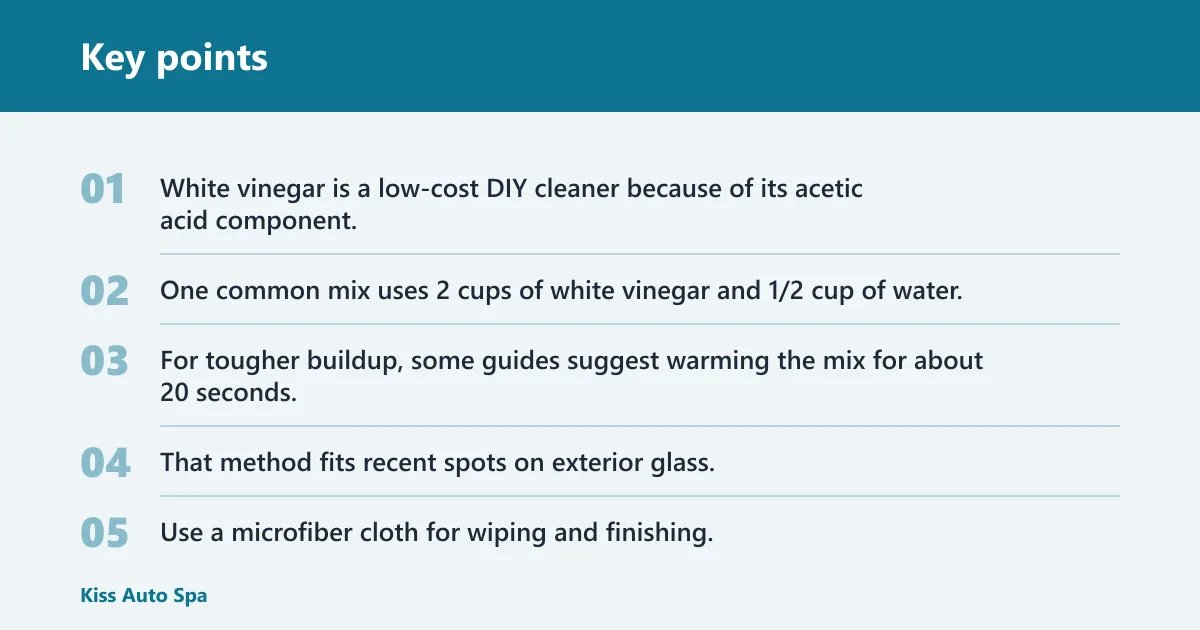
White vinegar is a low-cost DIY cleaner because of its acetic acid component. One common mix uses 2 cups of white vinegar and 1/2 cup of water, then the solution sits for a couple of minutes before scrubbing. For tougher buildup, some guides suggest warming the mix for about 20 seconds.
That method fits recent spots on exterior glass, especially side windows and windshield glass where the deposit is still superficial. Use a microfiber cloth for wiping and finishing, and a soft-bristled brush if a gentle pass is needed to loosen residue.
Baked-on spots on windshield glass
Once spots have been baked by heat and repeated drying, vinegar may still soften them, but it often needs multiple applications and careful wiping. On windshield glass, the problem is not only appearance. The residue can sit in the driver’s sight line or along wiper tracks and keep reappearing after rain.
Dedicated removers are better suited here because they are formulated for automotive glass and can include mild abrasives or polishing agents. That does not mean “more aggressive is always better.” It means the product is built for a harder job than pantry vinegar can usually finish.
When residue is no longer removable buildup
If the mark looks dull, cloudy, or permanently frosted even after cleaning, the glass may be etched rather than simply dirty. At that point, neither vinegar nor a spot remover is a guaranteed cure. More polishing may be needed, and some damage will not fully clear.
That is the point to stop scrubbing harder. More pressure can add swirl marks or push the problem into the coating, seal, or tint edge instead of removing the spot.
Water spot comparison table
The least aggressive option that still has a real chance of working is usually the safest one. That simple step-up rule keeps you from jumping straight to polishing when a mild acid wipe might solve the problem, but it also keeps you from repeating vinegar until the glass is tired and streaky.
| Situation | Start with vinegar | Move to a dedicated remover | Stop and use polish or professional help |
|---|---|---|---|
| Fresh haze after recent water spotting | Yes, after a patch test | Only if one full pass fails | No |
| Old white spots that survive wiping | Only as a quick first try | Yes, if residue remains after one attempt | Maybe, if clouding looks etched |
| Visible tint edge, coating, or seal near the spot | Use caution and a small test area | Preferred if the label allows coated glass | Yes, if compatibility is unclear or damage appears |
| Hard, baked-on mineral ring | Unlikely to finish the job | Start here | Yes, if the mark appears etched |
Why the table resolves this way
Vinegar wins only when the deposit is light and recent. A dedicated remover wins when the job needs more chemical strength or a light polishing action. If the spot is actually etched glass, neither one is the true fix, and more abrasion is the wrong direction.
Will vinegar damage car glass or window tint?
Vinegar will not usually harm bare car glass when used carefully, but it is not a universal safe choice for every surface around the window. Patch testing matters because aftermarket tint, coated glass, seals, and trim can react differently than plain glass. Stronger is not better if the finish is unknown.
Why patch testing matters
A small test spot near an edge tells you more than a general promise. If the area turns hazy, leaves residue, or changes sheen, stop there. That warning matters near tint film edges, where liquid can creep under the edge if the cloth is too wet.
Ventilation and gloves are sensible basic safety steps for either product. Rinse after treatment and dry the glass so leftover acid or dissolved minerals do not sit and streak again.
Where vinegar is riskier than a labeled glass product
Some dedicated removers carry surface-compatibility warnings that are specific to automotive glass, and that matters. Vinegar is a household cleaner first, not a product labeled for every coating and film combination. If the car has rain-repellent glass treatment, aftermarket tint, or unknown trim material, the label on a specialty product may provide clearer limits.
That does not make vinegar bad. It means vinegar has a narrower comfort zone than many readers assume, especially on newer glass treatments.
How a dedicated remover differs
A dedicated glass water spot remover is made to attack hard water minerals on car windows and windshield glass. Many formulas use mild abrasives or polishing agents, and some glass care products include cerium oxide for stubborn residue or old marks. Those agents are meant to work on glass, not on every surrounding surface.
What the formulas are meant to dissolve
These products are usually aimed at mineral deposits that have stuck through normal washing. They are not meant for tar, paint overspray, or oily film alone. That matters because the failure mode changes: if the spot is not mineral buildup, even a good remover may seem weak.
Why some need rubbing or polishing
Many removers still need contact time, hand pressure, or a polishing motion. That is normal. Dwell time matters, but the product should not dry on the glass. If it dries out before wiping, residue can streak and leave another round of cleanup.
Soft-bristled brush agitation can help on stubborn spots without the scratch risk of harsh pads. Finish with a microfiber cloth, then rinse and dry the panel so the dissolved minerals do not dry back into place.
How to choose by spot severity
Light haze, recent sprinklers, and a single round of spotting point toward vinegar first. Older buildup, repeated spotting, and cloudy glass point toward a dedicated remover. If the glass stays cloudy after a sensible attempt, the problem may have moved from deposit to damage.
Fresh spots and light haze
Choose vinegar if the glass still looks mostly clear and the marks are recent. Mix it with water, apply it with a microfiber cloth, let it sit for a couple of minutes, then wipe and dry. If the spot lightens but does not vanish, one more careful pass is reasonable.
Older deposits with visible etching
Choose a dedicated remover if the spot has a chalky edge, sits in wiper tracks, or survives the vinegar pass. For old buildup, cerium oxide polish may appear in some glass-care products, but that is a polishing step, not a first-line mineral cleaner. Use it only when the label calls for that kind of work.
When to stop and avoid more abrasion
If the area becomes clearer but still shows a dull outline, stop before chasing perfection with harder rubbing. That dull outline can be etching, and more scrubbing will not restore missing glass. At that point, polish or professional help is the better path.
Choose Glass water spot remover if… / Choose vinegar for car windows if…
Glass water spot remover is the better pick if the spots are old, thick, or still there after one vinegar attempt. It is also the safer choice when the glass has a label-specific coating warning, when the marks sit in wiper tracks, or when you need a product made for automotive glass rather than a pantry cleaner.
vinegar for car windows is the better pick if the spots are fresh, light, and clearly mineral-based. It is also the right first move when you want the lowest-cost test for recent haze, as long as you patch test first and keep it off questionable tint edges and unknown coatings.
Frequently asked questions
Is a glass water spot remover better than vinegar for car windows?
Yes, when the spots are old, heavy, or still visible after one careful vinegar pass. Vinegar is good for light mineral haze, but a dedicated remover is often the better choice for stubborn buildup on exterior glass.
What works better on hard water spots: vinegar or a dedicated remover?
For light spots, vinegar often does the job with less cost and less complexity. For hard, baked-on mineral deposits, a dedicated remover usually works better because it is formulated for automotive glass and may include mild abrasives or polishing agents for stubborn residue.
Can I use vinegar on a windshield with baked-on water spots?
You can try it, but do not expect vinegar to finish every baked-on spot. A warmed vinegar mix may help loosen the residue, yet long-standing deposits often need a dedicated remover or polishing step. If the mark still looks etched after cleaning, stop there.
Do I need to polish glass after using a water spot remover?
Not always. Many spots clear with the remover alone, followed by rinsing and drying. Polish only if the product label calls for it, the mark is old enough to need extra work, or the glass still shows a dull outline that looks more like etching than residue.
How do I know if my water spots are mineral deposits or something else?
Mineral spots usually look whitish, chalky, or hazy and come from water that dried on the glass. If the mark wipes away with an acid cleaner, it was likely deposit buildup. If it stays dull or clear but textured, the glass may be etched or coated with another residue.