Waterless Wash and Wax vs Waterless Wash Without Wax
Choose waterless wash and wax if you want one-step cleaning plus a thin protective finish; choose waterless wash without wax if you plan to apply your own sealant, coating, or topper afterward. Pick the wrong one and you can leave residue, weaken later bonding, or waste time repeating work. This guide compares both formulas by use case, finish, and layering.
| Factor | Waterless wash and wax | waterless wash without wax | Winner |
|---|---|---|---|
| Job to be done | Clean and leave a wax-like finish in one pass | Clean first, leave the surface ready for a separate protection step | Depends on the goal |
| Residue and follow-up layering | Can leave more residue on some paints or trims | Usually the cleaner base for sealant, coating, or detail spray | waterless wash without wax |
| Finish look | Typically leaves a glossier finish | Leaves a cleaner, more bare surface | Waterless wash and wax |
| Best fit for quick maintenance | Good when you want one step and a finished look | Better when you want to clean now and protect later | Depends on the goal |
| Matte paint caution | Needs more label checking because gloss additives can leave visible trace on some matte finishes | Often the safer starting point, but only if the label allows matte use | waterless wash without wax |
| Cost per wash | Usually costs more per use when the bottle is smaller or priced higher | Can be cheaper per wash if the bottle size and price favor it | Depends on product size and price |
Understanding finish and residue differences
Waterless wash and wax combines cleaning with a wax-like layer that is typically provided by lubricants and synthetic polymers. waterless wash without wax is made to clean only, so it leaves less behind and gives you a cleaner base for later protection. Both are generally intended for light to medium contamination, not heavy mud or packed grit.
Synthetic polymers and finish
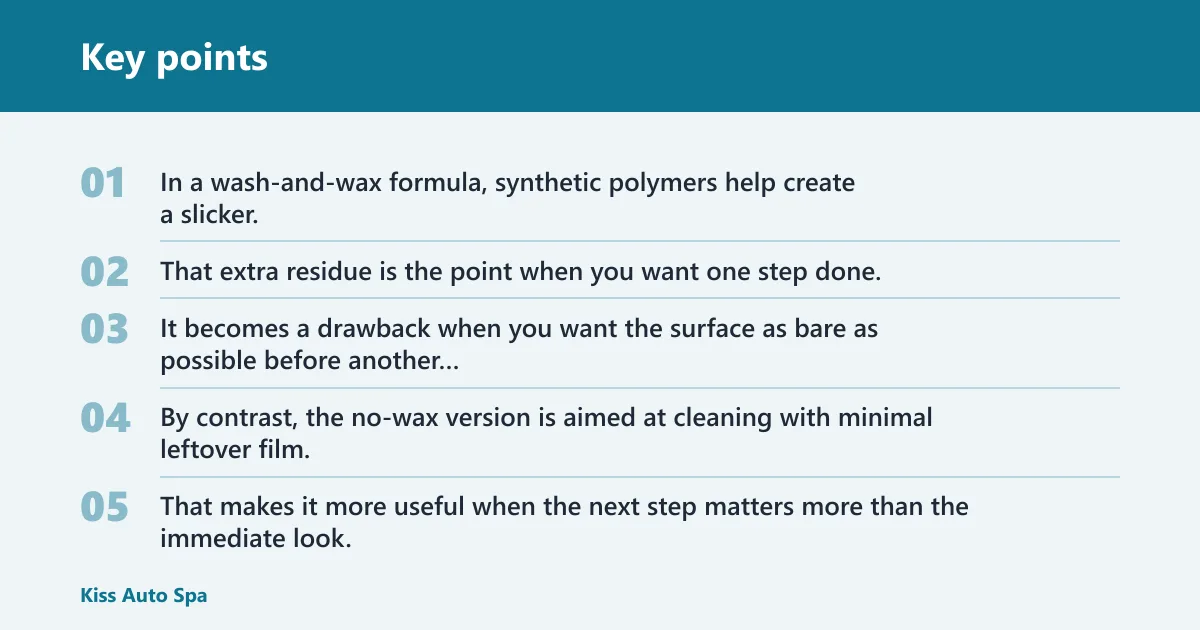
In a wash-and-wax formula, synthetic polymers help create a slicker, glossier finish and add some water and dirt repellency. That extra residue is the point when you want one step done. It becomes a drawback when you want the surface as bare as possible before another product.
By contrast, the no-wax version is aimed at cleaning with minimal leftover film. That makes it more useful when the next step matters more than the immediate look.
Residue, streaking, and wipe-off
Residue risk is not the same across all labels, but waxed formulas are more likely to smear or streak on sensitive surfaces if you overload the towel or let product dry too long. Multiple clean, dry microfiber towels matter here: one for the first wipe, another for leveling, and a final towel for buffing if the label calls for it.
Suppose you wipe a dark hood with one damp towel and keep rubbing after the panel starts to haze. The waxed formula can leave a faint film that needs a second pass. With a no-wax cleaner, the same mistake is more likely to leave plain wipe marks than a protective film, which is easier to correct before the next step.
Gloss versus a cleaner surface
Choose gloss only when you want the finish from the product itself. Waterless wash and wax usually leaves a more finished look right away. waterless wash without wax is the better starting point when you plan to add your own sealant, coating, or detail spray afterward.
When should you choose no-wax?
Choose waterless wash without wax when the next step matters more than the immediate shine. It is often the cleaner base for separate protection, and it can reduce residue risk before a sealant, coating, or topper goes on. It also makes sense when you want a maintenance clean without adding another layer to maintain later.
Prep before sealant, coating, or detail spray
If the goal is bonding, the surface should be as free of added wax residue as possible. A no-wax formula is the safer pick before a spray sealant or coating topper because it does not leave the same wax-like layer behind.
This matters most on finishes that show streaks easily or when you are working in thin layers where residue can block even coverage.
Maintenance cleaning with minimal residue
Maintenance cleaning between full washes is a common use for the no-wax side of the category. It removes dust and light film without changing the surface as much, so the next protection step remains your own choice. That is useful when you do not want to build up multiple layers from different products.
Waterless wash decision matrix
This matrix maps common situations to the formula that fits the job best. The caution notes matter because both product types still have the same basic dirt limit: light to medium contamination only.
| Scenario | Better formula | One-line reason | Caution note |
|---|---|---|---|
| Light dust | waterless wash without wax | It clears dust with the least added residue. | Use multiple clean microfiber towels and stop if the panel starts to feel gritty. |
| Road film | Waterless wash and wax | The added lubricants and synthetic polymers help leave a more finished surface after cleaning. | If the film is thick or gritty, pre-rinse first or use a traditional wash. |
| Quick show prep | Waterless wash and wax | It gives the fastest one-step clean-and-finish result. | Check matte pieces and soft trim before using it broadly. |
| Winter garage wipe-down | waterless wash without wax | It removes salt haze and dust without adding another layer that may streak in cold conditions. | Do not use it on packed slush or crusted grit without a pre-rinse. |
| Matte paint maintenance | waterless wash without wax | It is the safer starting point because matte finishes need residue control, not extra gloss assumptions. | Only use a product whose label says it is approved for matte paint. |
| Prep before separate wax or sealant | waterless wash without wax | It leaves the cleanest base for your own protection step. | Do not follow a waxed cleaner with a bonding product unless the label allows it. |
How dirty can the car be?
Both formulas are generally for light to medium contamination only. If the panel has heavy mud, thick grit, caked salt, or chunky winter buildup, stop and pre-rinse instead of dragging debris across the paint. The failure mode is not just a dull finish; it is scratch risk, towel overload, and smearing from a dirty wipe path.
A common first-timer mistake is trying to save time on a wheel arch or lower door that has visible grit. That is the point where a waterless product is the wrong tool, no matter which version you choose.
Why microfiber towels matter
Microfiber towels are not optional here. You need clean, dry towels because the first towel lifts soil, the next one reduces remaining film, and a final dry towel can remove haze or streaks. Reusing a loaded towel increases the chance of marring, especially on black paint and gloss plastics.
Do not fold one towel into a dirty square and keep going. Swap towels early. That one habit matters more than the marketing on the bottle.
How dirty can the car be?
If the surface has only light dust, light road film, or a thin layer of grime, a waterless product is within its safe operating range. If you can feel rough particles, see heavy buildup, or notice mud that would transfer to a microfiber in clumps, the car is too dirty for either formula. The safer move is a pre-rinse or a full wash.
When to stop and pre-rinse
Stop when the dirt is packed, gritty, or layered enough that the towel starts to drag. That is the point where lubricants cannot fully compensate for debris size. The more contamination sitting on the panel, the more the towel has to carry, and the less forgiving the wipe becomes.
Which formula is safer for matte paint, glass, and trim?
waterless wash without wax is often the safer starting point for matte paint, since matte finishes are commonly treated as needing residue-free behavior and do not call for shine-oriented assumptions. Glass and trim depend on the label: some formulas are approved for those surfaces, but waxed products can leave visible film or smear if the finish is sensitive. Always check the bottle before using either formula broadly.
Matte paint and residue control
Matte paint needs caution because any gloss-adding residue can change how the finish looks. Meguiar’s says its Ultimate Waterless Wash & Wax can be used on matte paint, but that is a product-level claim, not a blanket rule for all waxed formulas. Treat each label separately.
Glass and trim caution notes
Glass and exterior trim are common test spots for streaking. Waterless wash and wax can be used on some exterior surfaces, but finish type matters. If a product leaves a film on black trim or soft plastic, switch to the no-wax version or another label-approved cleaner for that part.
Can you use the waxed formula on glass and trim? Sometimes, yes. Should you assume it is safe everywhere? No. That is the kind of assumption that creates haze on glass and a greasy look on trim.
Cost per wash and bottle coverage
Price only makes sense when you compare bottle size and the number of uses the bottle is meant to cover. A larger bottle can still be cheaper per wash if the price per milliliter is lower, and a smaller bottle can win if the label says it covers more cars with less product. Compare both the volume and the stated coverage before deciding.
| Product | Size | Price | Coverage note |
|---|---|---|---|
| MCLAREN Waterless Wash & Wax | 500ml | 488 CZK | Designed to achieve a complete wash and wax in one application |
| Mothers Speed Waterless Wash & Wax | 710 ml | 509 Kč | Waterless wash and wax for cars or motorcycles |
| Meguiar’s Ultimate Waterless Wash & Wax | 768 ml | 599 Kč | One bottle covers 3 to 5 passenger cars on average |
On the data supplied here, the value question is not the same for every product. The same source gives the clearest coverage claim at 3 to 5 passenger cars on average, while the other two listings give size and price without a per-car figure. That means the smarter comparison is cost per wash, not shelf price alone.
Choose Waterless wash and wax if… / Choose waterless wash without wax if…
Choose Waterless wash and wax if you want one-step cleaning with a glossier finish, you are doing quick show prep, or you want a finished look after a light maintenance wash. It also fits when you do not plan to add another protection layer afterward.
Choose waterless wash without wax if you want the cleanest base before a sealant, coating, or detail spray, if the surface is matte and residue control matters, or if you want the lower-risk option for follow-up layering. It is also the better pick when you want maintenance cleaning without extra finish residue.
Say your truck has a thin film of pollen after being parked under a tree overnight. The no-wax formula is usually the better fit if you plan to apply a spray sealant next, because it clears the dust without adding a wax layer that can change how the next product bonds.
Suppose you are cleaning a silver daily driver before a weekend meet and you only want a quick finished look. Waterless wash and wax is the better match because the one-step result matters more than leaving a blank base for later protection.
Frequently asked questions
What’s the difference between waterless wash and wax with wax?
Waterless wash and wax cleans and leaves a thin wax-like layer behind, usually with synthetic polymers that add gloss and some protection. waterless wash without wax cleans without that added layer, so it is better when you want a cleaner surface for another product later. The main trade-off is finish versus layering control.
Is waterless wash and wax better than waterless wash without wax?
Not in every case. Waterless wash and wax is better when you want one-step cleaning and a glossier finish, but waterless wash without wax is better when you need the cleanest base for sealant, coating, or detail spray. The right choice depends on whether the next step is finished look or future bonding.
Will wash and wax leave more residue or streaks than no-wax?
Usually, yes, though the result varies by formula, surface, and towel quality. Waxed products are more likely to leave a visible film or streak on sensitive paint, glass, or trim if you use too much product or keep wiping after the panel starts to haze. No-wax formulas are typically the cleaner base.
Which is safer for matte paint: waterless wash and wax or without wax?
waterless wash without wax is usually safer for matte paint because matte finishes need residue control and should not be treated as if every gloss-adding product is compatible. Some waxed formulas may be labeled for matte paint, but that is a product-specific claim, not a general rule. Always check the label first.
Which product is better for quick maintenance between full washes?
Waterless wash and wax is better when you want a quick maintenance clean plus a finished look in one pass. waterless wash without wax is better when you want to maintain the car now and add protection later with another product. The faster option is not always the cleaner layering option.
Is the no-wax version better if I plan to apply a separate sealant?
Yes. waterless wash without wax is the better prep step before a sealant, coating, or topper because it leaves less residue that can interfere with bonding or even coverage. If the surface has only light dust, that cleaner base is usually worth more than the extra shine from a waxed cleaner.