Can You Use CLR on Car Glass Water Spots Safely?
CLR is a household cleaner that can be risky on car glass, especially around tint, coatings, trim, and seals. This guide explains when CLR is the wrong choice and when a dedicated automotive remover is safer.
CLR on car glass: safe, caution, no-go
Water spots are mineral deposits left by hard water. On car glass, the question is not only whether the spot will come off. It is whether the cleaner will disturb tint, seals, black trim, coatings, or leave residue that creates more cleanup. CLR is a multi-use cleaner that targets mineral deposits on glass, but car glass can include films, coatings, and adjacent materials that change the risk.
Bare glass versus tinted glass
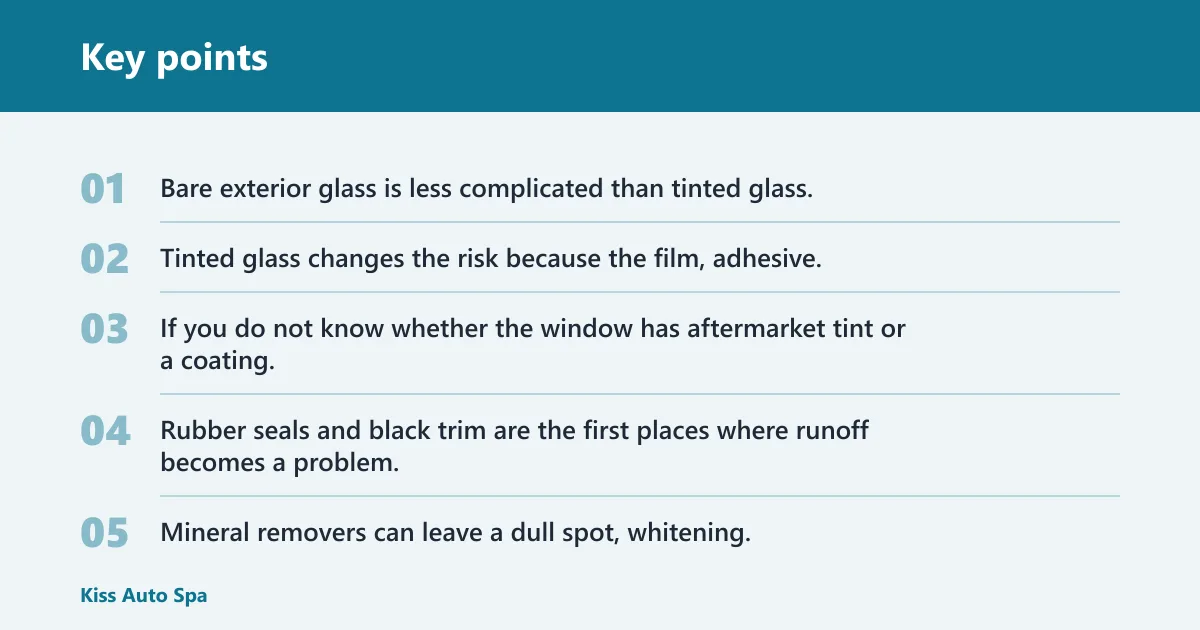
Bare exterior glass is less complicated than tinted glass, but unknown film or coating makes the surface a no-go for CLR. Tinted glass changes the risk because the film, adhesive, and edge seal can react differently than plain glass. If you do not know whether the window has aftermarket tint or a coating, treat it as a no-go for CLR.
Rubber seals and black trim
Rubber seals and black trim are the first places where runoff becomes a problem. Mineral removers can leave a dull spot, whitening, or staining on adjacent materials even when the glass itself looks fine. That is why runoff control matters as much as the spot you are trying to remove.
When spot severity changes the decision
Light spotting on bare glass may justify a careful test spot only if the product label allows glass use. Heavy buildup, old mineral crust, or repeated water marks around the same area often call for a dedicated automotive remover instead. If the spot has likely etched the glass, more chemical cleaning may only waste time and increase the chance of haze.
| surface condition | spot severity | recommended action | dwell-time ceiling | stop signals |
|---|---|---|---|---|
| Bare glass | Light mineral spotting | Test a tiny area first; use only if the label allows glass use and the spot clears without side effects | Follow the product label; do not invent a longer soak | Haze, streaking, residue, softening at the spot edge |
| Bare glass | Heavy buildup or older stains | Prefer a dedicated automotive water-spot remover; consider polish if the stain is etched | Do not extend the contact time to force removal | No visible change after a brief test, or any surface dulling |
| Tinted glass | Any severity | Do not use CLR unless the tint manufacturer explicitly allows it; choose a glass-safe remover labeled for automotive use | Do not assume one | Film lift, haze, edge swelling, tint discoloration |
| Rubber seals | Any severity | Keep CLR off the seal; use a product and method that minimizes runoff | Do not apply directly | Whitening, softening, tackiness, staining |
| Black trim | Any severity | Avoid CLR and use a dedicated automotive remover with controlled application | Do not apply directly | Dull patches, streaking, color change, residue |
Is CLR safe for windshields and side windows?
Windshields and side windows are not all the same, so the answer is conditional. Bare exterior glass can still be unknown if there is a factory coating, aftermarket tint, or edge treatment. If you cannot confirm the window is bare glass, a glass-safe automotive remover is the better choice.
Why automotive glass is not all the same
If you cannot confirm the window is bare glass, treat it as coated or unknown and do not use CLR. A product that removes mineral deposits from plain glass may still be a poor match for the full window assembly. The safer decision is based on the whole surface package, not the word “glass” alone.
Why coatings and aftermarket tint change the risk
Aftermarket tint is especially hard to judge from the outside. If CLR touches the film or the edge adhesive, the first warning may be haze or streaking, and by then the damage may not be temporary. That is why the default should be caution, not an assumption that all car windows behave like household glass.
Suppose a 2-inch hard-water ring sits on the lower corner of a bare rear quarter window, and the surrounding trim is black textured plastic. A dedicated gel or low-drip remover is the cleaner fit, because runoff control matters more there than raw strength.
What to do before you try CLR
Before any application, check the label, confirm the surface is bare glass, and protect nearby trim and seals. Use a tiny test area first only if the label permits glass use. If the product is not labeled for automotive glass use, or if the window has unknown tint or coating, stop there and choose a dedicated glass water-spot remover instead.
Check the label and the glass area
CLR Calcium, Lime & Rust Remover is presented as a multi-use cleaner, not a car-specific one. That means the label is the starting point, not the finish line. If the label does not clearly support the material you are treating, do not treat the surface as approved.
Mask or avoid adjacent trim and seals
Keep the cleaner off black trim, rubber seals, and paint. On vertical glass, even a small amount of runoff can creep into edges and corners. This is one reason gel and thick spray formulas matter: they slow runoff and give you more control near sensitive materials.
Use a small test spot first
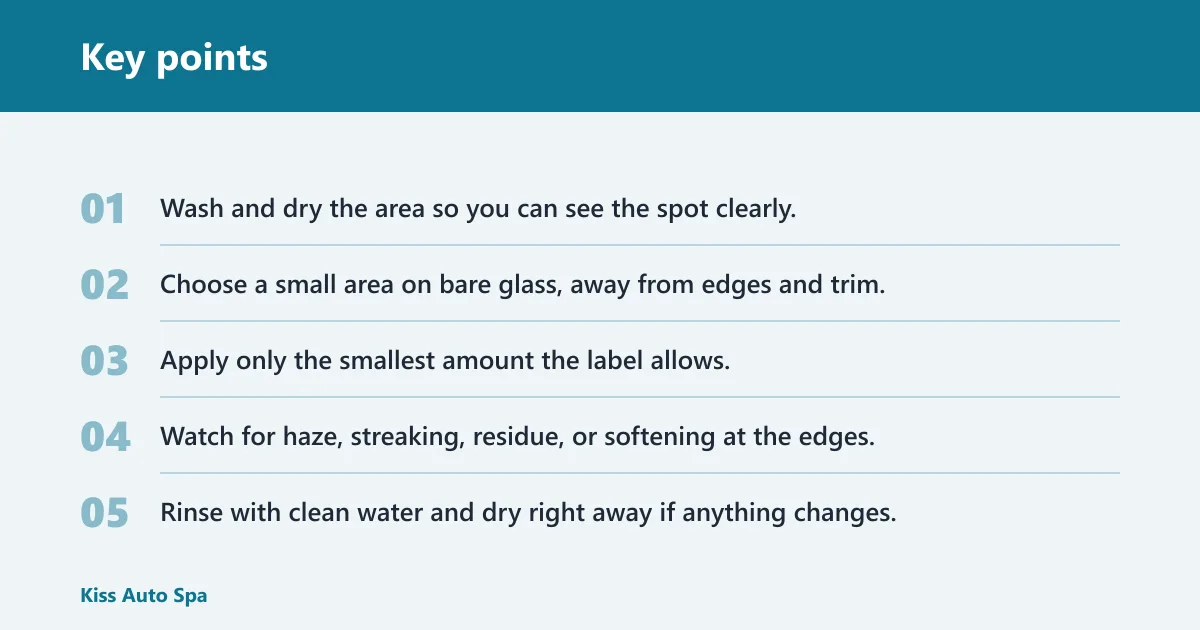
- Wash and dry the area so you can see the spot clearly.
- Choose a small area on bare glass, away from edges and trim.
- Apply only the smallest amount the label allows.
- Watch for haze, streaking, residue, or softening at the edges.
- Rinse with clean water and dry right away if anything changes.
A common mistake is spraying CLR across a sunroof panel to chase a few water spots, even though the surrounding trim and sealant may be sensitive to the cleaner. If the first quarter-sized test leaves a cloudy mark, that is not a “try more” signal. It is a stop signal.
How long should CLR stay on glass?
There is no honest fixed dwell time to give for automotive glass here. The only reliable rule is to follow the product label and stop at the first sign of haze, streaking, residue, or softening around the spot. If a product needs longer contact to work, a dedicated automotive remover is the better route.
Why a fixed dwell time is unsafe to assume
Glass, tint, seal material, trim texture, temperature, and spot age all change how a cleaner behaves. A set dwell time that seems fine on bare glass can be too long on tinted or coated surfaces. That is why any “one-size-fits-all” soak time is a bad idea for car windows.
Stop signals that mean wipe and rinse now
Stop immediately if the surface turns cloudy, if the cleaner starts to streak, if residue stays behind after the first pass, or if the material at the edge looks softened. Those changes can mean more than a temporary cleaning issue. They can mean the surface has already been affected.
What if CLR hazes or streaks the glass?
If CLR hazes or streaks the glass, rinse immediately and dry the area. Do not keep working the same spot. Visible haze or streaking can mean the cleaner is interacting badly with the glass finish, tint, or residue around the spot, and some of that damage may be permanent.
Rinse and neutralize immediately
Use clean water to flush the area well, then dry with a clean microfiber towel. The goal is to remove leftover cleaner, not to polish the haze away on the spot. If the residue remains after rinsing, do not extend the contact time.
When to stop and switch products
If the test spot fails to improve after a brief, label-compliant attempt, switch to a dedicated automotive water-spot remover. Chemical Guys Heavy Duty Water Spot Remover Gel is a gel formula aimed at stubborn mineral stains. That type of control matters near trim.
When etched spots need polishing instead
When mineral spots have etched the glass, more cleaner will not restore the surface. At that point, a glass polish or professional correction is the next step, not repeated chemical cleaning. If the spot still shows after a careful cleaner test, the safer assumption is that you are past the cleaner stage.
Water spot remover decision table
This table helps you choose between CLR, a dedicated automotive remover, and polishing. The main question is not whether the product can dissolve minerals. It is whether the surface around the spot can tolerate the chemistry and runoff.
| Surface condition | Spot severity | Recommended action | Dwell-time ceiling | Stop signals |
|---|---|---|---|---|
| Bare glass | Fresh, light spotting | CLR may be acceptable for a tiny test area if the label allows glass use | Follow the label; no invented soak time | Haze, streaking, residue, edge softening |
| Bare glass | Stubborn mineral film | Use a dedicated automotive remover with better runoff control | Per label only | No improvement after a brief test, or any dulling |
| Tinted glass | Any spotting | Choose a product explicitly approved for automotive glass and tint-safe use; avoid CLR unless confirmed by the tint maker | Do not assume one | Film lift, haze, discoloration, edge reaction |
| Rubber seals | Runoff risk | Use low-drip or wipe-on methods and keep cleaner off the seal | Do not apply directly | Whitening, softness, tackiness, staining |
| Black trim | Runoff risk | Use a controlled automotive remover; avoid CLR | Do not apply directly | Dull patching, streaks, residue, color shift |
| Etched glass | Persistent ring or ghost mark | Move to glass polish or professional correction | Not a cleaner job | Spot remains after cleaning |
Which dedicated removers are safer bets?
Dedicated automotive removers are the safer bet when the surface is mixed, vertical, or uncertain. The best choice depends on whether you need runoff control, a wipe-off method, or a product built for heavy buildup. Choose a formula by surface type, not by the strongest label claims.
Gel and low-drip formulas for vertical glass
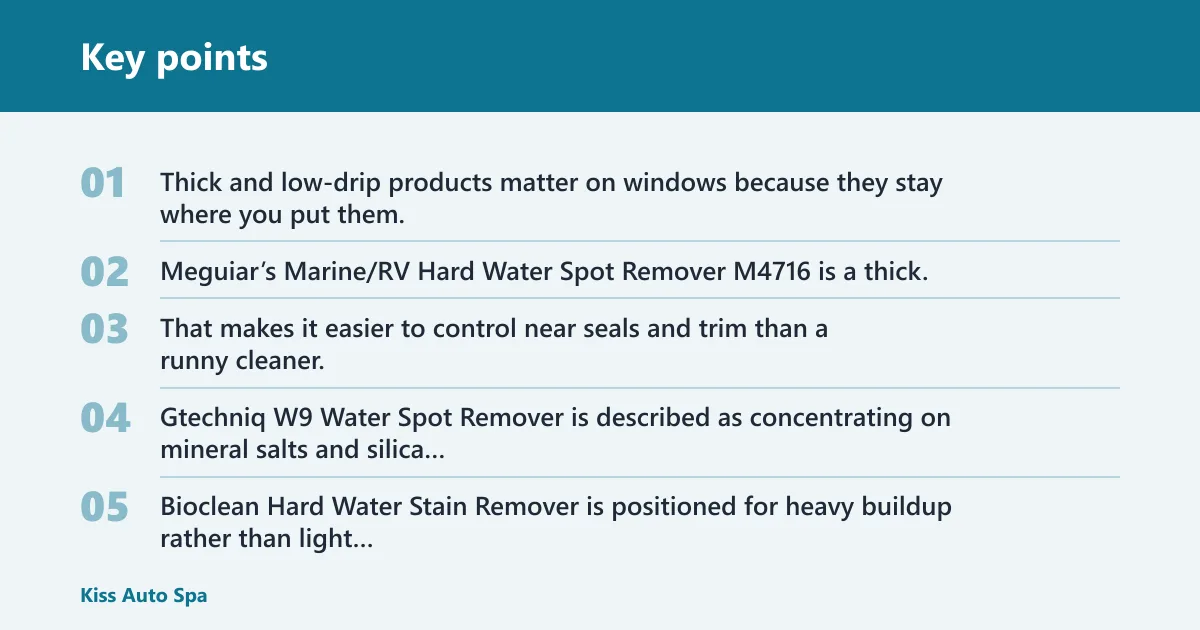
Thick and low-drip products matter on windows because they stay where you put them. Meguiar’s Marine/RV Hard Water Spot Remover M4716 is a thick, low-drip spray for vertical surfaces. That makes it easier to control near seals and trim than a runny cleaner.
How the named products differ by use case
Gtechniq W9 Water Spot Remover is described as concentrating on mineral salts and silica scale, and it is applied with a microfiber cloth, which fits a wipe-off approach when you want control. Bioclean Hard Water Stain Remover is positioned for heavy buildup rather than light spotting.
When a marine or industrial formula makes sense
Marine and industrial labels can make sense when the spots are old, heavy, or spread across large vertical surfaces. They are not a free pass for every windshield or tint stack-up, though. If the glass has a matte finish nearby or an unusual coating, surface type still comes first.
Picture a sedan windshield with chalky arcs across the lower third after repeated sprinkler overspray. A gel or thick spray remover is usually a better first buy than a general cleaner, because it can sit on the glass without running into cowl trim.
Frequently asked questions
Can you use CLR on car glass water spots safely?
Only if the product label allows glass use and the surface is confirmed bare exterior glass. Do not use it on tinted windows, coated glass, rubber seals, or black trim. If the spot hazes, streaks, or leaves residue, stop and switch to a dedicated automotive remover.
Will CLR damage tinted car windows or windshield glass?
It can. Tinted film, edge adhesive, and some coatings may react differently than plain glass, and the first sign may be haze or streaking. Because compatibility is not established here for every film or coating, the cautious answer is to avoid CLR on tinted windows unless the surface maker allows it.
How long should CLR sit on car glass before wiping it off?
Do not assume a fixed dwell time. Follow the product label, use only a tiny test area, and wipe or rinse at the first sign of haze, streaking, residue, or softening. If you need more time than the label supports, a dedicated automotive water-spot remover is the better choice.
What is the safest way to test a water spot remover on car glass?
Wash and dry the area, choose a small spot on bare glass away from edges, and keep the first application tiny. Watch for haze, streaking, residue, or trim reaction. Rinse with clean water and dry right away if the test spot changes in any unwanted way.
Is CLR better than vinegar for hard water spots on car windows?
Not as a general rule. The safer comparison is surface-specific, because tint, coatings, and nearby materials matter more than the ingredient alone. If the window is bare glass and the spot is light, either may still require a careful test. For mixed surfaces, a dedicated automotive remover is the cleaner decision.
When do water spots on car glass need a glass polish instead of a cleaner?
If the spot remains after a careful cleaner test, or if the mark looks like an etched ghost rather than a surface deposit, move to glass polish or professional correction. Cleaners remove mineral residue. They do not reliably remove etching that has already changed the glass surface.