Interior Windshield Cleaning: How to Remove Haze and Film
Clean interior windshield haze by matching the residue first: use about 70% isopropyl alcohol for oily film, an ammonia-free glass cleaner for nicotine or light grime, and a damp microfiber followed by a dry low-pile microfiber in overlapping vertical strokes. Miss the residue type or towel pattern, and you leave streaks, smeared glare at night, and haze that seems to come back overnight. This guide covers diagnosis, safe cleaners for tinted glass, the best towel and hand position for tight corners, and when repeat fogging points to HVAC leaks, off-gassing, or a clogged cabin air filter.
Interior windshield cleaning works better when you treat haze as contamination first and wiping second. The same cloudy patch can come from off-gassed plasticizers, smoke film, trapped moisture, or leftover cleaner. Each one responds to a different liquid, towel, and stop point.
What is interior windshield haze, exactly?
Interior windshield haze is a film on the cabin side of the glass that usually looks oily, cloudy, or smeary rather than gritty. It cuts visibility more than a light dust layer because headlights scatter across the film. Before cleaning, verify which side holds the residue: make one short test wipe on an upper inside corner and check from outside for a clean strip, because exterior spotting at the wiper arc can look similar from the driver’s seat.
How it looks different from exterior spotting
Interior haze usually spreads as a uniform veil or broad wipe marks. It often looks worse at night, in low winter sun, or when the defroster first hits the glass. Exterior contamination, by contrast, tends to show as water spots, bug residue, road film, or mineral specks with sharper edges.
Hard water mineral deposits are usually treated as an exterior issue rather than an interior film problem. Standard interior glass cleaner often will not remove them. Exterior minerals may need clay or a targeted mineral remover instead of more wiping inside the cabin.
Why oily haze is harder on visibility
Light dust blocks a little clarity. Oily film creates glare. That matters most when oncoming headlights hit the windshield at an angle and the inside glass smears the light back toward your eyes.
Interior film can also return quickly in heat. Off-gassed plasticizers released by dash and vinyl trim are a common source, and new vehicles can develop haze from dashboard plastics releasing vapors in heat.
The quick inside-versus-outside swipe test
Use one clean fingertip or a folded microfiber on a small upper corner. Make one short vertical swipe inside the cabin, then inspect from outside. If the clean strip appears, the contamination is on the interior side. If nothing changes, test the same way on the exterior before choosing cleaners.
A common first-timer mistake is scrubbing the inside for ten minutes when the real problem is exterior mineral haze at the wiper arc. The swipe test changes one variable first, so the next step is based on location, not guesswork.
What causes film on the inside of a windshield?
Film on the inside of a windshield usually comes from four sources: off-gassed plasticizers from dash and trim materials, smoke or vape residue, moisture residue from condensation, or cleaner left behind from earlier attempts. Each source leaves a slightly different look, return pattern, and reaction to alcohol or glass cleaner.
Off-gassing from dashboard and trim
Interior film can come from off-gassed plasticizers released by dash and vinyl trim. In warm weather, that vapor settles on cooler glass and leaves an oily layer. This is one reason haze can seem to reappear days after a careful wipe, especially after a hot afternoon.
On cars parked outside, the top half of the windshield often shows this film first because it heats and cools fastest. The film may feel slick on a towel and may smear before it finally lifts.
Smoke, vape residue, and cleaner buildup
Smoke residue and vape film act differently from fresh off-gassing. They cling to the glass and can leave yellow-gray smearing or a tacky drag on the towel. A routine ammonia-free automotive glass cleaner usually handles light grime, while stronger film may need an alcohol pass first and a glass-cleaner finish after.
Leftover cleaner causes its own haze. Common causes are an overloaded towel, a microfiber already carrying old residue, or spraying the glass so heavily that product runs into edges and dries as surfactant lines across the windshield.
Moisture film and HVAC-related fog
Temporary fog from cabin humidity is different from contamination. Moisture appears and clears with airflow and temperature changes. Residue film stays visible after the glass dries, or it leaves clear swipe marks where a towel passed through it.
If the inside fogs very fast in mild weather, check for moisture sources before blaming the glass alone. Wet carpets, a clogged cabin air filter, dirty vents, or HVAC issues can keep depositing residue and moisture together. If the film has a sweet smell or keeps returning with unexplained coolant loss, stop cleaning and inspect for a heater-core or coolant-related problem.
Why hard water usually points outside
Mineral spotting on the inside is uncommon unless the interior glass was previously hit with hard water and left to dry. Most stubborn white spotting is exterior. That distinction matters because an interior alcohol wipe will not fix etched or mineral-loaded outer glass.
Diagnose and stop recurring cabin film
Interior windshield haze often returns within days because the underlying source remains unaddressed. This guide explains how to distinguish between off-gassing plastics, HVAC-borne dust, and cleaner residue using a practical diagnosis table. It then details targeted cleaning techniques for each culprit, including specific handling for smoke and vape residue. fix recurring interior film
Understanding these root causes is essential for maintaining night visibility and reducing glare. The article also outlines climate control adjustments and maintenance intervals to prevent the haze from coming back. By identifying the specific mechanism driving the dirt accumulation, you can stop the cycle of repeated wiping that fails to provide lasting clarity.
What should you use on interior windshield film?
A common setup is an ammonia-free automotive glass cleaner for routine interior glass, isopropyl alcohol for oily film, and two clean microfiber towels, with a waffle-weave towel often kept for final buffing. Reach tools help at the top edge and corners, but only after the residue type is identified and nearby trim is protected.
Cleaner choice by residue type
Use an ammonia-free automotive glass cleaner as the starting point for normal interior windshield film, light smoker residue, fingerprints, and general cabin grime, especially anywhere overspray could touch side-window tint or a visor strip. Ammonia-based cleaners can damage window tint film, so tinted windows should not be cleaned with ammonia-based products. That caution matters at windshield edges too, where tint strips or nearby side glass may be exposed.
Invisible Glass is a widely available automotive glass cleaner option. Stoner says its glass products remove haze, fingerprints, road film, and interior plasticizer buildup. Stoner also describes its formula as ammonia-free and safe on tinted windows. Invisible Glass Cleaner is sold in aerosol form and also sold as a spray, with wipes, kits, and anti-fog products also in the market.
When to use isopropyl alcohol
Isopropyl alcohol is a film-cutting solvent, not the answer for every haze. A 50/50 isopropyl alcohol solution is commonly recommended for cutting interior film, and some guides reference about 70% isopropyl alcohol for oily film. Use it when the haze looks greasy, smears under ordinary glass cleaner, or returns after heat.
Alcohol can also expose failure cases. If the haze becomes sharper but still visible, that often means the oily layer was reduced and cleaner residue remains. Switch back to an automotive glass cleaner for the finishing pass instead of repeating alcohol until the towel drags.
Towel choice matters more than most readers expect
Use a clean, lint-free microfiber towel to apply cleaner and a second dry towel to buff. Glass-specific microfiber or low-pile towels usually leave less lint than plush detailing towels. For the final pass, the guide recommends a dry waffle-weave towel for buffing.
The two-towel method is simple: one towel spreads and lifts residue, the second levels what remains before it dries into streaks. Reusing a damp, loaded towel for the final buff is one of the most common causes of “mystery” haze.
When a reach tool helps
Some windshields are steep enough that hand pressure falls off near the top corners and mirror mount. In those cases, a low-profile reach-and-clean tool helps keep straight pressure without smearing the center of the glass with your forearm.
One competitor lists a 19-inch car windshield cleaner tool. Another competitor lists a 32-inch extendable handle windshield cleaner kit. Short fixed tools suit shallow dashboards; longer extendable tools help deep dashboard lips, vans, and steep rakes. Wrap the head with a clean glass towel rather than the generic pad if streak control matters.
How to clear different kinds of interior film
If the inside of your windshield keeps looking cloudy after cleaning, the next step is to identify what kind of film you’re dealing with. The supporting guide on interior windshield film removal explains how to tell oily haze, sticky residue, and mineral spots apart, then match each one to the right cleaner or solvent-safe method. That matters because the wrong approach can leave streaks, spread residue, or make the glass look dirty again by morning.
It also gives a practical order of attack so you can stop guessing, switch methods when one pass smears, and finish with clearer glass and less glare at night.
Before you wipe the glass
Clean vents, dash top, and windshield base first
Dust from defroster vents can blow straight back onto fresh glass. Wipe the dash top, vacuum the windshield base, and clean the vent slats before touching the windshield. If that step is skipped, repeat haze may be dust plus cleaner residue rather than a failed glass product.
Cool the glass and move out of direct sun
Hot glass flashes cleaners too fast and leaves more marks behind. Work in shade or wait until the glass is cool enough that the product stays wet for a few seconds. That gives the towel time to lift residue instead of dragging it into a larger smear.
Protect tint, trim, screens, and camera housings
Spray cleaner onto the cloth, not directly onto the glass. That controls overspray around dashboards, electronics, trim, mirror mounts, and camera or sensor housings near the windshield. It also reduces the chance of cleaner running into seams where it later streaks back out.
Suppose your windshield has a camera housing behind the mirror and a deep dashboard lip below. Spraying the glass directly can force liquid into the upper seam and across the dash grain. Spraying the towel first keeps moisture where the residue is and nowhere else.
How do you remove haze from the inside of a windshield?
Remove interior windshield haze by matching the cleaner to the film, using one damp towel and one dry towel, and wiping in straight overlapping passes. For oily haze, start with isopropyl alcohol; for smoke film or light grime, start with ammonia-free glass cleaner. Stop once the glass is clear and dry, not after repeated polishing.
Step-by-step cleaning sequence
- Confirm the haze is on the inside with a quick swipe test.
- Clean defroster vents, the dash top, and the windshield base.
- Move the vehicle into shade or wait for cool glass.
- Choose the cleaner: ammonia-free glass cleaner for routine film, or isopropyl alcohol for oily residue.
- Spray the product onto a folded microfiber towel, not onto the windshield.
- Wipe the inside in straight, overlapping vertical passes.
- Immediately follow with a second dry towel to level and buff.
- Inspect from outside the vehicle and under angled light.
- If haze remains, identify whether it matches the same residue or a different leftover layer before repeating.
Use controlled motion, not broad circles
One method uses vertical strokes inside and horizontal strokes outside. This matters because the wipe direction tells you where the remaining streak sits. If the line runs vertically, the residue is inside. If it runs horizontally, the residue is outside.
Straight overlapping passes are easier to read than circles. Circles can redistribute residue in every direction and make the final inspection harder, especially around the mirror mount and top corners.
Finish with a dry buff
After the wet pass, make a final buff with a dry waffle-weave towel. This is where streaks usually disappear or reveal their real cause. If the towel glides and the haze vanishes, the residue matched the cleaner. If it drags or leaves long translucent lines, the cleaner likely mismatched the film or too much product was used.
How to clear interior fog fast and keep it from returning
If the inside of your windshield fogs up, the quickest fix is to use the car’s defroster correctly: turn heat to high, switch to outside air, and keep A/C on so the cabin air dries out. The supporting article on interior windshield defogging breaks down that emergency sequence step by step, along with the common mistake of leaving recirculation on.
It also explains why glass fogs from the inside, how to dry the windshield surface, and what to change so the problem doesn’t come back. That matters because repeated fogging can cut visibility quickly in traffic, rain, or cold weather.
How do you clean the interior windshield without streaks?
Clean the interior windshield without streaks by reducing variables: use the right cleaner, a lightly damp towel, a second dry towel, and straight overlapping passes on cool glass. Most streaking is not from weak wiping, it comes from residue mismatch, excess liquid, dirty towels, or edges that were left dirty and bleed back.
Why streaks usually mean residue mismatch
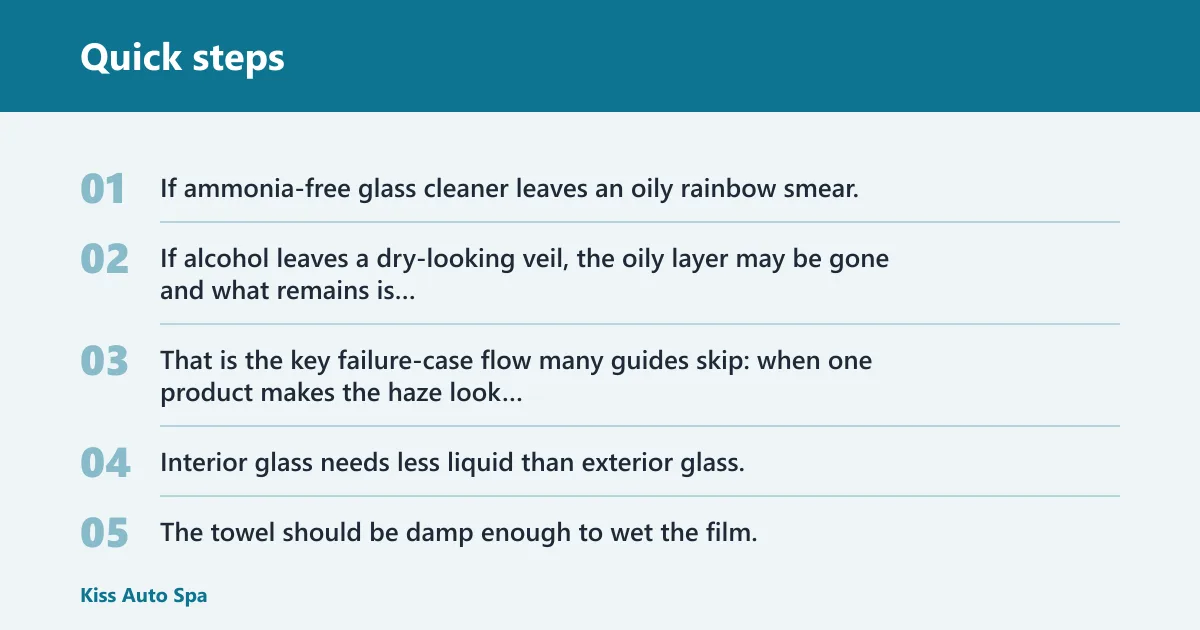
If ammonia-free glass cleaner leaves an oily rainbow smear, the film is often off-gassing residue and needs alcohol first. If alcohol leaves a dry-looking veil, the oily layer may be gone and what remains is cleaner residue or smoke film that needs a proper glass-cleaner finish.
That is the key failure-case flow many guides skip: when one product makes the haze look worse, it may be revealing the next layer rather than failing outright.
How much product is enough?
Interior glass needs less liquid than exterior glass. The towel should be damp enough to wet the film, not soaked enough to drip from the lower edge or mirror seam. Excess liquid spreads contamination to clean sections and increases the chance of overspray on interior surfaces.
Mirror mount, top corners, and dashboard lip
Fold the towel into a firm pad for the top edge and use the back of your fingers to maintain pressure near the headliner. At the mirror mount, work from the housing outward so loosened residue does not get trapped at the seam. For deep dashboard lips and top corners, a reach tool keeps the towel face flat.
Picture a compact crossover with a steep windshield and only two inches of clearance between dash and glass at the base. A bare hand often loses angle there, so the lower strip gets missed and haze reappears in the same band the next morning. A flat reach tool solves the access problem, not the cleaner problem.
What to do if the last pass still smears
Stop after one correction cycle and inspect. If glass cleaner smeared, switch to alcohol for oily film. If alcohol smeared, switch back to ammonia-free glass cleaner and a fresh dry towel. If both smear in the same area, check for loaded towels, residue at the edges, or an exterior spot being mistaken for interior haze.
How do you clean hard-to-reach inside windshield glass?
When the upper corners, lower edge, or deep cowl area are hard to reach, the right tool matters more than extra pressure. The supporting guide explains how a pivoting microfiber windshield tool, a slim wedge head, or an extendable handle solves different access problems on interior glass. It helps you match the tool shape to your windshield geometry so you can reach tight spots without leaving haze, streaks, or glare behind.
If your cleanup keeps failing in the same areas, the problem is often access, not technique. See the interior windshield cleaning tool guide for a practical breakdown of what works best for open dashboards, deep gaps, and stubborn corners.
Windshield haze decision table
| Symptom | Likely cause | Best cleaner | What not to use | Follow-up step | When to stop and inspect for a vehicle problem |
|---|---|---|---|---|---|
| Oily, broad smear that gets worse in heat and glows at night | Off-gassed plasticizer film from dash or trim | 70% isopropyl alcohol or a 50/50 isopropyl alcohol solution on a clean microfiber, then dry waffle-weave buff | Heavy direct spraying, dirty plush towels, ammonia near tint | Finish with ammonia-free automotive glass cleaner if alcohol leaves a slight veil | If the film returns very fast after every hot day despite clean vents and edges |
| Sticky gray-yellow haze with drag on the towel | Smoke or vape residue | Ammonia-free automotive glass cleaner on microfiber, followed by a dry towel | Household ammonia cleaner on tinted windows, oily dressings on nearby dash | Repeat once with fresh towels; clean vents and cabin surfaces that can re-deposit film | If odor, residue, and fog return from vents within days |
| Cloudy patch that appears with humidity and clears with airflow | Temporary moisture fog or condensation residue | Damp microfiber for residue, then dry waffle-weave towel; use HVAC to dry cabin air | Repeated alcohol passes on plain moisture, soaking seams near electronics | Defog with A/C and fresh-air mode, then clean any remaining residue once dry | If fogging is constant, carpets are damp, or a sweet coolant-like film is suspected |
| Sharp wipe marks after recent cleaning | Cleaner residue or overloaded towel | Ammonia-free glass cleaner lightly applied to towel, then immediate dry buff | More and more product, circular wiping, reused damp towel for final pass | Change towels and rework edges, mirror mount, and top corners | If the same lines seep back from trim seams or camera housing edges |
| White spotting or crusty marks that do not change from inside wiping | Exterior hard water mineral deposits | Address outside glass only with exterior decontamination | Treating it as interior haze, repeated interior alcohol wipes | Wash exterior, then use clay or targeted mineral removal if needed | If spotting appears etched into the outer glass and remains after exterior cleaning |
Why does haze come back after cleaning?
Haze comes back after cleaning when the source was not removed or the wrong residue was treated. Heat can keep pulling plasticizer vapor from interior materials, dirty defroster vents can blow dust back onto clean glass, and leftover product at the edges can reappear as soon as the cabin warms up.
Repeat off-gassing in heat
Some return is normal when interior materials are still releasing vapors. This is common in warm cabins and in newer vehicles. Cleaning removes what settled on the glass, it does not stop the source. Ventilation, sunshades, and periodic light cleaning slow the cycle.
Neglected vents and hidden edges
If haze comes back in a band along the lower windshield or near the top corners, check the vent outlets, windshield base, and trim edges. Dust and residue there can be blown back up during the first defrost cycle after cleaning.
When fast-return fog points to moisture or HVAC issues
If the windshield hazes within days and the pattern appears with cabin humidity, inspect the cabin rather than scrubbing harder. Persistent moisture, clogged filters, wet floor mats, or coolant-film suspicion can all mimic failed cleaning. That is the stop point: diagnose the car, not the towel.
Special cases: tint, cameras, and stubborn residue
Tint-safe cleaning around edges
Ammonia-free products are the safer choice around tinted windows because ammonia-based cleaners can damage tint film. Even if the windshield itself is untinted, overspray can reach the side glass or a tinted visor strip. Spray onto the towel, keep the towel only damp, and avoid flooding edges.
Low-moisture cleaning near cameras and sensors
Near camera housings, rain-sensor areas, and mirror mounts, control moisture first. Do not soak seams. Do not jab stiff tools into the housing edge. Use a lightly damp towel or a reach tool wrapped tightly with microfiber, then dry the area immediately with a second towel.
Tesla and other vehicles with windshield-mounted camera modules deserve the same low-moisture approach. Clean the glass face near the housing, not into it. If residue seems trapped under a plastic cover or sensor shroud, stop and inspect rather than forcing liquid into a sealed area.
When alcohol, glass cleaner, and buffing still fail
If the same patch survives alcohol, ammonia-free glass cleaner, and a proper dry buff, reassess the diagnosis. It may be exterior mineral spotting, etched glass, interior scratching, or residue bleeding from trim. More pressure rarely fixes those cases and can create fresh streaking.
Frequently asked questions
Can I use isopropyl alcohol on interior windshield film?
Yes, when the film looks oily or keeps smearing under ordinary glass cleaner. A 50/50 isopropyl alcohol solution is commonly recommended for interior film, and some guides mention 70% isopropyl alcohol for oily haze. Use it on a towel, not directly on the glass, then finish dry.
How do I defog the inside of my windshield?
Use the HVAC system to dry the cabin air first: run the defroster with A/C engaged and fresh-air mode if available. That clears temporary moisture fog. If a cloudy film remains after the glass dries, clean the residue with a microfiber towel instead of treating it as simple fog.
What tool reaches the top of the inside windshield?
A low-profile reach-and-clean tool helps on steep windshields, deep dashboards, and tight top corners. One listed option is a 19-inch windshield cleaner tool, while another is a 32-inch extendable kit. The best choice depends on cabin depth and whether you need reach at the top edge or lower glass base.
Can I use ammonia-based glass cleaner on tinted windows?
No. Tinted windows should not be cleaned with ammonia-based products because ammonia can damage tint film. Use an ammonia-free automotive glass cleaner instead, especially near windshield edges, visor strips, and side glass where overspray can drift onto tinted surfaces without you noticing it.
Why does my windshield haze come back after cleaning?
Return haze usually means the source is still active: off-gassing from interior plastics, smoke residue in vents, cabin humidity, or cleaner residue left at the edges. If the windshield fogs again within days, inspect vents, towels, and cabin moisture before repeating the same cleaning process.