Foam Cannon for Cars: How to Use and Choose One
Use a foam cannon as a pre-wash tool. Match it to your pressure washer’s GPM and PSI, then choose a milder setup for swirled or soft paint and a stronger rinse for heavy dirt. A poor match wastes soap, leaves grit behind, and can grind dirt into the clear coat. This guide shows how to choose the cannon, mix soap, and use it without adding scratches.
What a foam cannon does
A foam cannon attaches to a pressure washer lance or hose, mixes water, soap, and air at high speeds, and sends that mix through an adjustable nozzle. Spray width and direction control coverage, while the top dial changes foam output from thick to thin.
A foam cannon is a controlled pre-wash tool. It does not wash the car by itself. It loosens and carries off road film before any mitt touches the paint.
Foam cannon vs. foam gun
A foam cannon attaches to a pressure washer hose. A foam gun attaches to a garden hose. That difference matters because the pressure washer drives suction and foam generation, while a foam gun usually makes lighter suds and less cleaning force.
If you want dense foam and stronger pre-rinse action, choose the pressure-washer setup. If you only have a garden hose, a foam gun is the different tool.
What you’ll need
- Pressure washer with hose, lance, and the foam cannon
- Foam-cannon compatible car shampoo or car shampoo labeled paint-safe or pH-balanced
- Wash mitt or microfiber towel for the contact wash
- Two buckets, with one for rinse water and one for wash solution
- Bucket grit guards if you use them
- Clean water supply
- Soft drying towel or drying aid
For a full wash, a foam cannon works best with a bucket follow-up. Chemical Guys recommends a foam cannon plus two buckets, and it advises warm water in the bucket. That keeps the wash stage controlled after the pre-wash loosens debris.
Foam cannon setup matrix
The best setup depends on washer output, soap type, and paint condition. If the foam is too wet, too dry, or too thin, adjust one variable at a time and check again. Hard water can also make foam collapse faster than soft water, so soap choice and dilution matter.
| Washer output | Soap type | Dilution starting point | Spray setting | Use case | Troubleshooting |
|---|---|---|---|---|---|
| 1500+ PSI, moderate to strong flow | Foam-cannon compatible, paint-safe shampoo | Start at 2 oz in the bottle, then top with water | Wide fan, medium foam volume | Maintenance wash on lightly dirty paint | If foam is watery, close the top knob one step and move to a narrower fan. If coverage is weak, check the nozzle orifice and water flow first. |
| At least 1.8 GPM and 1,800+ PSI | Shampoo made for coatings or waxes | Start at 1–2 oz, then adjust by 1 oz | Wide fan, foam volume set toward thick | Ceramic-coated paint or sealed paint | If foam dries fast, reduce dwell time and move the car into shade. If the foam looks airy, add 1 oz of soap and check again. |
| Strong washer output with good flow | Foam-cannon soap for heavy soil | Start at 4 oz, then fill the bottle with water | Wide fan, highest practical foam volume | Heavily dirty vehicle, bug film, winter grime | If coverage is patchy, slow the pass and use a wider fan. If the foam stays thin, verify the washer is not under the minimum flow the cannon expects. |
| Lower-flow machine near the minimum | Foam-cannon compatible shampoo only | Start at 3 oz, then add water | Wide fan first, then narrow only if needed | Light dust on coated, waxed, wrapped, or PPF panels | If foam is weak, the washer may be the limit. A thinner mix can help spray, but it will not fix low flow. |
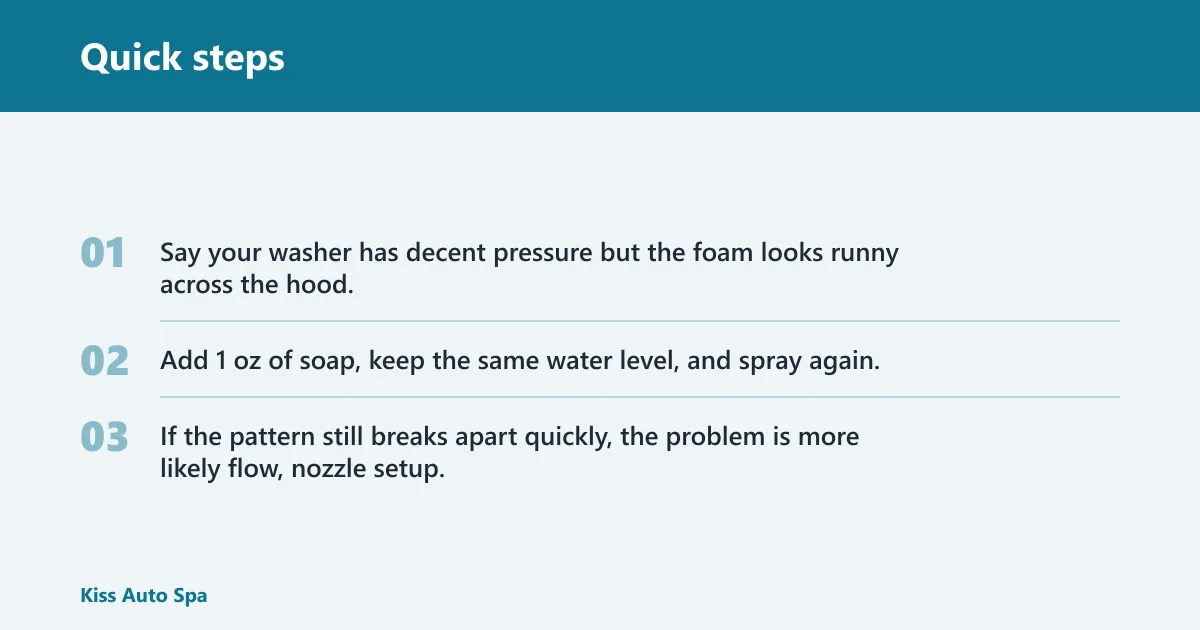
Say your washer has decent pressure but the foam looks runny across the hood. Add 1 oz of soap, keep the same water level, and spray again. If the pattern still breaks apart quickly, the problem is more likely flow, nozzle setup, or water hardness than the bottle mix alone.
How do you choose a foam cannon?
Choose a foam cannon by matching it to your pressure washer output, then check the nozzle adjustment, bottle size, and soap support for your paint condition. PSI matters, but GPM matters too because flow drives how well the cannon pulls soap and air into a dense mix. A good match gives even coverage without wasting soap.
Match the cannon to PSI and GPM
Ethos recommends at least 1.8 GPM and 1,800+ PSI for best results. Jimbo’s recommends a pressure washer with 1500+ PSI for good foam. Those numbers point to the same idea: the cannon needs enough pressure and flow to pull solution properly, not just a high PSI label.
If your machine is low on GPM, foam quality often suffers first. That is when the setup matrix matters more than the bottle brand.
Check the nozzle and bottle details
The adjustable nozzle controls foam thickness and spray pattern. The spray pattern width can be adjusted from narrow to wide, the back of the nozzle changes spray direction from vertical to horizontal, and the top knob controls foam volume from thick to thin.
For car panels, a wide fan usually gives better coverage. Use a narrower setting only when you need more reach on a wheel well or lower rocker area.
Choose soap for the surface condition
Use a foam-cannon compatible shampoo that is paint-safe or pH-balanced. For ceramic-coated, waxed, or sealed paint, choose a shampoo that will not strip the protection you want to keep. For wraps and PPF, stay with a gentle formula and avoid harsh degreasers unless the product label says it is safe for those surfaces.
Soap-to-water dilution matters. Too little concentrate can leave watery foam. Too much can leave residue or waste product without improving cleaning.
How do you use a foam cannon on a car?
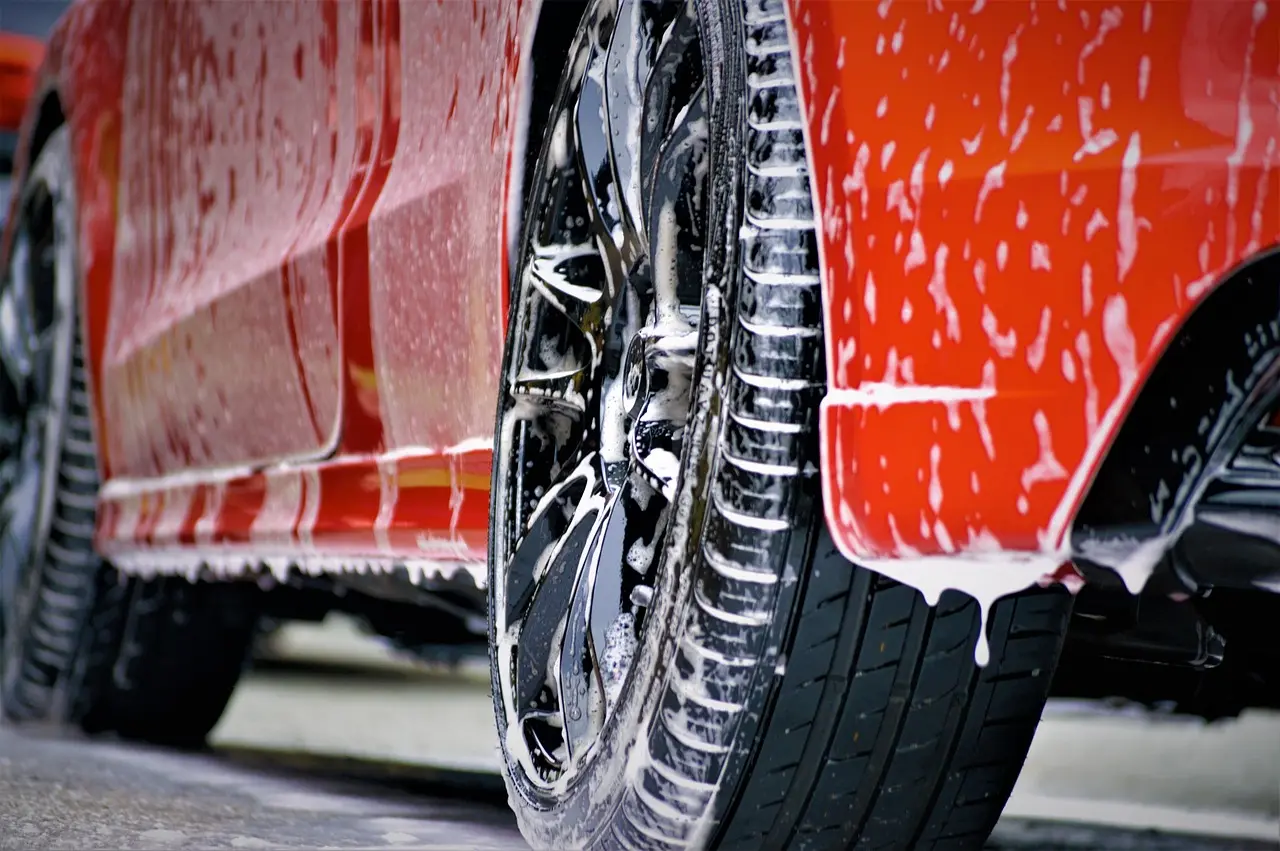
Rinse loose dirt first. Foam the car next, let it sit for a few minutes without drying, then rinse again before any mitt touches the paint. That sequence lowers scratching risk because the foam works on loose grime before contact washing starts.
- Pre-rinse the vehicle from top to bottom.
- Fill the foam cannon bottle with the chosen shampoo and water.
- Set the top knob toward thicker foam, then adjust the fan width to wide.
- Set the nozzle direction for vertical coverage on panels, then change it only if the spray angle needs it.
- Apply foam from the roof down, keeping the panels evenly covered.
- Let the foam sit for a few minutes in shade or on cool panels.
- Rinse the foam off before it dries.
- Do a contact wash with a mitt and two buckets if the car is dirty enough to need one.
The same source says to let foam sit for a few minutes, but not dry. The same source recommends 3–5 minutes of dwell time. Those instructions fit the same rule: stop before the foam starts to dry on the paint. On hot panels or in direct sun, shorten the dwell time or move the car first.
Suppose a black sedan sits in partial shade on a warm afternoon. Foam may look great for the first two minutes, then thin out on the hood edge. That is your cue to rinse early, not to wait for a thicker layer to dry in place.
How much soap should I put in a foam cannon?
Start with the product label, then adjust by small measured amounts. The same source recommends 1–3 ounces of Citrus Wash & Gloss in the foam cannon. Jimbo’s suggests 4 ounces of soap and filling the bottle with water. Those are not universal rules, so the right amount depends on the shampoo, washer output, and the foam you want.
A practical approach is to begin near the lower end for maintenance washing and move up 1 oz at a time if the foam is too thin. Check after each change. That keeps you from wasting soap just to chase thicker suds.
Soap and dilution decision guide
- Lightly dirty, coated paint: start low and use a gentle shampoo.
- Waxed or sealed paint: use a compatible shampoo and avoid harsh cleaners.
- Heavily dirty vehicle: use the stronger starting point and plan a contact wash.
- Hard water: test a slightly richer mix if foam breaks apart fast.
Can a foam cannon replace a bucket wash?
A foam cannon can handle a maintenance wash on a lightly dirty car, but it does not replace contact washing on dirtier vehicles. It lowers friction before the mitt work starts, and that is the main reason it helps. For road film, winter grit, or bug-heavy panels, a two-bucket wash is still the safer finish.
Foam alone is often enough only when the car is already clean, coated, and only lightly dusty. Even then, rinse before foaming and rinse again before deciding whether to touch the paint.
When foam alone is enough
Use foam alone only for easy maintenance, such as a garage-kept car with light dust or a recently washed coated vehicle. In that case, the foam can loosen film and the final rinse may be enough.
When a contact wash is still needed
If the car has visible grit, traffic film, or heavy contamination, add the mitt stage. The same source recommends a foam cannon plus two buckets for a full wash. The foam loosens grime, and the mitt removes what the rinse leaves behind.
Common mistakes
Most foam problems come from a small number of setup errors. Fix those first, before changing products.
- Using the wrong soap. Use a foam-cannon compatible shampoo that is paint-safe or pH-balanced.
- Skipping the pre-rinse. Rinse loose dirt first so the foam works on film, not grit.
- Foaming in direct sun. Move to shade or wait for cooler panels so the foam does not dry early.
- Poor pressure washer match. Check both PSI and GPM, not one number alone.
- Nozzle set too narrow. Open the fan width for panel coverage and adjust the top dial if the foam is too thin.
- Overlong dwell time. Rinse after a few minutes and before the foam dries.
One common first-timer mistake is assuming thicker foam always means better cleaning. A heavy layer on a hot hood can dry faster than a moderate layer in shade, so the better result is the one that stays wet long enough to soften grime and then rinses clean.
Frequently asked questions
How do you use a foam cannon on a car step by step?
Start with a rinse, fill the bottle with foam-cannon soap and water, set the fan wide, and spray from top to bottom. Let the foam sit for a few minutes, then rinse before it dries. If the car is dirty, follow with a two-bucket wash and a wash mitt.
What do I need to use a foam cannon with a pressure washer?
You need a pressure washer, the hose or lance connection the cannon fits, foam-cannon compatible soap, and a rinse setup for the pre-wash and final rinse. If you plan a full wash, add two buckets, a wash mitt, and clean microfiber towels.
What PSI and GPM does a foam cannon need?
For better foam, Ethos recommends at least 1.8 GPM and 1,800+ PSI. Jimbo’s recommends 1500+ PSI for good foam. The practical rule is to match the cannon to both pressure and flow, because GPM affects how well the unit draws soap and air.
How long should foam sit on a car before rinsing?
Plan on a few minutes, then rinse before the foam dries. The same source recommends 3–5 minutes, while Chemical Guys says to let foam sit for a few minutes but not dry. Shorten that time in direct sun, on hot panels, or in dry wind.
What is the difference between a foam cannon and a foam gun?
A foam cannon attaches to a pressure washer hose. A foam gun attaches to a garden hose. The cannon uses pressure washer output to mix water, soap, and air for denser foam and stronger pre-wash action, while the gun is the lighter-duty hose-based option.