Detailing Brushes for Cars: Types, Uses, and Care
Choose detailing brushes by surface: soft flagged synthetic for paint and piano black, medium bristle for emblems and trim, stiff nylon or brass-free specialty brushes for wheels, and replace any brush that sheds, curls, or traps grit. Wrong brush choice can scratch clear coat, haze plastic, and push dirt deeper into seams. This guide covers brush types, where each belongs, how to clean them, and when to retire them.
Detailing brush basics
Detailing brushes fill the gaps towels, mitts, and pads cannot reach. They clean vents, switch gaps, lug recesses, badge edges, and textured trim where dirt hides and cloth fibers leave residue behind.
The cleaner matters, but the brush controls the result. Firmness, fiber type, head size, and handle shape change how much pressure reaches the surface, how much chemical the brush holds, and whether the bristles stay straight after repeated use.
What detailing brushes clean that towels and mitts miss
Use a brush any time the surface has a seam, edge, perforation, recess, or texture. That includes dashboards with vent slats, leather stitching, radiator grilles, wheel bolts, and emblem borders. A towel usually skims over those areas and leaves grime in place.
Brushes also help when a surface is too small or too irregular for a mitt to fit safely. That is why many detailing brush pages list interior work, wheels, engine bays, vents, badges, trims, and delicate surfaces in the same product family.
Why bristle firmness matters on different surfaces
Soft bristles are the starting point for sensitive surfaces. Use them on piano black trim, screens, and other glossy interior parts where visible marring shows fast. Stiffer bristles belong on durable, dirt-heavy surfaces such as wheel faces, engine bay plastics, and exterior grilles.
That split is the central rule. Work Stuff describes soft brushes for interiors and stronger bristles for wheels and engine bays,.
Where brush shape and handle control change results
A brush with a long, slippery handle can pull your hand into the panel. An ergonomic grip, Tri-Grip handle, or balanced handle improves control on long sessions and helps you keep the bristles moving lightly instead of digging in. Control matters more than brute force.
Short heads fit tight gaps. Longer handles help on deeper recesses and wheel barrels. The right shape lets you work straight into a seam instead of bending the head sideways and splaying the fibers.
Detailing brush match matrix
This matrix gives you a surface-by-surface selection system. It pairs bristle type, size, chemical compatibility, and after-care rules so you can choose the safest brush for the job and keep it in shape longer.
| Surface | Safe bristle type | Recommended size range | Chemical compatibility | Scratch risk | Post-use cleaning/storage rule |
|---|---|---|---|---|---|
| Piano black trim | Ultra-soft synthetic, flagged tips | 20 mm, 22 mm, 23 mm | Delicate-surface safe; low-foam APC only if the label allows it | High if pressure is heavy or grit is trapped | Rinse immediately, dry completely, and keep it separate from wheel tools |
| Vents | Soft synthetic or soft hybrid | 16 mm, 20 mm, 22 mm | Interior cleaners and mild APC use | Moderate if the head is too large for the slat gap | Rinse, shape the bristles, and store bristles up |
| Badges | Soft synthetic or natural/hybrid | 16 mm, 22 mm, 24 mm | Mild APC, trim-safe cleaners, and rinseable soaps | Moderate on sharp badge edges and old adhesive lines | Flush residue from the ferrule and dry away from dust |
| Wheels | Stiff synthetic, acid-resistant if needed | 24 mm, 30 mm, 40 mm | Wheel cleaners and acid-resistant products when the label specifies them | Low on durable wheel finishes, higher near soft lacquer or damaged edges | Rinse until runoff is clear, then air-dry fully before storage |
| Engine bay plastics | Stiff synthetic, metal-free | 24 mm, 30 mm, 40 mm | APC use with the product’s listed dilution range | Moderate on aged plastics and brittle clips | Rinse well, shake out water, and store away from solvents |
| Leather seams | Soft synthetic or soft natural/hybrid | 16 mm, 20 mm, 22 mm | Leather-safe cleaners; avoid aggressive APC unless the label approves it | Moderate if the stitching is raised or the seam is dry | Rinse gently, blot dry, and keep the head in shape |
| Screens | Ultra-soft synthetic | 20 mm, 22 mm | Screen-safe interior cleaners only | High if the brush is stiff, dusty, or over-damp | Clean lightly, dry fully, and keep it in a clean interior-only slot |
What are detailing brushes used for?
Detailing brushes are used for narrow, shaped, or textured surfaces that need targeted cleaning. They move cleaner into vents, seams, wheel hardware, and trim edges without flooding the area. The right brush also limits cross-contamination by keeping interior dust away from wheel grit.
Interior cleaning tasks
Inside the cabin, brushes handle vent slats, switch gaps, cupholder ridges, stitching, seat rails, and textured plastics. The same source lists interiors, vents, badges, trims, and delicate surfaces as common use cases. That is the right category for soft bristles and smaller heads.
For piano black trim and screens, use ultra-soft fibers and light contact only. Those surfaces show haze quickly, and a brush with trapped dust can leave marks even if the bristles feel soft in the hand.
Exterior trim and badge work
Exterior badges, emblems, grilles, and sills collect road film and dried wax around edges. Detailing1 notes that brushes reach ventilation grilles, switch gaps, emblems, radiator grilles, wheel bolts, and spokes. Those shapes are exactly where a small brush outperforms a cloth.
For trim and badges, the safest move is usually a soft or medium brush with a manageable head. Keep the pressure low and let cleaner do the work.
Wheel, spoke, and lug-area cleaning
Wheels need firmer brushes because brake dust And heavy grime cling to recessed areas. Detailing1 also offers an acid-resistant wheel and engine brush, which matters when the cleaner chemistry is more aggressive than an interior spray.
Use stiffer synthetic bristles for spokes, wheel bolts, lug pockets, and barrel access. Avoid using the same brush on wheels and cabin plastics. That is how grit gets transferred back to delicate surfaces.
How do you choose the right brush size?
Choose brush size by the gap, opening, or surface width you need to reach. A brush that is too large pushes bristles against surrounding trim and increases scratch risk; a brush that is too small wastes time and carries too little cleaner into the recess.
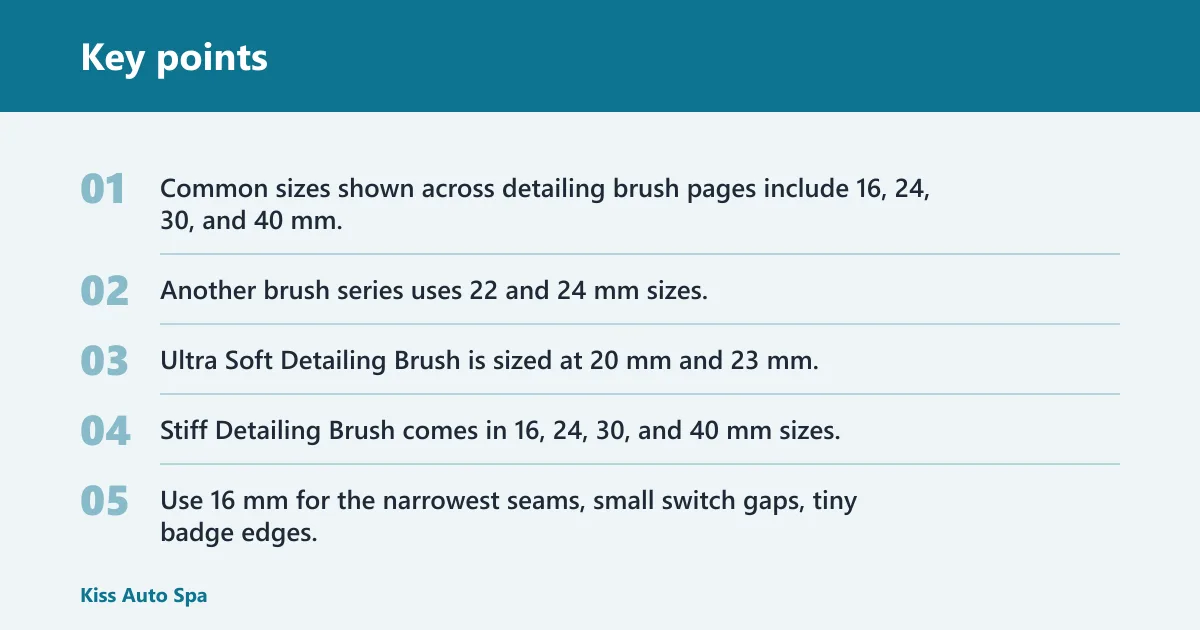
Common sizes shown across detailing brush pages include 16, 24, 30, and 40 mm. Another brush series uses 22 and 24 mm sizes. Ultra Soft Detailing Brush is sized at 20 mm and 23 mm. Stiff Detailing Brush comes in 16, 24, 30, and 40 mm sizes.
16 mm to 24 mm for tight crevices
Use 16 mm for the narrowest seams, small switch gaps, tiny badge edges, and tight wheel hardware. Move up to 20 mm, 22 mm, or 23 mm when the gap is still small but needs a little more fiber spread for even cleaning. The 24 mm size is often the step up for vents, emblems, and compact trim zones.
DetaiIing1 lists interior brush sizes of 16mm, 24mm, and 30mm, which shows how manufacturers often group tight-access tools around those jobs.
30 mm and 40 mm for broader surfaces
Use 30 mm when you need coverage on larger trim sections, wider grilles, or wheel spokes with more open space. Use 40 mm for broad wheel faces, engine bay plastics, and larger exterior shapes where a bigger head helps move cleaner evenly.
Bigger does not mean safer. A 40 mm head on a piano black panel is a poor fit if the fibers touch nearby gloss and carry dust across it.
Sizing for awkward shapes and deep gaps
Some surfaces are narrow but deep, such as grille slats, badge recesses, or wheel bolt tunnels. In those spots, a smaller brush with a longer handle can be better than a larger head with short reach.
Say your wheel has deep lug recesses and a 24 mm brush keeps snagging on the edge. Dropping to 16 mm often gives the bristles room to enter the pocket without bending outward and dragging grit along the paint.
Which bristle type fits each job?
Bristle type should match both surface sensitivity and chemical exposure. Soft and ultra-soft fibers protect delicate finishes. Stiffer synthetic fibers handle grime, repeated rinsing, and stronger cleaners better. Natural and hybrid bristles sit between those poles and can suit mixed tasks.
Soft and ultra-soft fibers for delicate surfaces
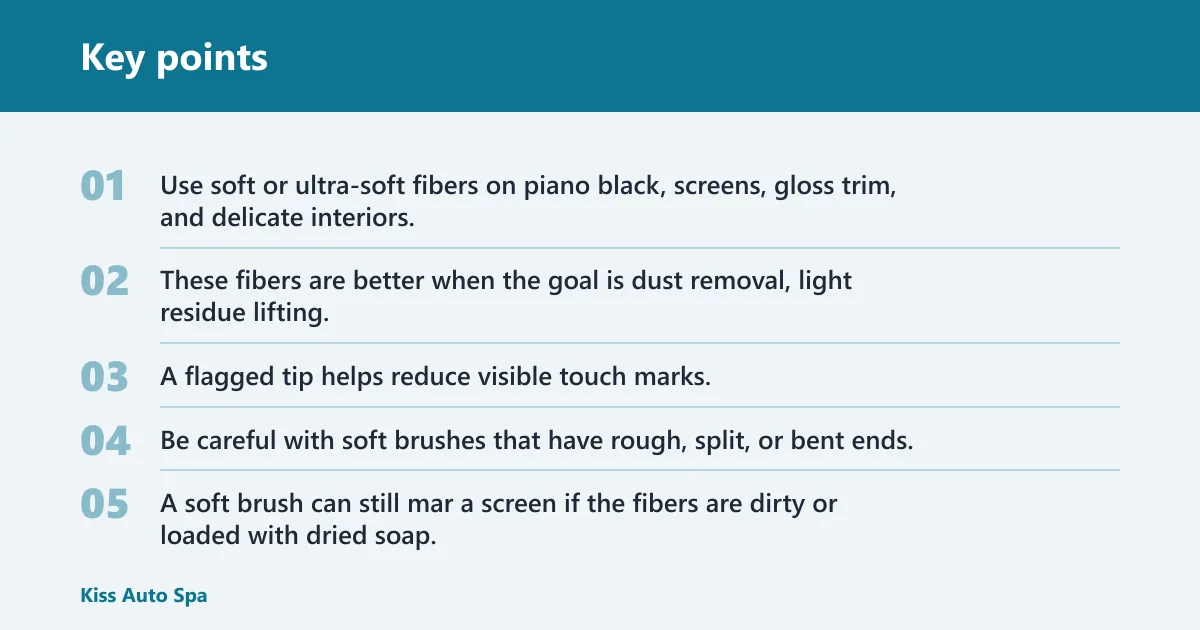
Use soft or ultra-soft fibers on piano black, screens, gloss trim, and delicate interiors. These fibers are better when the goal is dust removal, light residue lifting, or cleaner placement in a small seam. A flagged tip helps reduce visible touch marks.
Be careful with soft brushes that have rough, split, or bent ends. A soft brush can still mar a screen if the fibers are dirty or loaded with dried soap.
Synthetic bristles for chemical resistance and repeat use
Synthetic bristles are the safer default for cleaners with more chemical bite. The same source notes that selection depends on natural or synthetic bristles and chemical exposure. That matters when you use APC, wheel cleaner, or a stronger degreaser on durable surfaces.
Synthetic bristles also hold shape better after repeated rinsing. That is useful for wheel brushes and engine bay tools, where the brush must survive grime, agitation, and frequent cleaning.
Natural and hybrid bristles for mixed jobs
Natural or hybrid bristles can work well on general interior tasks, badge areas, and softer exterior trim when the cleaner is mild. They can feel more flexible on the surface, but they are not automatically better than synthetic. Chemical resistance and drying behavior still matter.
Boar’s hair is often discussed as a premium natural option, but it is not a universal answer. It can be effective on badges and trim, yet it is less practical than synthetic when a cleaner is stronger or the brush needs frequent rinsing and fast turnover.
Boar’s hair vs synthetic: which is better?
Neither is always better. Boar’s hair can be useful for gentle surface contact and fine dust work, while synthetic usually wins on chemical resistance, easier cleaning, and predictable shape retention. For most owners, synthetic is the safer all-rounder for interiors and wheel work.
If you need one brush for many tasks, choose synthetic first. If you are building a careful interior kit, add a soft natural or hybrid brush for light trim cleaning, but keep it away from the dirtiest jobs.
Handle and kit choices
Good handles reduce hand fatigue and help you control the pressure. Good kits reduce the temptation to use one dirty brush everywhere. A brush set should separate delicate tasks from dirty tasks by size, bristle firmness, and storage slot.
Ergonomic grip, Tri-Grip handle, and balanced handle designs
An ergonomic grip gives you steadier finger placement. A Tri-Grip handle adds control when the brush is wet or soapy. A balanced handle spreads the weight so the head does not feel top-heavy during longer sessions.
These details matter most when you are cleaning many vents, badge edges, or wheel spokes in one session. Less hand strain usually means less accidental pressure on the surface.
What belongs in a 3-pack or mixed-size kit
A useful 3-pack should cover one small brush, one mid-size brush, and one larger brush. That gives you access to tight crevices, general trim, and broader surfaces without forcing a single head to do everything.
For a mixed-size kit, look for interior and exterior separation. An interior set should stay on dust, leather seams, vents, and screens. An exterior set should stay on badges, grilles, wheels, and engine bay plastics.
When to buy interior-only, exterior-only, or complete kits
Buy an interior-only kit if your main concern is cabin dust, screens, and trim. Buy an exterior-only kit if you already have safe interior brushes and need dedicated wheel and badge tools. Buy a complete setup if you want separate tools for each zone and fewer storage mistakes.
Soft99 exterior auto detailing brushes are sold in three sizes, which is a good reminder that a kit does not need many pieces to be useful. It needs the right pieces.
How do you clean and store detailing brushes?
Clean brushes right after use so cleaner residue and grit do not harden in the bristles. Dry them completely before storage. Keep the fibers shaped, and separate clean interior brushes from dirty exterior brushes so wheel dust never migrates back to trim or screens.
Rinsing after use and drying fully
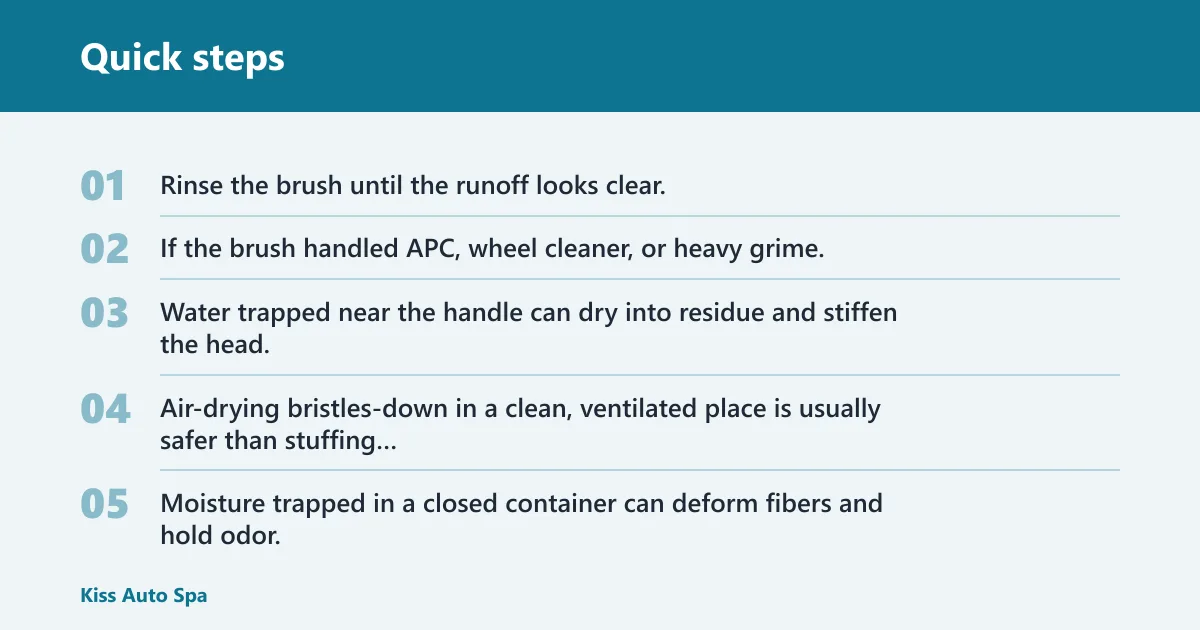
Rinse the brush until the runoff looks clear. If the brush handled APC, wheel cleaner, or heavy grime, rinse the ferrule and base of the fibers too. Water trapped near the handle can dry into residue and stiffen the head.
Then dry the brush fully. Air-drying bristles-down in a clean, ventilated place is usually safer than stuffing them into a closed bag. Moisture trapped in a closed container can deform fibers and hold odor.
Keeping bristles shaped during storage
Do not store a brush crushed under other tools. Flat pressure bends the bristles and reduces cleaning control. Store them so the tips are not compressed and the head can return to its original shape.
A common first-timer mistake is leaving a soft brush leaning on its side after washing. The next time it is used on piano black, the splayed edge contacts more paint than intended and leaves visible haze faster than a shaped head would.
Separating clean interior brushes from dirty exterior brushes
Keep separate groups for interior and exterior use. If a brush has touched brake dust, wheel cleaner, or engine bay grime, do not move it back to screens or leather seams just because it has been rinsed. A clean-looking brush can still carry embedded grit.
Mark them by color, storage slot, or bag. That simple separation prevents cross-contamination and reduces the risk of smearing dirt across glossy trim.
When to retire, reclassify, or replace a brush
Retire a brush when it sheds, curls, or traps grit that will not rinse out. Reclassify it for dirty tasks only if the head is still intact but no longer safe for sensitive surfaces. Replace it when the fibers lose shape, the ferrule loosens, or the brush no longer cleans without extra pressure.
Suppose a 22 mm interior brush starts shedding after repeated APC exposure. Move it out of the cabin kit immediately. If the fibers still hold together, it can become an exterior-only or engine-bay brush, but it should not return to screens or piano black.
What should be in a car detailing brushes kit?
A practical brush kit should cover small, medium, and broad jobs, plus a separate path for delicate surfaces. At minimum, include a small soft brush for seams, a mid-size brush for vents and trim, and a firmer brush for wheels or engine bay plastics.
Look for mixed sizes that map to the work you actually do. A 20 mm or 22 mm soft brush is useful for screens and narrow vents. A 24 mm brush can handle badges and most interior gaps. A 30 mm or 40 mm brush suits wheels, grilles, and larger engine bay plastics.
For many owners, the most useful setup is one interior-only kit, one exterior-only kit, and one dedicated dirty brush that never leaves wheel duty. That system is simple and it prevents expensive mistakes.
Frequently asked questions
What are detailing brushes for cars used for?
They clean small and irregular areas that towels cannot reach well: vents, switch gaps, badges, wheel bolts, spokes, grilles, seams, and textured plastics. The right brush helps place cleaner precisely and keeps dirt from being pushed deeper into edges and recesses.
What’s the difference between soft and stiff detailing brushes?
Soft brushes suit delicate surfaces such as piano black trim, screens, and leather seams because they reduce visible contact marks. Stiff brushes suit wheels, engine bay plastics, and heavy grime because they move contamination more aggressively and hold shape under stronger cleaners.
What size detailing brush do you need for small crevices?
Start with 16 mm for very tight spaces. Move to 20 mm, 22 mm, or 23 mm for small gaps that need a little more reach, and use 24 mm when the opening is slightly wider but still precise. The wrong size can rub surrounding trim.
Can you use detailing brushes on piano black trim safely?
Yes, but only with ultra-soft fibers, very light pressure, and a clean brush that has never touched grit-heavy areas. A dirty or stiff brush can haze the surface quickly. Keep piano black tools separate from wheel and engine bay brushes.
How do you clean car detailing brushes after washing a car?
Rinse them until the runoff is clear, then work any residue out of the base of the bristles with clean water. If they saw stronger chemicals, rinse longer. After that, dry them fully and store them where the fibers are not compressed.
Do drill brushes work for car detailing safely?
Only on tough, non-delicate surfaces where the risk is acceptable. They are not a safe choice for piano black, screens, soft interiors, or thin trim edges. The rotating action is too aggressive for fine control, so hand brushes are the safer default for precision work.