Why Are Microfiber Towels Better for Car Paint Than Cotton?
Microfiber towels are better for car paint because split fibers hold dust and grit inside the towel instead of dragging it across clear coat, which lowers swirl risk far more than cotton. A poor towel choice can leave light scratches, lint, and haze that dull paint and turn a simple wipe into paint correction. This guide explains why microfiber is safer than cotton for drying, wiping, and finishing, and how to choose the right towel for each paint-safe job.
Why microfiber beats cotton on paint
Clear coat is the finish you are trying to protect. It is thin, it marks easily, and it shows swirls when debris rubs across it. A towel for paint care should do two things at once: pull loose grime away from the surface and keep that grime from being pushed into the finish.
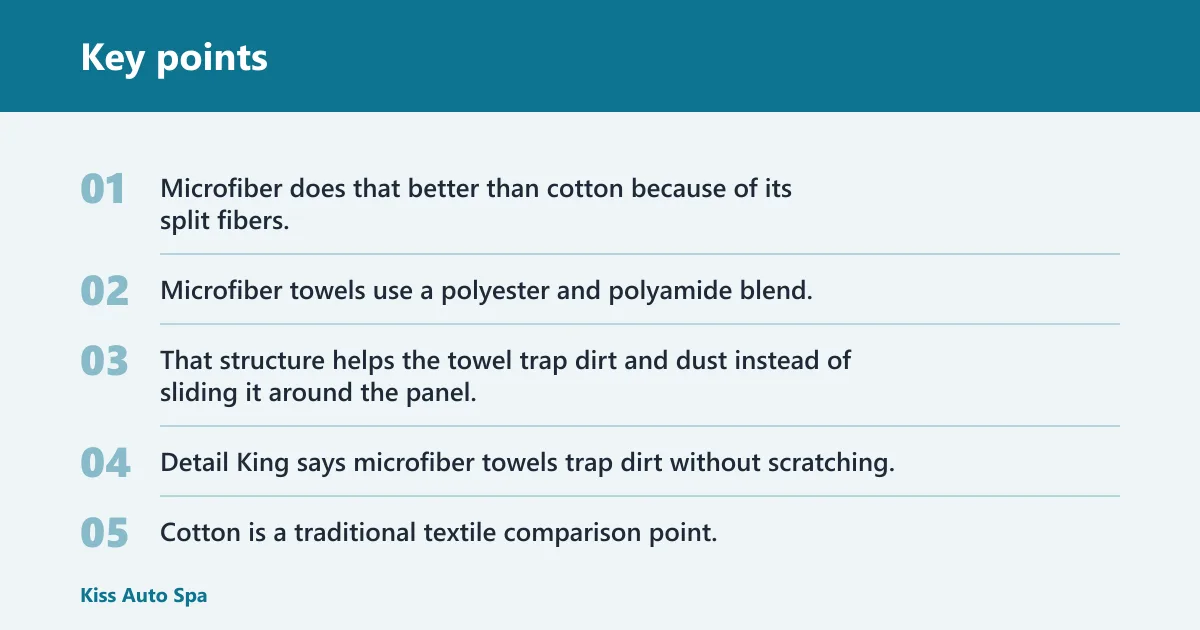
Microfiber does that better than cotton because of its split fibers. Microfiber towels use a polyester and polyamide blend, and those fibers are split and woven tightly. That structure helps the towel trap dirt and dust instead of sliding it around the panel. Detail King says microfiber towels trap dirt without scratching, absorb water efficiently, and distribute waxes and sealants evenly.
Cotton is a traditional textile comparison point, but it is more likely to leave lint behind and is less effective at trapping contaminants. That matters on clear coat, where any gritty particle can act like fine sandpaper. Cotton can have a place in general shop use, but it is not built for paint-safe detailing.
Why split fibers reduce swirl marks
Swirl marks usually come from contamination, pressure, and repeated wiping. Split fibers help because they create more contact points and more space to hold grit away from the surface. Instead of pushing a particle across the panel, a clean microfiber towel can lift it into the nap. That lowers the chance of micro-marring on fresh wax, sealant, or cured paint.
Picture a dusty hood after an overnight sit. A dry cotton towel can drag that dust across the clear coat and leave faint arcs. A clean microfiber towel, used with light pressure, is far less likely to leave that kind of trail.
Paint safety decision table
| Panel condition | Contamination level | Best towel type | GSM range | Risk if wrong towel is used | Recommended first-pass versus final-pass towel |
|---|---|---|---|---|---|
| Heavily dusty paint | High loose grit | Plush microfiber only after a safe rinse or pre-clean | 350-500 | Dragging grit into clear coat and adding swirls | First pass: rinse or blower; final pass: plush microfiber |
| Lightly dusty paint after a wash | Low to moderate | Plush microfiber for final wipe | 300-500 | Lint, haze, or fine marks from a rough towel | First pass: drying towel; final pass: plush microfiber |
| Rinseless wash panel | Moderate, with solution on surface | Plush microfiber or low-pile microfiber depending on residue | 300-500 | Residue dragging or towel saturation | First pass: plush microfiber; final pass: low-pile for residue check |
| Cured sealant or fresh wax | Low | Plush microfiber for removal | 350-500 | Streaking or patchy removal if the towel holds too much product | First pass: plush microfiber; final pass: clean low-pile buff towel |
| Ceramic coating leveling | Very low product load, fresh coating | Low-pile microfiber | 200-300 | High pile can leave residue high spots or over-retain coating | First pass: low-pile leveling towel; final pass: second clean low-pile towel |
| Glass, mirrors, interior trim | Low | Waffle weave or low-pile microfiber | 200-300 | Streaking from a towel that holds too much product | First pass: waffle weave or low-pile; final pass: dry low-pile |
Does microfiber scratch car paint?
Clean microfiber is designed to reduce marring, but no towel is scratch-proof. A dirty, damaged, or poorly washed microfiber towel can still mar paint, especially on black or soft clear coat. The towel’s edge, seam, tags, and contamination level matter as much as the fabric itself.
Microfiber is safe for paint, glass, and interiors when it is clean and in good condition. If the towel has embedded grit, a torn seam, or hard debris from a previous job, it can still leave marks. Low-pile microfiber is often considered safer than plush for coating leveling or light residue removal because it tends to retain less product and is easier to inspect for contamination.
A common first-timer mistake is grabbing one towel for every step. That invites cross-contamination. A towel that touched lower body panels can carry grit to the hood, then to a fresh wax layer, then to glass.
Edge construction and seam risk
Paint-safe towel choice is not only about pile height. Binding, tags, and stitched edges can scratch if they are stiff or exposed. A soft, edgeless, or tightly finished microfiber towel is safer around body lines and tight gaps. If a seam feels hard to the touch, do not use it on clear coat.
Which microfiber towel should you use?
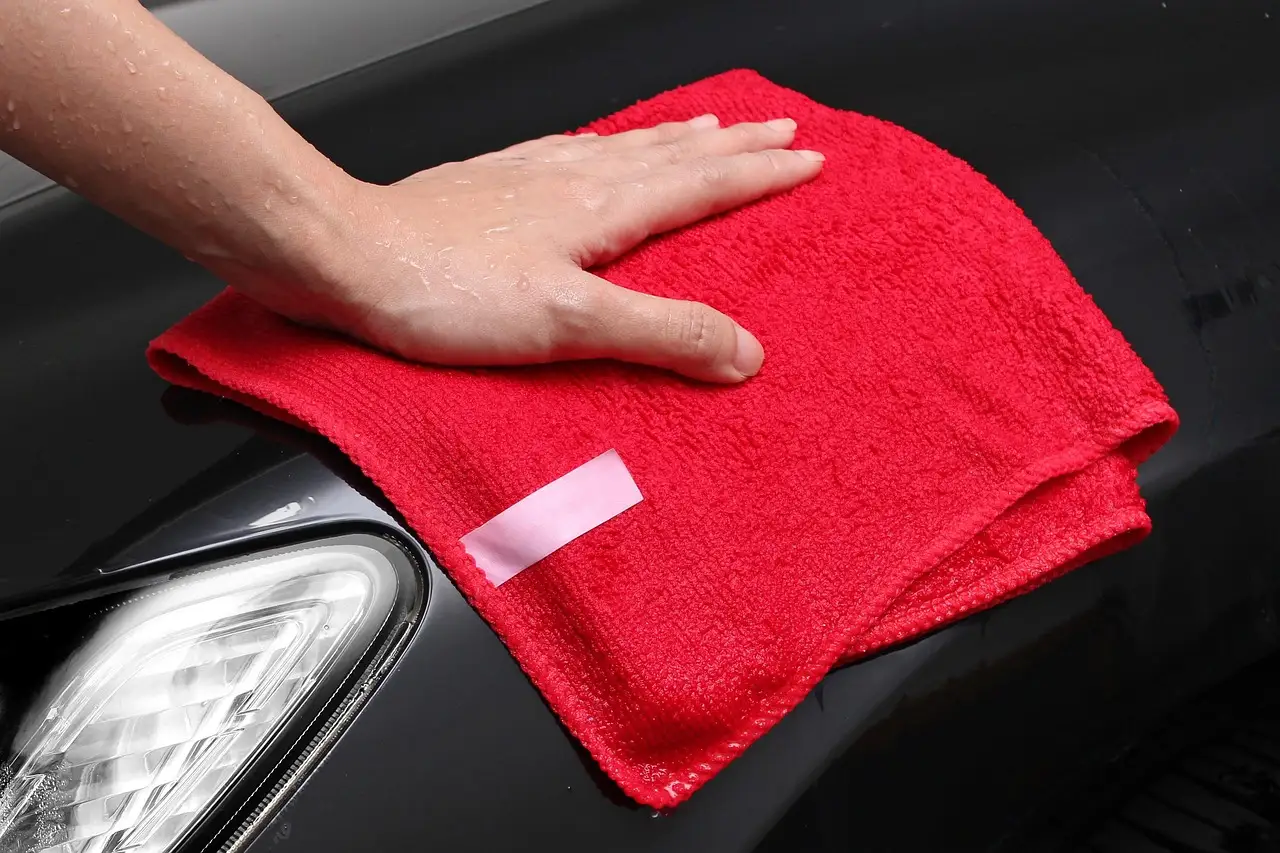
The best microfiber towel depends on the task. Plush towels suit drying and residue removal. Waffle weave towels are useful for glass and mirrors because their texture helps reduce streaking. Low-pile towels are better for interiors and ceramic coating leveling. Twist loop towels absorb a lot of water and are built for exterior drying.
Plush microfiber towel
Plush microfiber has a soft, high-pile surface. It is a good choice for drying, wax removal, polish removal, and general finish wiping. Because it feels fuller, it can hold more residue and help reduce visible marring on delicate paint when the towel is clean.
Twist loop drying towel
A twist loop drying towel has high absorption and is suited for streak-free drying on exterior panels. Its looped construction helps pull water away quickly, which matters after a wash or rinseless rinse. Use it on wet panels, not on dusty dry paint.
Waffle weave towel
A waffle weave towel has a low-lint drying and glass profile. It is often used for windows, mirrors, and final glass wipes because it helps reduce streaking. It is not the first choice for heavy residue removal on sticky wax or thick polish.
Low-pile microfiber towel
Low-pile microfiber is useful for interior cleaning, quick detail sprays, and ceramic coating leveling. It retains less product than plush towels, which makes it easier to manage high spots and to wipe off light films without leaving heavy residue behind.
Say your sedan has a cured sealant and a light layer of road film after a wash. A plush microfiber towel can remove the last traces more gently than a cotton towel, while a second clean low-pile towel can catch any faint streaking before it sets.
What GSM works for each job?
GSM means grams per square meter, a towel density and thickness metric used in detailing. It is not a quality score by itself. Lower GSM towels are lighter and better for cleaning, while higher GSM towels are better for drying and absorbing water. Match GSM to the task and the contamination level.
For glass and interiors, 200 to 300 GSM is a common range because lower pile is easier to control and often leaves less residue. For general paint wiping, 300 to 500 GSM is a practical middle ground. For drying and buffing, 500 GSM and up is commonly used for more absorbency, but very plush towels can hold on to residue if the panel still has contamination.
- 200 to 300 GSM: glass, mirrors, interior plastics, coating leveling.
- 300 to 500 GSM: general paint wiping, wax removal, quick detail work.
- 500 GSM and up: drying, heavy water removal, soft buffing.
How do you wash microfiber safely?
Wash microfiber separately so lint from cotton and other fabrics does not transfer into the towel pile. Detail King advises cold water for light cleaning, warns against fabric softeners and bleach, and advises low heat or air drying. Those steps help keep the fibers open, absorbent, and paint-safe.
- Sort microfiber by task: drying, paint wiping, glass, and interior towels should stay separate.
- Shake out loose dirt before washing so grit does not abrade the fabric.
- Use a mild detergent with no fabric softener or bleach.
- Choose cold water for light cleaning when the towels are not heavily soiled.
- Dry on low heat or air dry to protect the fibers.
- Store clean towels in a closed bin or bag so they do not pick up dust.
The same source says microfiber lasts longer when maintained properly. That is another reason to keep paint towels away from greasy shop rags, bath towels, and any fabric that sheds lint.
Frequently asked questions
Why are microfiber towels better for car paint than cotton?
Microfiber towels are better for car paint because split fibers trap dust and grit instead of dragging it across clear coat. Cotton can shed lint and is less effective at holding contaminants away from the finish, so it is more likely to leave haze or fine marks during paint-safe wiping.
What GSM microfiber towel is best for drying a car?
For drying, 500 GSM and up is a common choice because higher GSM towels are better for absorbing water. Twist loop drying towels fit that job well, and some plush towels also work. On very clean paint, the softest drying towel is usually the one that leaves the least streaking and pressure.
Can I use cotton towels on clear coat?
You can use cotton in some general cleaning tasks, but it is not the best choice for clear coat care. Cotton is more likely to leave lint and does not trap grit as well as microfiber. For wiping paint, microfiber is the safer default because it controls contamination better.
What microfiber towel should I use to remove wax or polish?
A plush microfiber towel is usually the best choice for wax or polish removal because it is soft and holds residue well. If the residue is light or the finish is especially sensitive, a second low-pile microfiber can help with the final pass. Keep the towel clean so it does not smear product back onto the panel.
How do I wash microfiber towels without ruining them?
Wash microfiber separately from cotton and avoid fabric softener and bleach. Use cold water for light cleaning, then dry on low heat or let the towels air dry. Those steps help preserve absorbency, reduce lint transfer, and keep the split fibers open for paint-safe use.
What is the difference between plush, waffle weave, and low-pile microfiber towels?
Plush microfiber has a high, soft nap for drying and residue removal. Waffle weave has a textured grid that works well for glass and mirrors with lower streaking. Low-pile microfiber has a shorter nap, which makes it useful for interiors, ceramic coating leveling, and tasks where less product retention is better.
What towel type is safest for ceramic coating leveling?
Low-pile microfiber is usually the safest choice for ceramic coating leveling because it holds less product than plush towels and lets you inspect the panel more easily. That helps reduce high spots and streaking. Use a fresh, clean towel for the leveling pass, then a second clean towel for the final check.