Why Pet Hair Gets Stuck in Car Upholstery So Badly
Pet hair clings to car upholstery because static charge, fabric weave, and the barbed shaft of each hair lock it into fibers. Tight weaves, looped cloth, and textured carpet hold it worst. Leaving it there wastes time and can leave odor, allergens, and grime packed into seats and seams. This guide explains the mechanical and static reasons behind the bond, which upholstery types trap hair hardest, and which tools fit each surface.
Why pet hair sticks so hard
Dog hair does not sit on upholstery like dust. It slips into weave depth, catches on nap, and gets held by static and friction. On fabric, the top layer may look loose while another layer sits below the surface, already caught in loops and seams.
Static electricity and friction
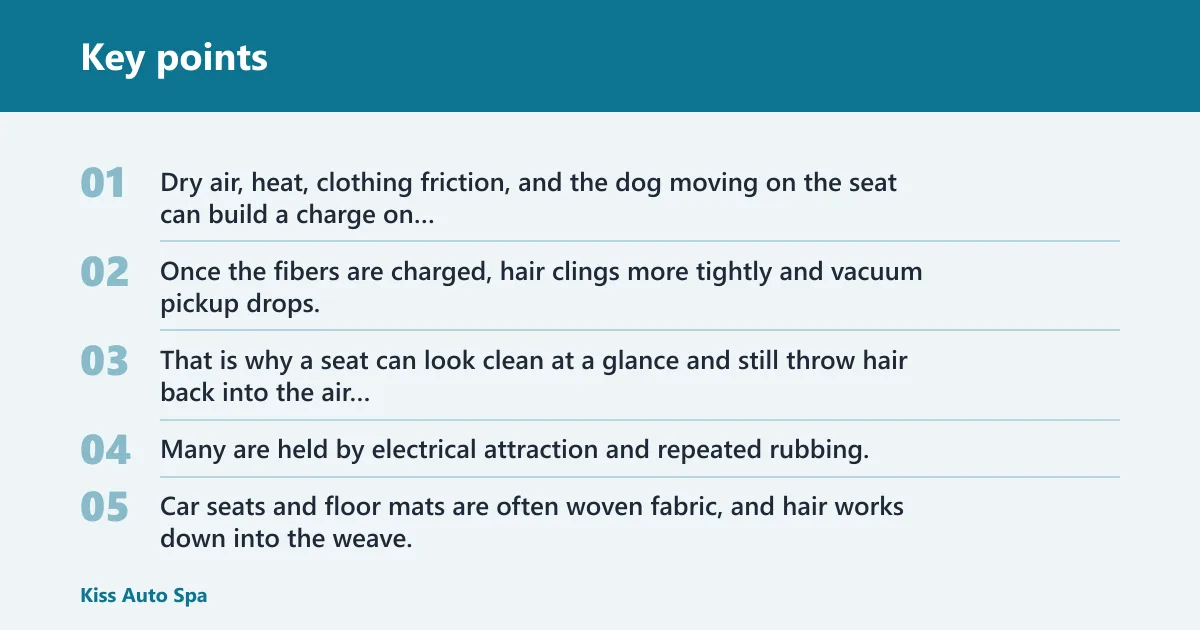
Dry air, heat, clothing friction, and the dog moving on the seat can build a charge on the fabric. Once the fibers are charged, hair clings more tightly and vacuum pickup drops, especially on fabric that already has a rough texture.
That is why a seat can look clean at a glance and still throw hair back into the air when brushed. The loose hairs are not only resting on top. Many are held by electrical attraction and repeated rubbing, so a suction-only pass misses what friction already pinned down.
How fabric weave and nap trap hair
Car seats and floor mats are often woven fabric, and hair works down into the weave. Looped cloth gives the shaft of the hair edges to catch on, while denser nap hides embedded strands beneath the surface. The deeper the weave, the harder hair may be to release.
Fabric nap matters too. It lifts and holds fibers first, then hides what is already embedded below. That is why a panel can seem hairy even after a few vacuum passes. The top layer moves, but the lower layer stays wedged where suction cannot reach well.
Why seams and crevices hold the most hair
Seams, seat tracks, and the gap between cushions often collect more hair because they can compress it. The pressure packs loose strands into a tighter bundle, then friction drives more fibers into the same spot. Once compressed, hair behaves less like loose lint and more like felted debris.
Picture a rear bench with a child seat removed. The seat face may need one tool, but the seam line and buckle cutout need another. Hair often gathers where stitching changes direction or where the upholstery folds, because those spots trap air, pressure, and loose fibers together.
Why some dog hair is harder to remove
Hair type matters. Fine undercoat, coarse topcoat, short stiff hairs, and long hairs do not bind the same way. Some slide across a surface. Others snag quickly, weave into fabric, and resist lift even after the top layer has been loosened.
Fine undercoat versus coarse topcoat
Fine undercoat tends to spread through the surface and mat down into a soft layer that clings by static and friction. Coarse topcoat behaves differently. It can poke into loops and seams like tiny hooks, so it often looks easy to grab but is harder to pull free once it lands deep in the weave.
That split helps explain why one car fills with fuzzy gray dust while another holds long dark strands. The first case is usually a packed underlayer. The second often involves longer, stiffer hairs that bridge across fibers and catch at several points instead of one.
Short stiff hairs versus long hairs
Short stiff hairs can slip between fibers and sit nearly flush with the cloth, which makes them hard for a vacuum to catch. Long hairs are easier to see, but they can wrap around loops and seat texture. Either way, the problem is contact area, not just length.
A common first-timer mistake is assuming a quick sweep will lift pet hair from fabric seats, even though the strands weave into the upholstery fibers. A short, stiff hair on a cloth seat may need friction first, while a long strand on smooth vinyl may lift with a single wipe. The wrong tool wastes time because it misses the way the hair is attached.
When hair starts to felt into fabric
Felted hair can be one of the hardest stages to remove. It forms when loose strands are pressed, rubbed, and charged until they bind together with dust and fabric fibers. At that point, the mass is no longer a simple layer of fur. It becomes a compact mat that resists normal vacuuming and surface brushing.
When a rear bench has been used daily by a shedding dog, the problem often shifts from surface hair to a compressed gray layer that behaves like felt. In that stage, the issue is not just volume; it is bond strength. The bundle has to be disturbed mechanically before suction can do useful work.
Cloth seats versus leather
Cloth seats trap more hair because the fiber structure gives hair places to lodge. Leather often releases hair more easily because the surface is smoother and less porous. Vinyl usually sits between the two, smoother than cloth, but still able to hold dirt and hair in seams, stitching, and texture.
Why cloth seats trap more hair
Cloth seats have weave depth, nap, and stitched seams, so hair has multiple ways to get trapped. The woven structure gives loose strands room to settle below the surface, and that hidden layer is what makes cloth feel “hairy” long after the top looks brushed off.
Dense nap makes the problem worse. It can cover embedded strands while leaving the top layer looking only mildly dirty. That is why cloth can hold far more hair than a quick look suggests, especially in areas that get repeated rubbing from passengers or a crate.
Why leather releases hair more easily
Leather has fewer fiber loops for hair to catch on, so loose strands usually stay on the surface. A dry cloth or glove can move them with far less effort than cloth needs. The main hold points on leather are seams, perforations, and folds rather than the field of the panel itself.
Even so, leather still needs care. A slightly damp rubber glove may be too wet for moisture-sensitive leather, so friction methods should stay gentle there. The goal is to lift the hair without leaving residue or pushing moisture into stitching and seams.
Where vinyl fits between the two
Vinyl behaves more like a smooth shell than a woven textile. Hair usually sits on top unless it gets trapped at edges, stitching, or texture. That makes vinyl easier to clean than cloth, but not always as easy as full leather if the panel is shaped with many seams or grip patterns.
Why vacuuming alone fails
Vacuum suction often cannot pull embedded hairs free from fabric. The hair is already locked into weave depth, nap, or a compressed seam, so airflow moves around it instead of grabbing it. That is why the recommended process is loosen hair first, then vacuum it up.
Suction cannot grab hair locked in nap
Even a stronger vacuum still depends on access. If the hair is stuck beneath the nap or packed into a seam, the airflow has little room to reach it.
Best use of upholstery and crevice attachments
The upholstery attachment works best after loosening. It can then collect the freed hair without scattering it back across the seat. The crevice tool is specifically recommended for seat seams and between cushions, where hair tends to pack tightly and hide below the visible surface.
Small sections help here. Working in areas about a square foot at a time keeps the loosened hair from spreading back into nearby fabric. That approach also makes it easier to see which spots still need friction before the next pass.
Best first tools by surface
Start with the tool that matches the surface, the hair type, and the failure point. The best first tool is usually the one that breaks static and lift resistance before suction enters the picture. After that, vacuuming becomes the cleanup step instead of the main event.
Rubber glove method on fabric
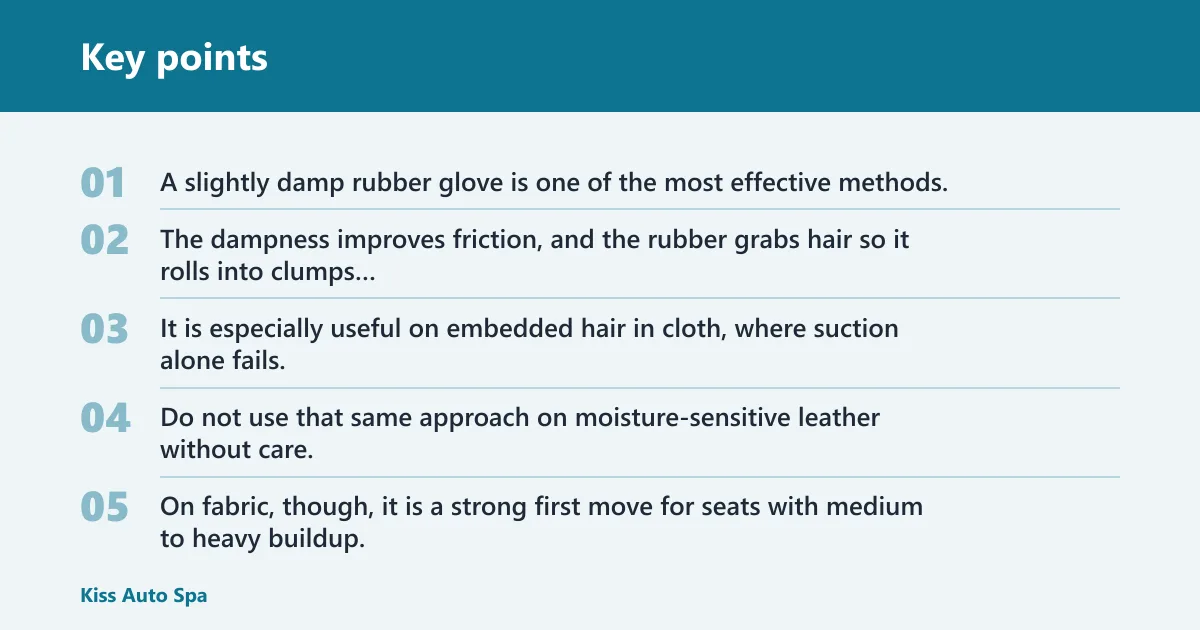
A slightly damp rubber glove is one of the most effective methods. The dampness improves friction, and the rubber grabs hair so it rolls into clumps instead of sliding across the seat. It is especially useful on embedded hair in cloth, where suction alone fails.
Do not use that same approach on moisture-sensitive leather without care. On fabric, though, it is a strong first move for seats with medium to heavy buildup. Once the hair balls up, you can lift it by hand or vacuum the clumps away.
Rubber squeegee on flat panels
A rubber squeegee can work on fabric seats using the same friction principle. It is best on flatter panels where you can drag it in a controlled line. The rubber edge gathers hair into ridges and balls, which makes the next vacuum pass more useful.
It is less useful in deep seams, stitched channels, or curved bolsters. In those areas, the edge may skim over the problem instead of biting into it. That makes it a good surface tool, not a universal one.
Fabric softener spray as a static aid
Fabric softener spray may help reduce static and make hair easier to move, but it can leave residue. Treat it as an aid, not a primary remover, and test carefully on any surface first.
It is not a cure for packed hair. It can make the fibers less clingy and help the glove, squeegee, or vacuum do more work. If the hair is already felted into the seat, that spray alone will not break the bond.
Where pumice stone can and cannot go
A pumice stone can be aggressive on low-pile carpet and is generally reserved for durable, low-pile surfaces when safer methods have not worked. It is generally not a good choice for cloth seats according to some detailing guidance, because it can pull fibers if overused. That risk goes up on softer or textured fabric.
Use it only as a last-resort tool on durable, low-pile surfaces. The goal is controlled abrasion, not scrubbing. If the seat material shows fuzzing, pilling, or visible fiber lift, stop and switch to a safer method.
Pet hair adhesion decision matrix
This table turns the problem into a surface-and-hair decision. It separates loose surface hair from embedded hair and felted hair, so you can choose the first tool without guessing. It also shows when the job is past a simple DIY pass.
| Upholstery type | Hair type | Severity | Why it sticks | Best first tool | Likely failure point | When to escalate |
|---|---|---|---|---|---|---|
| Leather | Long hair, coarse topcoat | Light surface hair | Sits on top, with seams as catch points | Dry rubber glove or soft wipe | Seams and perforations hold leftovers | When seams keep filling after wiping |
| Leather | Fine undercoat | Moderate | Static cling on smooth surface and stitching | Rubber glove, then upholstery attachment | Hair stays in stitching and folds | When residue and hair remain in stitched channels |
| Cloth seat | Fine undercoat | Moderate to heavy | Works into weave depth and nap | Slightly damp rubber glove | Embedded hair below the surface layer | When repeated passes still leave a gray base layer |
| Cloth seat | Short stiff hairs | Heavy | Snags in loops and resists suction | Rubber squeegee on flat panels | Curves, bolsters, and seams | When the hair mats into a felted sheet |
| Low-pile carpet or floor mat | Mixed coat, packed debris | Heavy to severe | Compressed fibers and soil lock the hair down | Pumice stone with caution, then vacuum | Fiber damage if pressure is too high | When the surface fuzzes or the mat is old and matted |
| Dense nap fabric | Fine undercoat, mixed hair | Severe | Nap hides embedded hair and blocks airflow | Glove first, then upholstery attachment | Deep embedment and static rebound | When the hair layer stays packed after friction passes |
When DIY is not enough
Some interiors stop responding to home tools. That usually means the hair is felted, packed into seam lines, or mixed with grime that has glued it into the fabric. At that point, extraction equipment or a pro detailer becomes the practical next step.
Signs hair is felted into the fabric
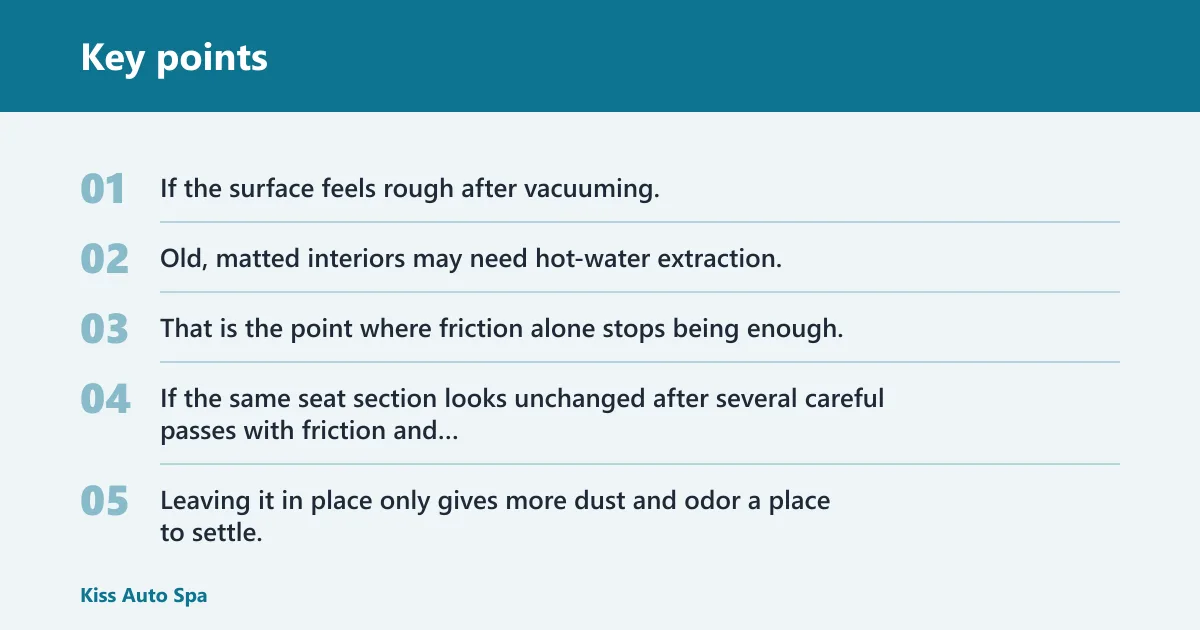
If the surface feels rough after vacuuming, or if the hair breaks up into short stubborn tufts instead of lifting cleanly, the bundle is likely felted. Old, matted interiors may need hot-water extraction. That is the point where friction alone stops being enough.
Another clue is repetition. If the same seat section looks unchanged after several careful passes with friction and suction, the hair is below the level those tools can reach. Leaving it in place only gives more dust and odor a place to settle.
When extraction equipment helps
Extraction helps when the problem is no longer loose hair but bonded residue inside the fibers. It can flush out dirt, loosen compressed debris, and pull material from deeper in the weave. That matters most on cloth seats and mats that have been neglected for a long time.
Extraction is not the first step. It works best after the bulk hair has already been lifted away. Otherwise, the machine spends its effort on a surface layer and never reaches the packed layer below.
When to hand off to a pro detailer
Hand off the job when the upholstery is heavily matted, the seams are packed tight across multiple rows, or the surface starts to show wear from repeated DIY passes. A pro detailer also makes sense when the car has several fabric types mixed together and each one needs a different removal method.
Say a 2020 Subaru Outback with cloth rear seating and cargo-area fabric has repeated dog use, and the bench still shows a dark gray base layer after glove work and a vacuum pass. That pattern points to embedment rather than loose surface hair, so a stronger correction step is justified.
Experience
Weekly Maintenance
Weekly upkeep keeps hair from reaching the felted stage. A quick rubber glove pass on fabric seats, a short vacuum around seams, and a light wipe on leather or vinyl stop buildup before it becomes compressed. The goal is not perfect detail work each week, just preventing the bond from getting stronger.
For pet hair in everyday use, lint rollers and rubber gloves solve different problems. Lint rollers are fastest for light, fresh surface hair on small areas, but they lose efficiency on embedded fabric. Rubber gloves cover more area, create stronger friction, and work better once hair has started to cling.
A practical routine is simple: use a lint roller for quick touch-ups on headrests and lightly used leather panels, then switch to a rubber glove on cloth seats and mats. If the same section keeps needing repeated cleanup, move to seams and creases before the buildup becomes compressed.
Frequently asked questions
Why does pet hair stick to car seats so much?
Pet hair sticks because static charge, friction, and the shape of the upholstery fibers all work together. Cloth seats and mats let hair slip into weave depth and nap, while seams and folds pack it tighter. Once the hair is embedded, suction alone has trouble pulling it free.
Why won’t a vacuum remove pet hair from car upholstery?
Because the strands are held in place by the fabric itself. Vacuuming works best after a friction step loosens the hair and gives the airflow something to lift.
Does static electricity make pet hair cling to car fabric?
Yes. Dry air, heat, and rubbing build static on car fabric and upholstery, and that charge pulls pet hair tighter to the surface. This cling reduces vacuum effectiveness because the hair stays attached instead of lifting into the airflow. It is one reason cloth seats can look clean but still hold hair.
Why do some dog hairs felt into car seats faster than others?
Fine undercoat and short stiff hairs tend to work into fabric differently than long or coarse hairs. The smaller fibers can spread through the weave and compress into a mat more quickly, while longer hairs can snag across loops and seam lines. Both can felt, but the path is not the same.
Why is pet hair harder to remove from cloth seats than leather?
Cloth seats are harder because they have weave depth and nap that trap hair below the surface. Leather has far fewer places for hair to anchor, so most of it stays on top and wipes away more easily. Vinyl sits between them, with seams and texture doing most of the trapping.
Does using a fabric softener spray actually help loosen pet hair?
Sometimes, but only as a limited aid. Fabric softener spray may reduce static and help hair release, yet it can leave residue and does not solve packed or felted hair by itself. It works best as a light prep step before a glove, squeegee, or vacuum pass.