Best Upholstery Stain Remover for Car Interiors
The best upholstery stain remover for car interiors depends on the stain: enzyme cleaner for pet messes and odor, oxygen cleaner for coffee and food, solvent or degreaser for grease, and a pH-neutral cleaner for general cloth seats. Wrong chemistry can set the stain deeper, leave rings, or damage fabric and foam. This guide shows how to match cleaner to stain type, seat material, and cleanup method for fresh, set-in, and odor-causing messes.
Best cleaners for cloth, pets, and quick spots
For broad cloth-seat use, CAR GUYS Super Cleaner is the most flexible starting point because it works on seat fabric, leather, and vinyl, and it does not require a vacuum or extractor. That makes it a sensible first pick when you want one cleaner for mixed interior materials and everyday spills, as long as you still use agitation on set-in stains.
Top pick for cloth seats
CAR GUYS Super Cleaner fits the widest range of cloth-seat problems because it can handle seat fabric, leather, and vinyl without a special machine. It is a better first buy than a niche cleaner when the vehicle has mixed surfaces, or when you want one bottle for coffee drips, light grime, and spot cleaning.
Best for pet messes
Bissell Professional Pet Stain and Odor Remover is the clearest match for urine, stool, and vomit because it is enzyme-based and built for odor control. Severe messes can need soaking time, and Bissell’s guidance includes covering the area with a wet towel for up to three days in the hardest cases.
Best for quick spot treatment
FOLEX Instant Carpet Spot Remover is the simplest choice for a fast, odor-free spot treatment on colorfast fabrics. It is useful when the stain is fresh, small, and on carpet or cloth, and when you want no-rinse cleanup without waiting for foam to dry.
Quick picks by stain type
Stain chemistry matters more than brand name. Coffee, tea, urine, grease, and dye transfer behave differently, so the cleaner that works on one may fail on another or push the stain deeper into the foam.
- Fresh coffee and tea: FOLEX Instant Carpet Spot Remover for small spots on colorfast fabric; Meguiar’s Carpet and Upholstery Cleaner for cloth seats with a built-in scrub brush.
- Pet urine and vomit: Bissell Professional Pet Stain and Odor Remover for enzyme action and odor control.
- Grease and food spills: CAR GUYS Super Cleaner for mixed interiors, or Tuff Stuff Multi-purpose Cleaner when foam delivery helps lift stubborn residue from vinyl or cloth.
- Dye transfer: Chemical Guys Lightning Fast Stain Extractor for deeper cleaning on carpet and seat fabric, with a brush attachment option when transfer sits in the fibers.
Best upholstery stain removers we recommend
CAR GUYS super cleaner
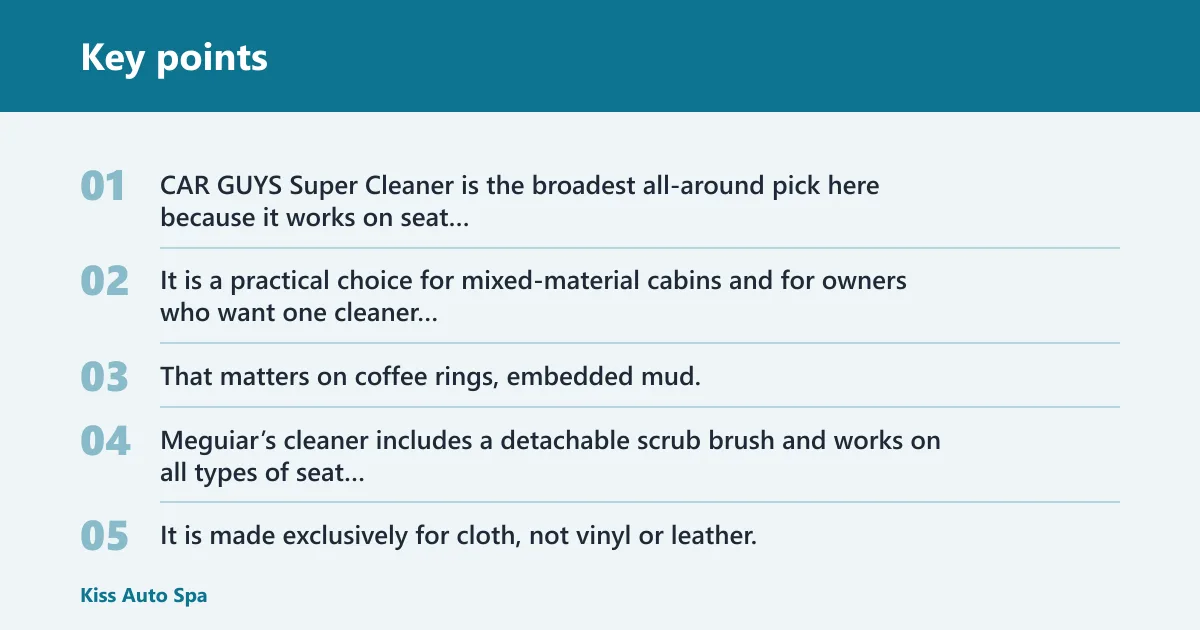
CAR GUYS Super Cleaner is the broadest all-around pick here because it works on seat fabric, leather, and vinyl, and it does not require a vacuum or extractor. It is a practical choice for mixed-material cabins and for owners who want one cleaner for spot jobs, light food spills, and general grime.
It still needs agitation for set-in stains. That matters on coffee rings, embedded mud, and older spill marks that sit below the surface of the fabric.
Meguiar’s carpet and upholstery cleaner
Meguiar’s cleaner includes a detachable scrub brush and works on all types of seat upholstery and auto carpets. It is made exclusively for cloth, not vinyl or leather, so it belongs on fabric seats rather than coated surfaces.
The quick-dry format makes it a strong fit for cloth seats when you want faster turnaround after spot cleaning.
Bissell Professional pet Stain and odor Remover
Bissell Professional Pet Stain and Odor Remover handles urine, stool, and vomit stains, and it is enzyme-based. That chemistry targets the source of pet mess odor instead of masking it.
It is the most specific option in this list for biological messes. For severe contamination, the long dwell guidance is the point, not a flaw.
Tuff Stuff multi-purpose cleaner
Tuff Stuff uses foam delivery, which helps hold cleaner on vertical bolsters and textured trim instead of letting it run off immediately. It is aimed at stubborn stains and works on vinyl, but it is not safe for leather.
That makes it a better fit for vinyl door inserts, synthetic seat panels, and cloth spots than for leather seats.
Chemical Guys Lightning Fast stain Extractor
Chemical Guys Lightning Fast Stain Extractor is built for deep cleaning on carpet and seat fabric, and it offers a drill brush attachment option. That matters when a stain sits deep in the pile or when agitation by hand is not enough.
Use it when stain removal is the goal and the fabric can tolerate stronger mechanical action.
FOLEX instant carpet spot remover
FOLEX is an instant spot treatment with no rinsing and an odor-free finish, designed for colorfast fabrics. It is useful for fresh spills, small stains, and quick cleanup where the goal is to avoid residue and extra drying time.
It is less suited to large, set-in contamination or pet accidents that need odor treatment, not just visible stain removal.
Resolve carpet cleaner
Resolve is designed for Ws or W fabrics, and it should stay away from velvet, silk, vinyl, and leather. That narrow fabric guidance makes it useful only when the seat material allows wet cleaning and the fabric is colorfast.
It can work for household and car use, but only after a colorfastness check in a hidden area.
Armor All Carpet and Upholstery cleaner spray
Armor All Carpet and Upholstery Cleaner Spray uses a three-in-one foam that cleans, lifts stains, and deodorizes with a new car scent. The spray application is convenient for quick jobs and for owners who want a simple aerosol-style cleaner rather than a bottle and separate brush.
It is best for surface-level cleanup where odor control and easy application matter more than deep extraction.
Which cleaner works for your stain?
Start by asking what kind of stain it is, then match the cleaner to the chemistry. That approach avoids wasted effort and helps prevent a stain from reappearing after the seat dries.
Fresh coffee and tea
Coffee and tea are tannin stains, so a quick spot cleaner or a cloth-safe upholstery cleaner is usually the first move. FOLEX is a good small-spot option, while Meguiar’s or CAR GUYS works better when the spill has spread across a seat panel.
Old grease and food stains
Grease needs a cleaner that can break down oily residue, not only a deodorizer. Tuff Stuff and CAR GUYS are better fits than a pet formula, and stubborn spots may need repeated agitation with a brush rather than a single spray-and-wipe pass.
Pet urine, stool, and vomit
Biological messes need enzyme action because odor can remain even after the visible spot looks clean. Bissell is the most specific match here, and its long soak guidance is the clearest clue that this is not a quick-wipe job.
Dye transfer and muddy spots
Dye transfer can sit in the fibers and return after the fabric dries if the cleaner only moves the pigment around. Chemical Guys Lightning Fast Stain Extractor is the deeper-cleaning option in this group, especially when agitation and extraction are needed.
Stain chemistry decision matrix
| Stain type | Best cleaner type | Agitation tool | Dwell time | Risk level |
|---|---|---|---|---|
| Fresh coffee | Foam or spray spot cleaner for cloth | Soft upholstery brush or microfiber towel | 1 to 3 minutes | Low if blotted quickly |
| Old grease | Degreasing foam or multi-purpose upholstery cleaner | Stiff nylon brush | 3 to 5 minutes | Medium if over-wet |
| Pet urine | Enzyme cleaner | Blotting towel, then light brushing | 10 to 15 minutes, or longer for severe cases | High because odor can return |
| Food spills | Foam or spray upholstery cleaner | Soft brush | 2 to 5 minutes | Medium if residue is left behind |
| Dye transfer | Deep-cleaning upholstery and carpet cleaner | Brush or extractor | 3 to 10 minutes | High on non-colorfast fabric |
Foam, spray, or extractor?
Foam is useful when you need dwell time and controlled wetting. Spray is better for fast spot treatment. An extractor becomes worth it when the stain sits deep, returns after drying, or covers a larger area than a small spot.
When foam helps
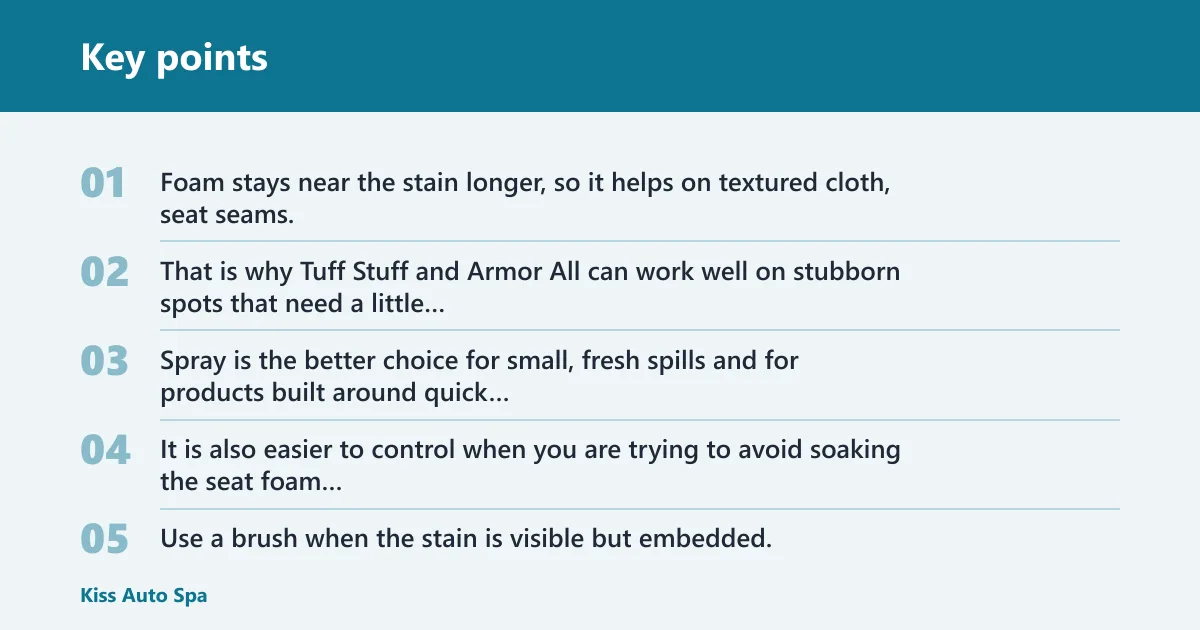
Foam stays near the stain longer, so it helps on textured cloth, seat seams, and vertical panels. That is why Tuff Stuff and Armor All can work well on stubborn spots that need a little more hang time before wiping.
When spray is enough
Spray is the better choice for small, fresh spills and for products built around quick cleanup, such as FOLEX. It is also easier to control when you are trying to avoid soaking the seat foam underneath.
When to use a brush or extractor
Use a brush when the stain is visible but embedded. Use an extractor when the stain has soaked through, when odor remains after drying, or when a previous cleanup left a ring. Chemical Guys Lightning Fast Stain Extractor is the closest match here because it is built for deeper cleaning and can use a drill brush attachment.
Say your cloth seat has about a 2-inch coffee ring from a drink spilled yesterday. A spray cleaner may lift the surface mark, but a soft brush with a short dwell time is more likely to clean the edge of the ring before it dries into a halo.
Suppose a pet accident soaked into the seat cushion and the cabin still smells after the fabric looks dry. That points to contamination below the surface, so an enzyme cleaner with longer dwell time matters more than a quick foam pass.
How do you choose the safest cleaner?
The safest cleaner is the one that matches the fabric first and the stain second. Cloth can usually take more options than leather or vinyl, but even cloth needs a colorfastness check before you cover a large area.
Cloth versus leather versus vinyl
Cloth seats and carpets give you the widest field of options. Meguiar’s, Resolve, FOLEX, and Bissell all fit cloth under the right conditions, while CAR GUYS covers seat fabric, leather, and vinyl. Tuff Stuff is not safe for leather, and Meguiar’s should stay off vinyl and leather.
Vinyl can often handle a cleaner that would be too harsh for leather, but the label still matters. Leather needs products that specifically allow that surface, which is why CAR GUYS is useful and Tuff Stuff is not.
Colorfastness testing
Before full use, test the cleaner in a hidden area and wait for it to dry completely. A fabric can look fine while wet and still show lightening, darkening, or a new ring after it dries.
Residue, drying, and reappearing stains
A sticky residue usually means too much product, not enough extraction, or both. If the stain returns after drying, the cleaner may have moved soil from the top of the fabric into the lower layers, where it wicked back up as the seat dried.
A common first-timer mistake is spraying more cleaner after the first pass looks uneven. That often spreads the mark wider and leaves the foam pad damp for too long, which can pull the stain back to the surface later.
- Identify the stain type first: coffee, grease, urine, food, or dye transfer.
- Check the seat material: cloth, carpet, vinyl, or leather.
- Choose the cleaner that fits both the stain and the fabric.
- Use the least aggressive application that still gives dwell time.
- Agitate lightly on cloth; use a brush or extractor only when needed.
- Blot or extract until the fabric feels just damp, not wet.
- Let the area dry fully before judging whether the stain is gone.
Can you use a household upholstery cleaner on car seats? Yes, but only if the product is compatible with the seat material and the label allows that use. Resolve is the clearest example here: it is meant for Ws or W fabrics, and it should avoid velvet, silk, vinyl, and leather.
Frequently asked questions
What is the best upholstery stain remover for car interiors?
The best all-around pick for broad cloth-seat use is CAR GUYS Super Cleaner because it works on seat fabric, leather, and vinyl and does not require a vacuum or extractor. For pet messes, Bissell is more specific. For quick spots on colorfast fabric, FOLEX is the cleaner to start with.
Which car stain remover works best on coffee stains?
For coffee, a fast spot cleaner such as FOLEX works well on small, fresh stains, while Meguiar’s is a stronger choice when you want a built-in scrub brush on cloth seats. Coffee is a tannin stain, so quick blotting and light agitation matter more than heavy soaking.
Is a foaming or spray upholstery cleaner better for car seats?
Foam is better when you need dwell time and less run-off on seat bolsters or textured fabric. Spray is better for small, fresh spots and cleaner control. If the stain is deep or keeps returning, neither format may be enough without brushing or extraction.
Can I use a household upholstery cleaner on car seats?
Sometimes, yes, but only if the cleaner is labeled for the exact fabric type in your car. Resolve is designed for Ws or W fabrics and should avoid velvet, silk, vinyl, and leather. Always test in a hidden area first, because a good household cleaner for a sofa can still be wrong for a seat.
What stain remover is safest for cloth car seats?
For cloth seats, the safest choice is usually the one with the clearest fabric match and the least aggressive chemistry for the stain. FOLEX is a good colorfast spot treatment, Meguiar’s works on cloth upholstery and auto carpets, and CAR GUYS is useful when the cabin has mixed materials.
Do I need a brush or extractor for tough car upholstery stains?
For set-in stains, a brush often makes the difference because it works cleaner into the fibers. An extractor is worth using when the stain is deep, the area is large, or the spot returns after drying. Chemical Guys Lightning Fast Stain Extractor is the clearest fit for that kind of job.
Which cleaner works best for pet stains in car interiors?
Bissell Professional Pet Stain and Odor Remover is the best fit for pet urine, stool, and vomit because it is enzyme-based and built for odor control. For severe cases, the long dwell guidance matters, since odor can come from material below the visible stain.
How do I avoid sticky residue after cleaning car upholstery?
Use less product than you think you need, agitate only enough to lift the stain, and blot or extract until the area is just damp. Sticky residue usually comes from leaving cleaner in the fabric. If the seat feels tacky after drying, the area likely needs a water-only wipe and more drying time.