What Are Detailing Brushes for Cars Used for?
Detailing brushes clean seams, vents, badges, lug nuts, upholstery edges, and engine-bay crevices. Use soft bristles on paint, clear plastic, and interior trim, and reserve stiffer nylon for wheels and dirty metal. Use the wrong brush and you can scratch paint, haze soft plastics, or drive grit deeper into seams. This guide explains which brush belongs on each surface, what it should never touch, and how to choose size, stiffness, and control.
What detailing brushes do
Detailing brushes lift dust, grime, and trapped debris from spots towels, mitts, and wash pads miss. That includes vents, seams, badges, emblems, grilles, wheel hardware, and engine-bay edges. Work Stuff describes them for interiors, wheels, engine bays, vents, badges, trims, and delicate surfaces, which is the right mental model: a brush is a precision tool, not a universal cleaner.
They do two jobs. First, they dislodge dry dust and fine debris from narrow gaps. Second, they agitate cleaner against textured surfaces so contamination lifts instead of smearing. That agitation helps, but it also raises risk if the bristles are too stiff, the brush is too large, or the surface is soft enough to mark.
Which brush goes on which surface?
Match the brush to the surface, not to the product bottle. Soft brushes belong on interiors and other delicate surfaces; stiffer brushes belong on wheels, tires, and engine bays; and some surfaces are safer with microfiber or air instead of any brush at all. That last point matters most on high-gloss trim and soft clear plastics.
Soft brushes for interiors, seams, and vents
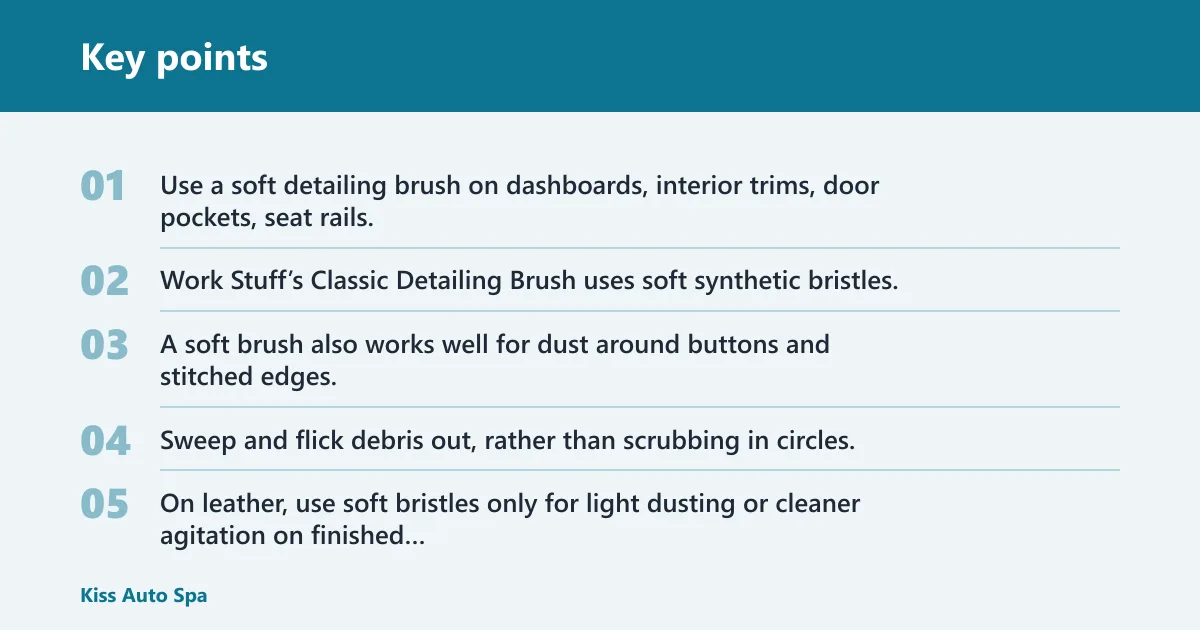
Use a soft detailing brush on dashboards, interior trims, door pockets, seat rails, badges, vents, and small seams. Work Stuff’s Classic Detailing Brush uses soft synthetic bristles, and the Albino Detailing Brush uses soft white bristles; both fit the use case where lower scratch risk matters more than brute force. A soft brush also works well for dust around buttons and stitched edges.
Keep pressure light. Sweep and flick debris out, rather than scrubbing in circles. On leather, use soft bristles only for light dusting or cleaner agitation on finished surfaces, and avoid hard pressure that can push dirt into grain or burnish the finish.
Stiffer brushes for wheels and engine bays
Stiffer brushes belong where grime is heavier and the surface can take more contact: wheel faces, tire sidewalls, lug areas, spokes, barrels, and engine-bay plastics. The same source describes the Black Detailing Brush as suited to stronger cleaning on wheels and engine bays, and the Stiff Detailing Brush as chemical-resistant for those same areas. That extra stiffness helps move stubborn brake dust and oily film.
Do not move that same brush to interior plastics, screens, or piano black trim. Stiff bristles can leave haze, micro-marring, or visible sweep marks on sensitive finishes. On painted exterior parts, stay careful near edges and badges, because dirt trapped in the bristles can cut faster than the label suggests.
When to skip the brush
Skip the brush when the surface is highly polished, very soft, or already loaded with grit. Piano black trim is the clearest example. Ultra Soft Detailing Brush uses microfiber ultra-soft bristles and is positioned for screens and piano black trim, which points to the right choice: almost no pressure, brief contact, and a cleaner surface first if loose grit is present. If the area is dusty, an air blower or clean microfiber may be safer than any brush.
Interior detailing brush uses
Interior detailing is where soft bristles do the most work. You use them on vents, seams, badges, dashboards, trims, dust removal, and agitation in tight spaces. The goal is to lift debris without scuffing soft-touch plastic, coated trim, or glossy accents that mark easily.
Vents, buttons, and seams
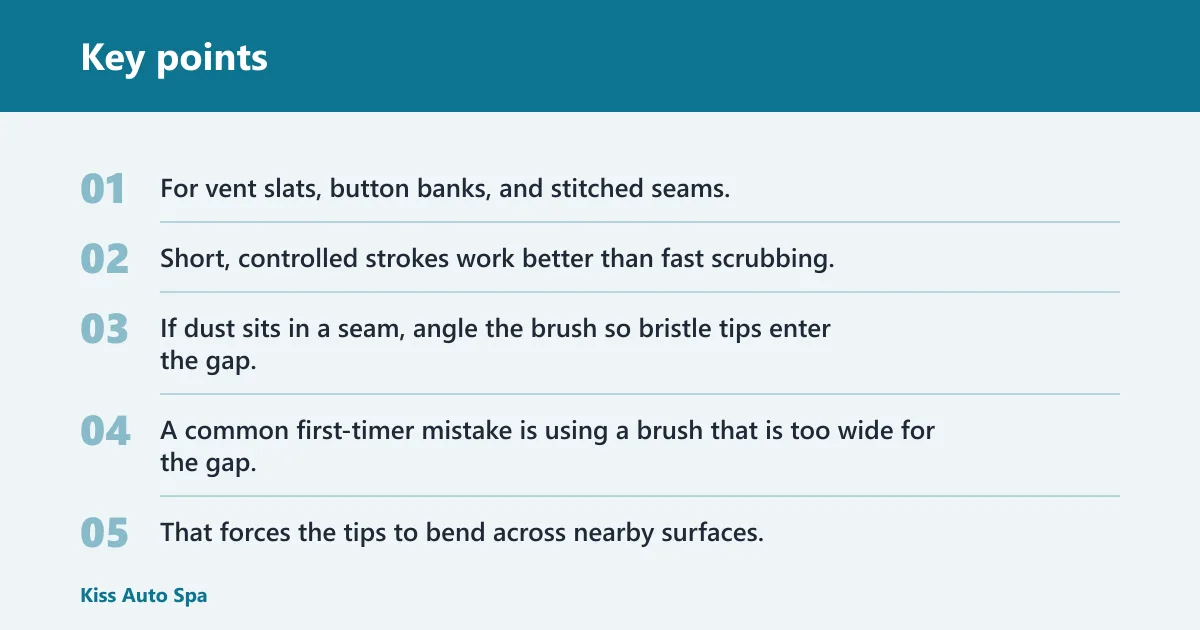
For vent slats, button banks, and stitched seams, smaller brushes give better control and less accidental contact. Short, controlled strokes work better than fast scrubbing. If dust sits in a seam, angle the brush so bristle tips enter the gap, then pull debris outward in the same direction rather than grinding back and forth.
A common first-timer mistake is using a brush that is too wide for the gap. That forces the tips to bend across nearby surfaces, which raises the chance of touching adjacent trim or pushing grit farther into the seam.
Dashboards, trims, leather, and screens
Dashboards and molded trims usually tolerate a soft brush when the surface is clean and the pressure is low. Leather is more delicate. Use a very soft brush or microfiber-tipped tool on finished leather, and avoid aggressive agitation on pronounced grain or stitched bolsters. Screens call for the softest option available, or a microfiber cloth if dust is loose.
Piano black trim sits in the highest-risk group. It shows scratches fast, so the safest sequence is: remove loose dust first, then use an ultra-soft or microfiber-style brush with almost no pressure, and finish with a clean microfiber if any residue remains. A stiff brush should never be the first choice there.
Exterior detailing brush uses
Exterior detailing needs a different balance. Badges, emblems, grilles, sills, textured plastics, and pre-wash grime often need firmer bristles than an interior job. The surface still matters, though. Painted panels near the work area need gentler contact than the dirt-heavy part you are targeting.
Badges, emblems, grilles, and sills
For badges and emblems, a small soft brush removes dirt around edges without snagging on raised lettering. Grilles and lower sills can take more agitation, especially when road film is packed into texture. Use a brush that fits the spacing, because a large head can hit surrounding paint while you are trying to clean a tiny recess.
Pressure and direction on exterior parts
Use light-to-moderate pressure and move from the cleaner side toward the dirtier side. On painted exterior parts, keep the brush moving in one direction across the textured area instead of scrubbing in tight circles. That lowers the chance of dragging grit back over the same spot.
If a badge has dried bug residue around its edges, a 24 mm soft brush can fit the letters better than a larger head. If the residue still resists, give the cleaner more dwell time instead of force. More pressure usually creates more risk than result on glossy paint.
What size detailing brush do you need?
The same source lists common detailing brush sizes as 16, 24, 30, and 40 mm. The right size depends on the gap, not the vehicle. Smaller heads fit vents and badges; medium sizes handle seams and tighter exterior details; larger heads suit broader panels and wheel faces. Size affects reach, control, and how much surrounding material the bristles can touch at once.
16 mm and 24 mm for vents and tight crevices
Use about 16 mm for narrow vent slats, tiny buttons, and very tight crevices. Use about 24 mm when the gap is still small but needs a little more bristle coverage, such as around interior controls, small emblems, and tighter wheel hardware. These sizes give you precision and reduce stray contact on surrounding trim.
30 mm for badges, seams, and smaller exterior parts
About 30 mm is often a useful middle ground for badges, seams, doorjamb edges, and smaller exterior parts. It gives enough surface coverage to move dust efficiently without becoming awkward in tighter spaces. It is often the size that feels easiest to control when the area is uneven but not tiny.
40 mm for broader panels and wheel faces
About 40 mm suits broader panels, wheel faces, and larger exterior textures where coverage matters more than pinpoint access. It is less suitable for vents or fine lettering, because the larger head can touch too much at once. Use it where the surface area is open and the finish is tough enough for broader contact.
Wheel and engine bay brushes
Wheels and engine bays need durable brushes because those areas collect heavier contamination. The same source describes the Stiff Detailing Brush as chemical-resistant and suited to wheels, tires, and engine bays. That matters because brake dust, tire dressings, oily film, and road grit behave differently from interior dust.
Wheel faces, lug areas, spokes, and barrels
Use durable bristles around lug areas, spoke backs, and barrel access points, but rinse often. A wheel brush that carries grit from one section to another can scratch the finish or scatter contamination. If the brush loads up, stop and rinse it before continuing. Wheel cleaner can help loosen grime, but it does not remove the need for controlled agitation.
Engine-bay plastics, covers, and seams
Engine bay cleaning needs stronger bristles, but also controlled moisture and a gentle touch. Target plastics, covers, and seams, not exposed electrical risk points. Keep the brush damp, not dripping, and use short motions so cleaner does not pool where it should not. A chemical-resistant brush is useful here because cleaners in the bay are often harsher than interior products.
What should be in a car detailing brush kit?
A practical brush kit should cover interior, exterior, wheel, and engine-bay work without forcing one brush to do everything. A compact setup usually means at least one soft small brush, one medium soft brush, one stiffer wheel or engine-bay brush, and one ultra-soft option for screens or piano black trim. That combination handles most common car surfaces without overbuying.
Brush sets and multi-size bundles are useful because they match different tasks better than one single brush. They also help separate clean jobs from dirty ones. Interior-only brushes should stay away from brake dust, and wheel brushes should not be dragged back onto delicate cabin trim.
Why ergonomic and tri-grip handles matter
An ergonomic handle or tri-grip handle improves control during longer detailing sessions and reduces accidental contact with nearby surfaces. Work Stuff’s Ultra Grip Brush Classic uses a non-slip Tri-Grip handle, which is the kind of detail that matters when your hand is wet, soapy, or working at an awkward angle. Better control means fewer slips into delicate trim.
Detailing brush decision table
The table below gives a surface-to-brush match chart. Use it as a quick filter before you touch the car. If the surface is high-risk, start with the softest tool that can still do the job, or skip the brush entirely.
| Surface | Recommended bristle type | Ideal brush size | Pressure level | Do-not-use warnings |
|---|---|---|---|---|
| Vents and thin slats | Soft synthetic or microfiber ultra-soft | 16 mm or 24 mm | Very light | Avoid stiff bristles; do not jam the brush deep into the slats. |
| Buttons, seams, and badges | Soft synthetic | 24 mm or 30 mm | Light | Do not scrub side-to-side across sharp edges or raised lettering. |
| Dashboard and interior trim | Soft synthetic | 30 mm | Light | Do not use stiff nylon on soft-touch plastic or glossy inserts. |
| Leather seats and finished leather trim | Ultra-soft or very soft synthetic | 24 mm or 30 mm | Very light | Do not over-brush grain or stitched seams; avoid hard pressure. |
| Piano black trim | Microfiber ultra-soft | 16 mm or 24 mm | Very light | Do not use stiff brushes; do not scrub dusty panels dry. |
| Wheel faces and spokes | Stiff or chemical-resistant | 30 mm or 40 mm | Moderate | Do not carry wheel grit onto interior trim or paint edges. |
| Lug areas and barrel access | Stiff or chemical-resistant | 16 mm or 24 mm | Moderate | Do not force a large brush into a tight recess. |
| Engine-bay plastics and seams | Chemical-resistant stiff | 24 mm or 30 mm | Light to moderate | Do not soak components; avoid electrical connections and exposed openings. |
Wrong brush for the job: failure cases
A wrong brush choice usually fails in one of three ways. First, it mars soft plastic or piano black trim. Second, it traps grit and moves that grit across the next surface. Third, it pushes contamination deeper into seams instead of lifting it out. Those failures are avoidable when size, stiffness, and pressure match the surface.
Say your center console has piano black trim, light dust, and a 40 mm stiff brush nearby. That brush is the wrong choice even before you start. The large head reaches too far, the bristles are too aggressive, and one careless pass can leave visible haze that a soft microfiber would have avoided.
Picture a wheel brush used on a wheel face, then on the lower door trim without rinsing. Even if the brush is soft enough, the trapped brake dust can scratch the trim. Clean tools matter as much as the label on the handle.
Frequently asked questions
What are detailing brushes for cars used for?
They loosen dust, grime, and debris from tight spaces regular wash tools miss. Common targets include vents, seams, badges, wheels, engine-bay plastics, and textured trim. The right brush moves contamination out of the gap without spreading it across nearby surfaces.
Where do you use a detailing brush on a car?
Use one on interior vents, buttons, seams, dashboards, trims, badges, grilles, sills, wheel faces, lug areas, and engine-bay plastics. The surface decides the brush. Soft brushes suit delicate interiors; stiffer brushes suit wheel and engine-bay work.
What’s the difference between soft and stiff detailing brushes?
Soft brushes are for delicate surfaces and light agitation. Stiff brushes are for heavier grime and tougher surfaces such as wheels, tires, and engine bays. The main difference is how much contact force they deliver, which changes both cleaning power and scratch risk.
Can detailing brushes scratch piano black trim?
Yes. Piano black trim is a high-scratch-risk surface, so even a modestly firm brush can leave haze or fine marks if pressure is too high or grit is still present. Use an ultra-soft or microfiber-style brush, very light pressure, and clean the area first if dust has settled.
What size detailing brush do I need for vents and crevices?
For vents and narrow crevices, 16 mm is the smallest practical starting point, and 24 mm covers slightly wider slots or seams. Smaller heads give better control and reduce accidental contact with surrounding trim. Larger sizes are better left for badges, wheel faces, and broader surfaces.
Can you use detailing brushes on wheels and engine bays?
Yes, and those are two of the main places for firmer brushes. Use durable, chemical-resistant bristles on wheels, tires, and engine-bay plastics, but keep moisture controlled and rinse the brush often. Do not move a dirty wheel brush to interior surfaces afterward.
Are detailing brushes safe for leather and screens?
They can be, if the brush is soft enough and the pressure is very light. Leather tolerates gentle dusting and cleaner agitation better than hard scrubbing. Screens need the softest option available, and piano black trim often does better with microfiber-style bristles than with conventional nylon.