No-shine vs Glossy Tire Dressing: Which Should You Choose?
Choose No-shine tire dressing for a factory-style daily-driver look with less visual risk; choose glossy tire dressing when you want stronger contrast and a show-car finish. Pick the wrong finish, and the tires can look greasy, catch dust, or fight the paint. This guide compares durability, appearance, residue, sling, and the best use case for each finish.
| Decision factor | No-shine | glossy tire dressing | Winner |
|---|---|---|---|
| Appearance | Matte or satin, natural OEM-style look, low-gloss finish | High-gloss, deep wet-look finish with stronger contrast | Depends on goal |
| Visual risk on daily drivers | Lower risk of looking overdone on factory wheels and newer cars | Can look too dressed-up if the sidewall is small or the paint is already busy | No-shine |
| Sling control | Easier to keep thin and controlled | More likely to sling if applied too heavily or driven too soon | No-shine |
| Show-car impact | Subtle, clean, restrained | More dramatic and reflective | glossy tire dressing |
| Upkeep style | Usually simpler to refresh without changing the car’s look too much | Needs more careful application to keep the finish even and tidy | No-shine |
What each finish looks like on the tire sidewall
No-shine tire dressing leaves the sidewall with a matte or satin finish that reads as natural and OEM-style. Glossy tire dressing gives the rubber a wetter, darker look that stands out more against the wheel and fender.
The same tire can look different from one car to another because sidewall texture changes the result. Raised lettering, molded patterns, and porosity can catch product unevenly, so a smooth sidewall often looks glossier than a heavily textured one even with the same dressing.
How the sidewall changes the result
Textured rubber holds product in small valleys and around lettering, which can mute shine. A flatter sidewall reflects light more evenly, so glossy dressing looks richer and no-shine looks cleaner and closer to bare rubber.
A common first-timer mistake is judging the finish before the dressing has settled. A sidewall that looks slightly wet during application can dry down to a much subtler look, especially with a water-based formula applied in a thin coat.
Which looks more natural on a daily driver?
No-shine usually suits a daily driver because it keeps the tire close to the factory look and avoids an oily appearance. No-shine tire dressing is the safer visual choice when the car is washed often, parked on the street, or already has wheels that draw attention. Glossy tire dressing can work on a street car, but it starts to read as a deliberate styling choice, especially on newer OEM wheels and low-profile tires.
Why factory-style wheels favor no-shine
Modern wheels often have clean spokes, machined faces, and sharp brake-dust lines. A matte sidewall frames those details without adding too much contrast, while a high-gloss tire can pull attention away from the wheel design and make the car look more dressed up than the rest of the exterior.
How paint color changes the visual effect
Black paint can often tolerate more sidewall shine because the tire tends to blend into the body side from a distance. White or light paint can make the tire edge stand out more, so glossy dressing may look louder on that combination, while no-shine can help keep the profile balanced.
Suppose a compact sedan with 17-inch OEM wheels gets parked outside at work every day. A low-gloss sidewall looks intentional and tidy after a wash, while a wet-look finish may seem heavy once dust starts building on the tire shoulder.
Does glossy tire dressing sling more?
Glossy tire dressing can be more likely to sling than no-shine if it is applied too thickly or the vehicle is driven before it has dried. The finish itself is not the only factor; the real issue is excess product staying on the surface instead of leveling out. Manufacturer instructions commonly warn against overapplication because it leaves residue that can transfer to paint and body panels.
Why thickness matters
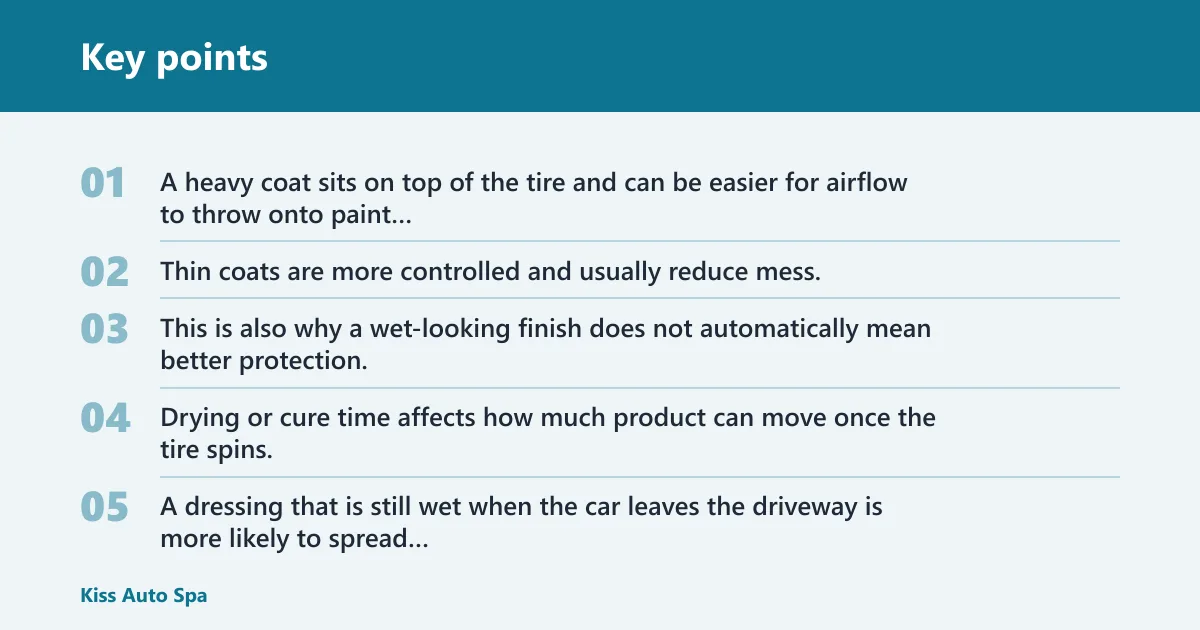
A heavy coat sits on top of the tire and can be easier for airflow to throw onto paint and wheel faces. Thin coats are more controlled and usually reduce mess, especially when the sidewall has raised lettering or deep texture that can trap surplus dressing. This is also why a wet-looking finish does not automatically mean better protection; gloss level is mainly visual, not proof of longer-lasting defense.
Why cure time matters before driving
Drying or cure time affects how much product can move once the tire spins. A dressing that is still wet when the car leaves the driveway is more likely to spread onto body panels, while a fully dried finish is less likely to sling. Product labels matter here: wet-tire use is acceptable only when the specific formula says so.
Eco Car Care notes that gloss-heavy drugstore products can sling off onto body panels, which is why application control matters as much as the label. The practical fix is simple: apply less product, let it dry on its own, and wipe away obvious excess before the car moves.
Tire dressing decision matrix
This matrix ties the finish to the use case. If you want a factory-style result with lower visual risk, the no-shine side usually wins. If you want a deeper black sidewall with more drama, glossy tire dressing fits that goal better. UV and ozone exposure can age sidewalls over time, so the finish choice should be based on appearance and maintenance habits, not on gloss as a proxy for protection. Michelin and Bridgestone both note that sunlight, weather, and storage conditions contribute to rubber aging, which is why routine care matters regardless of sheen.
| Use case | Best finish | Reason | Application caution | Expected maintenance |
|---|---|---|---|---|
| Daily driver | No-shine | Looks more natural and less greasy on routine street cars | Apply thinly with an applicator pad to avoid over-shine | Refresh as needed after wash cycles and road grime |
| Weekend/show car | glossy tire dressing | Gives stronger contrast and a more dramatic sidewall | Use light coats and allow cure time to prevent sling | Check before events and touch up for an even wet look |
| Hot sunny climate | No-shine | Pairs well with UV-protection claims without looking greasy in bright light | Avoid thick coats that can bake into an uneven finish | More frequent inspections since heat and UV can shorten appearance life |
| Black paint | glossy tire dressing | Matches the darker body color and creates a stronger visual frame | Keep it off the tread and do not overapply near wheel lips | Watch for dust build-up that can dull the wet look |
| White or light paint | No-shine | Prevents the tire from looking too stark or attention-heavy | Control overspray and wipe raised lettering clean | Top up only when the sidewall starts to fade |
5-point selector for the right finish
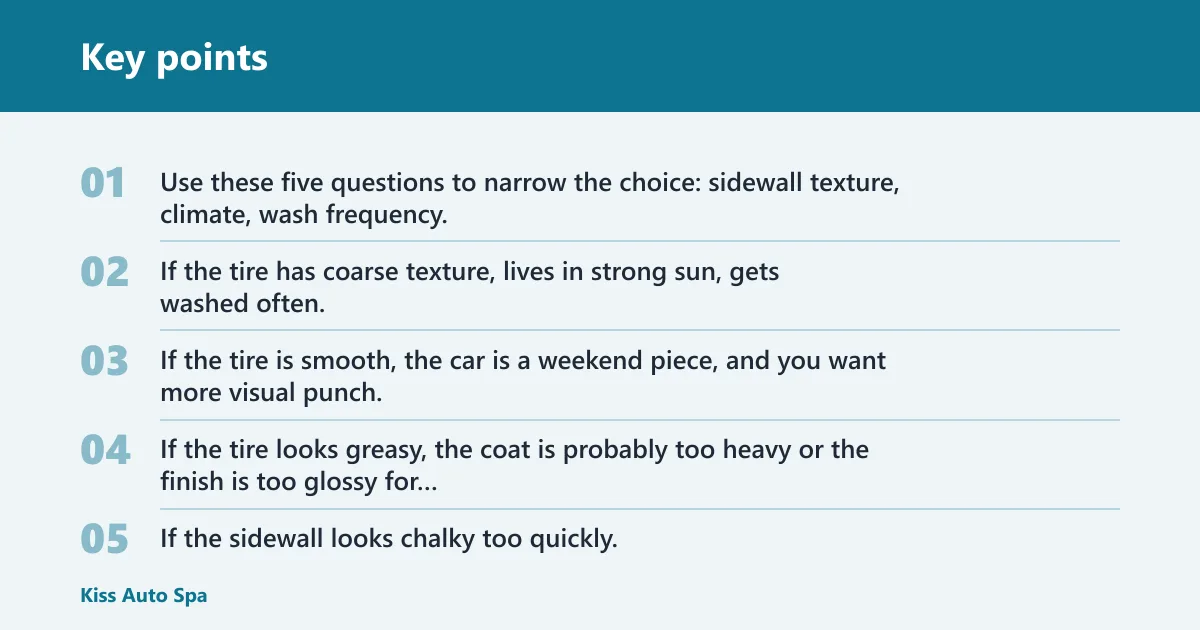
Use these five questions to narrow the choice: sidewall texture, climate, wash frequency, paint color, and tolerance for maintenance. If the tire has coarse texture, lives in strong sun, gets washed often, sits next to light paint, and you want low upkeep, no-shine is the cleaner answer. If the tire is smooth, the car is a weekend piece, and you want more visual punch, glossy makes more sense.
Wrong choice troubleshooting
If the tire looks greasy, the coat is probably too heavy or the finish is too glossy for the car. If the sidewall looks chalky too quickly, the formula or prep may be too light for your conditions. The fix is usually the same: clean the tire again, reapply in thinner layers, and match the gloss level to the vehicle’s role instead of forcing a one-size-fits-all look.
Time2Shine says a satin finish can be achieved by wiping back with microfiber, which is useful when the product comes out glossier than intended. That adjustment gives you a middle ground without starting over.
How long does each finish last?
Finish duration depends on prep, weather, and driving conditions. Appearance longevity and protective longevity are not always the same thing: a tire can look dull sooner than the formula stops offering any benefit. Some glossy products are described as lasting up to 2–3 weeks, while professional dressings are often described as lasting four to eight weeks, but neither figure is universal because tire surface condition and road use change the result. For realistic expectations, use the product’s label claim as the ceiling, not a promise.
Why prep changes longevity
A clean tire sidewall gives dressing a better surface to cling to. Old buildup, road grime, and leftover dressing can interfere with even coverage, so cleaning with a tire brush before application usually improves both appearance and wear.
Water-based formulas are common in many modern dressings because they are often easier to spread thinly and can be more controllable. That control helps maintain a cleaner finish, especially when you want a satin result instead of a heavy shine.
What to expect from each finish
No-shine often fades in a more subtle way, so the tire may still look acceptable even after the initial pop softens. Glossy dressing usually looks strongest at first, then needs closer upkeep to keep the wet-look sidewall even from wheel to wheel.
Choose No-shine if… / Choose glossy tire dressing if…
Choose No-shine if you want a subtle OEM-style look, a daily driver finish that blends with factory wheels, or a lower-risk choice on white or light paint. It also makes sense if you want UV protection claims without calling attention to the sidewall.
Choose glossy tire dressing if you want a showroom-style look, stronger contrast on black paint, or a deeper black appearance that reads more dramatic in photos and at events. It fits best when you are willing to control application thickness and allow full drying time.
Tire dressing should go on a cleaned sidewall, not the tread. Some products can be used on clean wet or dry tires, but a dry, clean sidewall is the safer starting point because it gives you more control over where the product lands and how it dries.
- Wash the tire sidewall with a tire brush to remove old dressing and road grime.
- Rinse and dry the sidewall if the product calls for dry application, or confirm that wet use is allowed.
- Put a small amount of dressing on an applicator pad for controlled coverage.
- Work the product into the sidewall and around raised lettering without touching the tread.
- Let it dry naturally before driving, and buff lightly only if the finish looks uneven or too glossy.
Why an applicator pad is the safer tool
An applicator pad generally gives better control than spraying blindly. It reduces overspray, helps spread the product evenly, and makes it easier to keep dressing out of grooves, wheel barrels, and tread blocks. A dedicated pad is especially useful when you want a clean finish rather than a wet, high-gloss one.
Time2Shine advises not to apply dressing to the tire tread. That warning matters because traction surfaces are not part of the cosmetic finish, and any dressing there can create an unnecessary safety problem. Follow the product label for wet-tire use, but keep the tread clean either way.
What is the difference between matte and glossy tire dressing?
Matte tire dressing, often sold as no-shine, leaves a low-gloss or satin finish that looks closer to untreated rubber. Glossy tire dressing creates a wet-look surface with deeper black color and stronger reflection, which is why it reads more dramatic on the car.
The difference is visual first, but application matters too. A thin, controlled coat can make a glossy product look restrained, while a heavier application can make even a satin product read shinier than intended.
Frequently asked questions
Should I choose no-shine or glossy tire dressing?
Choose no-shine if you want a factory-style daily-driver look with less visual risk and easier upkeep. Choose glossy tire dressing if your goal is stronger contrast, a wetter sidewall, and a finish that stands out more in direct light or at events.
Which tire dressing looks more natural on a daily driver?
No-shine usually looks more natural on a daily driver because it keeps the sidewall close to OEM appearance. It avoids the heavily dressed look that can feel out of place on newer cars, especially when the wheels already have a clean factory design.
Does glossy tire dressing sling off more than matte dressing?
It often can, but the main cause is application thickness and drying time, not the shine level alone. A thick glossy coat that is driven too soon is more likely to sling than a thin, well-controlled coat that is allowed to dry naturally.
How long does a matte tire dressing last compared with a glossy one?
Longevity varies by prep, weather, and driving, so there is no single universal answer. Some glossy products are described as lasting up to 2–3 weeks, while professional dressings may last four to eight weeks; a matte finish can be shorter or similar depending on the formula and conditions.
Can tire dressing be applied to wet tires or only dry tires?
Some formulas can be used on clean wet or dry tires, but a dry sidewall is usually easier to control and inspect. If the product label allows wet use, make sure the tire is still clean and keep the dressing off the tread and braking surfaces.
What finish is best if I want UV protection without a greasy look?
No-shine is the safer fit when you want UV protection claims without a greasy appearance. Many water-based formulas also mention hydrophobic protection, which can help the tire shed water while still keeping the sidewall at a low-gloss level. UV exposure still ages rubber over time, so the main benefit is controlled appearance plus routine care, not a permanent shield.
How do I keep tire dressing from looking too shiny?
Use a water-based formula, apply it with an applicator pad, and start with a thin coat. If the finish still looks too glossy, wipe back lightly with microfiber to knock the sheen down and let the sidewall dry fully before driving.
Will no-shine tire dressing still darken faded tires?
Yes. No-shine dressing still darkens faded rubber; it just does so with a matte or satin finish instead of a wet look. That makes it useful when you want the tire to look refreshed without making the sidewall appear heavily coated.
Which tire dressing is better for a showroom-style look?
Glossy tire dressing is the stronger pick for a showroom-style look because it creates the deeper black appearance and the stronger visual frame around the wheel. It works best when applied thinly and evenly so the sidewall looks intentional rather than greasy.
Sources
- Michelin on tire care, aging factors, and maintenance basics.
- Bridgestone on tire care and the effects of weather and storage on rubber.
- Meguiar’s for product guidance that emphasizes thin, controlled application and avoiding excess.
- Armor All for realistic longevity ranges and finish expectations on consumer tire dressings.
- 303 Products for water-based tire dressing guidance and finish-control context.