Can a Shop Vac Remove Pet Hair From Car Interiors Well?
Yes, a shop vac removes loose pet hair from car interiors well, but it usually misses hair worked into carpet, seat fabric, and seams. Skip the right sequence, and you waste time, leave odor-causing debris behind, and push hair deeper into the material. This guide shows the best vacuum-first workflow, when agitation is needed, and which attachments work best on each surface.
Can a shop vac remove pet hair from car seats?
A shop vac is often strong on loose hair, crumbs, and grit. It is much less effective on pet hair tangled into car fabric upholstery, especially textured cloth, seam lines, and carpet loops. For those areas, vacuuming works best after you loosen the hair first.
Use a wet/dry vacuum with a hose nozzle that follows the seat shape and a crevice attachment for seams. Suction matters, but airflow and a tip that stays close to the surface matter too. If the nozzle floats too far off the fabric, hair stays put.
What you’ll need
- Wet/dry shop vac
- Hose nozzle
- Crevice attachment
- Rubber glove
- Pumice stone made for cleaning use
- Soft brush or microfiber towel for final pickup
How to use a shop vac on pet hair
- Clear loose debris first. Remove trash, mats, and large dirt before you vacuum. That keeps the nozzle from clogging and lets suction stay focused on hair.
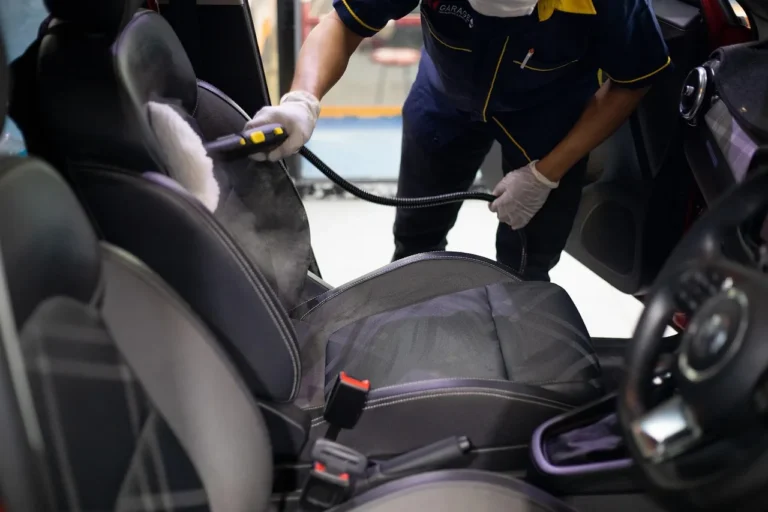
- Start with exposed surfaces. Run the nozzle over seats, carpet, and cargo areas with slow passes. Keep the tip close to the fabric so the suction stays focused on loose hair.
- Switch to the crevice tool. Use the narrow attachment along seams, seat tracks, and the edge where the cushion meets the backrest. Those spots trap hair that a wide nozzle skips.
- Repeat in cross directions. Make a second pass across the first direction, then recheck the same zone. Crosswise passes help lift hair that sits in different directions inside the weave.
- Add agitation where needed. If hair stays embedded after vacuuming, use a rubber glove or a pumice stone on fabric only. Loosen the hair first, then vacuum again right away so it does not resettle.
Pet hair decision table
| Hair type | Seat material | Vacuum result | Recommended next tool | Risk level |
|---|---|---|---|---|
| Loose hair on carpet | Floor carpet | Usually removed well with slow passes | Crevice attachment for edges | Low |
| Embedded hair on cloth seats | Textured fabric upholstery | Often only partial removal | Rubber glove, then vacuum again | Medium |
| Hair along seams | Seat stitching and folds | Usually missed by a wide nozzle | Crevice tool, then spot vacuum | Low |
| Hair in tight weave | Car fabric upholstery | Often clings after several passes | Pumice stone on fabric only | Medium |
| Hair on delicate trim | Perforated or soft surface | Vacuum can pull some loose strands | Vacuum only, light touch | High for abrasion |
What if pet hair is stuck in fabric?
When hair is rooted in fabric fibers, suction alone often leaves a visible layer behind. That is why a vacuum works better as a first pass than as the only pass. The goal is to loosen the hair with friction, then remove it before it clings back to the weave.
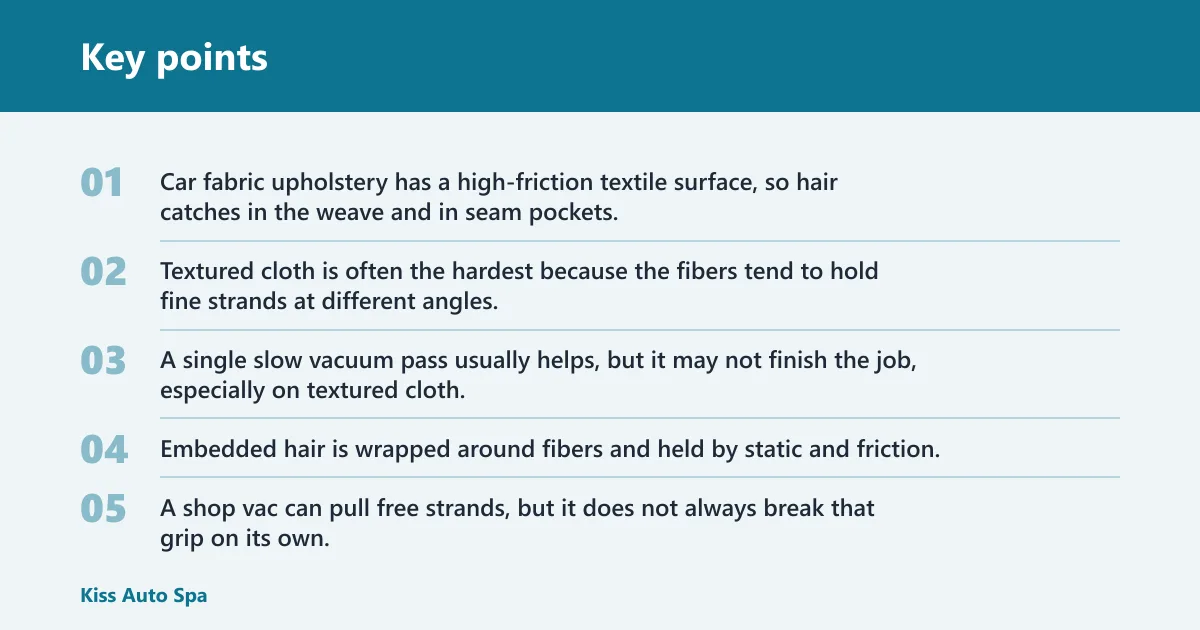
Car fabric upholstery has a high-friction textile surface, so hair catches in the weave and in seam pockets. Textured cloth is often the hardest because the fibers tend to hold fine strands at different angles. A single slow vacuum pass usually helps, but it may not finish the job, especially on textured cloth.
Why a vacuum misses embedded hair
Loose hair sits on top of the material. Embedded hair is wrapped around fibers and held by static and friction. A shop vac can pull free strands, but it does not always break that grip on its own.
A common first-timer mistake is to keep making dry vacuum passes on the same seat for minutes at a time. That can move hair around without lifting it. A better approach is to loosen the hair, then vacuum immediately while it is exposed.
Use a rubber glove first
Rubber gloves work by friction and static. They are a low-cost option for fabric seats and mats, especially where hair sits in a broad patch rather than a deep seam. Swipe in one direction, gather the hair into a roll, then vacuum the pile.
Say your back seat has a band of fine dog hair across the center cushion. A rubber glove lifts that layer quickly, while the shop vac handles the loose clumps left behind. That two-part approach is usually faster than vacuuming alone from the start.
Use a pumice stone with care
A pumice stone can remove pet hair from fabric, and it is helpful where a full-size cleaner is hard to use. The stone can remove pet hair very quickly when you use it on fabric surfaces that tolerate light abrasion. It should be good quality so it does not chip, flake, or leave residue.
Pumice is best for fabric, not delicate surfaces. Keep it away from soft plastics, leather, perforations, and trim edges. If the seat cover is thin or the weave already looks worn, start with a glove instead.
Can a shop vac remove pet hair from car interiors well? Yes, for loose hair and debris. For embedded hair, use agitation first and vacuum second.
When to stop and change tools
If the same section still looks fuzzy after about two vacuum passes and one agitation pass, stop and switch tools. Move to the next method. That keeps you from wearing the fabric while chasing a few stubborn strands.
Keep a pumice stone in the glove box or trunk if you want a cheap helper tool that is easy to store. A stone can cost less than ten dollars, but only if you pick one that is meant for cleaning and not one that sheds grit.
Common mistakes
Most problems come from using the wrong order. Vacuuming first is right for loose hair, but it is often not enough on fabric by itself. If you skip agitation on textured cloth, you leave embedded hair behind.
- Using only a wide nozzle. A wide head can miss seams and tight corners. Switch to the crevice attachment for seat edges and stitching.
- Scrubbing delicate surfaces. Pumice can mar soft or perforated surfaces. Limit abrasive tools to fabric seats and mats.
- Overworking one spot. Too many dry passes can waste time. Add friction after the first pass, then vacuum again.
- Using a poor-quality stone. A stone that chips or flakes can leave residue behind and scratch the surface.
- Skipping seam lines. Hair gathers there first. Pull the seat open slightly if needed and use the crevice tool.
Suppose a hatchback cargo area has a thick mat covered in loose golden retriever hair. A shop vac may clear most of it in a few slow passes. If the same hair is packed into the mat fibers, a rubber glove or pumice stone should come before the final vacuum pass.
Frequently asked questions
How do I use a shop vac for dog hair in my car?
Start with debris removal, then vacuum the seats and carpet with the nozzle close to the surface. Use the crevice attachment around seat rails, piping, and stitching. If hair remains in the weave, use a rubber glove or pumice stone on fabric, then vacuum again immediately.
Will a shop vac get pet hair out of carpet and upholstery?
It can get loose hair out of both, and it works well on carpet edges and floor mats. Upholstery with tight or textured fabric usually needs an extra step. The vacuum is the cleanup tool; the glove or stone is the loosen-up tool.
What tool helps a vacuum grab embedded pet hair?
A rubber glove is the simplest option for friction-based pickup, and a pumice stone is the stronger abrasive helper for fabric. Use either one to lift the hair first, then vacuum right away. That sequence matters more than the brand of vacuum head.
Why does vacuuming alone not remove pet hair from fabric?
Hair works down into the fibers and clings by static and friction. A suction tool can remove loose strands, but it cannot always break the grip inside textured cloth. That is why one agitation pass often saves more time than five extra vacuum passes.
Is a pumice stone safer than a vacuum for pet hair on car seats?
Not automatically. A good pumice stone can be very effective on fabric, but it can chip, flake, or mar delicate surfaces if used carelessly. The safest choice depends on the material: fabric seats and mats can handle it better than perforated trim or soft upholstery.
Can I keep a pumice stone in my car for pet hair cleanup?
Yes, if you choose a decent-quality stone and store it where it stays clean and dry. The glove box or trunk is a practical place. Keep it away from delicate trim and use it only on fabric surfaces, then finish with the shop vac.