Acid Wheel Cleaner vs Non-acid: When Is Each Safe?
A common rule of thumb is to use acid only on bare, acid-safe wheels with heavy mineral brake dust or oxidation, and to keep dwell to about 30–60 seconds; choose non-acid for coated, painted, polished, anodized, or unknown wheels. Wrong chemistry can stain, dull, etch, or pit a finish fast. This guide explains a finish-first decision rule based on wheel material, contamination type, and dwell-time risk.
| Decision factor | Acid wheel cleaner | non-acid | Winner |
|---|---|---|---|
| Finish safety | Higher risk on sensitive finishes; acidic formulas can discolor, etch, or corrode incompatible wheel finishes. | Usually safer for routine use, but finish compatibility still matters because non-acid does not automatically mean pH-neutral. | non-acid |
| Heavy brake dust and oxidation | Often stronger on mineral-heavy contamination and neglected buildup, especially when the wheel is acid-safe. | Can handle routine grime well; stronger alkaline versions can increase cleaning power, but may still need agitation on baked-on deposits. | Acid wheel cleaner |
| Control and mistake tolerance | Needs tighter control of dilution and contact time; leaving it on too long increases damage risk. | More forgiving for maintenance washing, but hot wheels, direct sun, and drying still create risk. | non-acid |
| Best fit use case | Reserved for specific heavy contamination on compatible finishes. | Better for regular cleaning on clear-coated, chrome, painted, powder-coated, and similar finishes. | non-acid |
Acid wheel cleaner vs non-acid: the safety trade-off
Finish compatibility matters more than the label. Acid wheel cleaner uses acidic chemistry to break down contamination on a wheel surface, while non-acid formulas may use surfactants, detergents, and alkaline cleaning agents instead. The right choice is the one that fits the wheel finish and the grime level, not the one that sounds stronger.
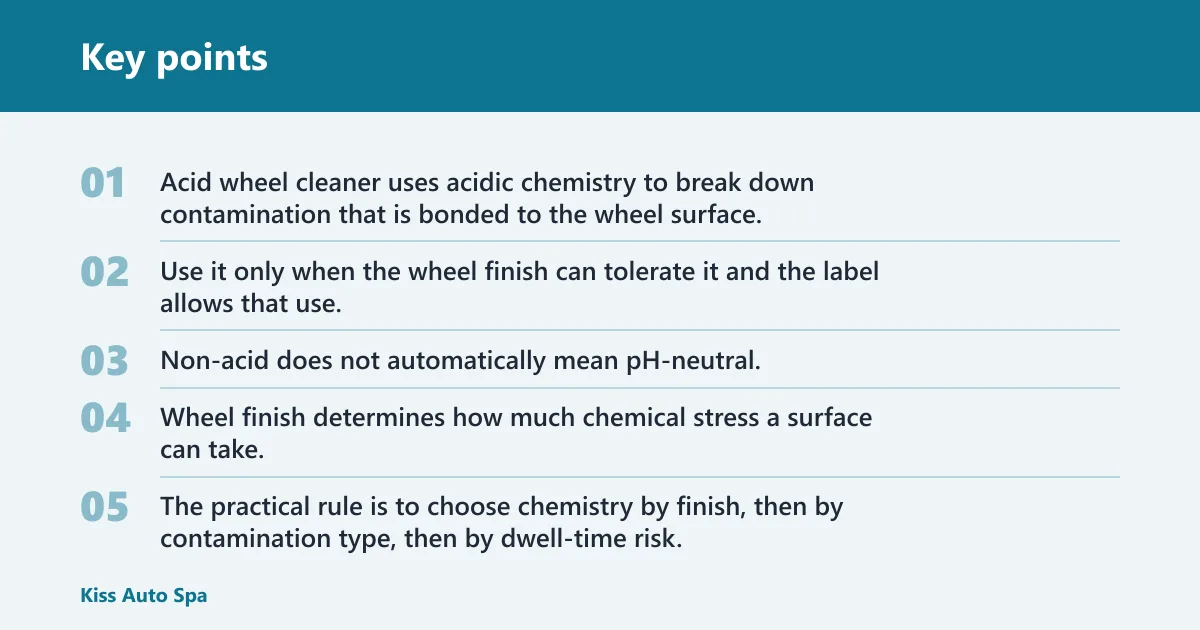
A quick rule is simple: acid is for specific, acid-safe wheels with severe mineral contamination, and non-acid is the better starting point for routine cleaning and most finished wheels. That is especially true when the wheel material is unknown, because the wrong chemistry can create staining, haze, etching, or corrosion before the wheel has a chance to dry.
What acid wheel cleaner is and where it fits
Acid wheel cleaner uses acidic chemistry to break down contamination that is bonded to the wheel surface. It can be effective on heavy mineral brake dust and oxidation, but it also carries higher risk on sensitive finishes, so dilution and contact time must be controlled tightly.
Use it only when the wheel finish can tolerate it and the label allows that use. Acidic formulas can discolor, etch, or corrode incompatible wheel finishes, and leaving acid on too long increases damage risk.
What non-acid wheel cleaner is and where it fits
Non-acid does not automatically mean pH-neutral. It may be mildly alkaline or strongly alkaline, and those stronger alkaline formulas can approach the risk of acid on delicate finishes if they are left too long or used on the wrong material.
Many non-acid cleaners are built for routine maintenance because they use surfactants and detergents to loosen grime without the same level of acid attack. That said, the finish still decides the final choice, and label instructions still matter.
Why finish type matters more than the label
Wheel finish determines how much chemical stress a surface can take. Clear coat, chrome, painted, powder-coated, polished, anodized, matte black chrome, and bare or uncoated aluminum all react differently, so the same bottle can be safe on one wheel and unsafe on another.
The practical rule is to choose chemistry by finish, then by contamination type, then by dwell-time risk. That order prevents the common mistake of reaching for the strongest bottle when the wheel only needs a gentler cleaner plus a brush.
Wheel cleaner comparison table
Here is the practical comparison. Acid can win on severe contamination, but non-acid wins more often because it is easier to use safely on common finished wheels. The real decision point is whether the wheel finish can tolerate the chemistry long enough for it to work.
| Criterion | Acid wheel cleaner | non-acid | Winner |
|---|---|---|---|
| Routine maintenance | Usually more aggressive than routine use requires. | Common maintenance choice for frequent washes. | non-acid |
| Severe mineral brake dust | Often better when the finish is compatible. | May need agitation or a second pass. | Acid wheel cleaner |
| Finish safety margin | Lower on sensitive finishes. | Higher, but not automatic or universal. | non-acid |
| Control required | High. | Moderate. | non-acid |
Routine maintenance
For weekly or frequent washing, non-acid is the cleaner to start with. A pH-balanced wheel cleaner is commonly positioned as a safer choice for chrome, polished, painted, and powder-coated wheels, though it may still need agitation when brake dust is heavy.
That does not make it harmless. Non-acid cleaners can still be too strong for a sensitive finish if they are left on too long or allowed to dry in the sun.
Severe contamination
When contamination is baked on, acid may cut through it faster on a compatible wheel. That is the one case where acid can have a real advantage, especially on wheels that have heavy mineral deposits or neglected oxidation.
If the cleaner needs a long dwell time to work, the risk rises. At that point, a softer approach with a wheel brush or a professional service is usually safer than forcing the chemistry to do all the work.
Which wheel finishes can take which chemistry?
Finish is the first filter. A wheel can look similar from ten feet away and still react very differently once cleaner touches it, especially around spokes, lug recesses, and the barrel where chemical residue can linger.
Clear-coated wheels
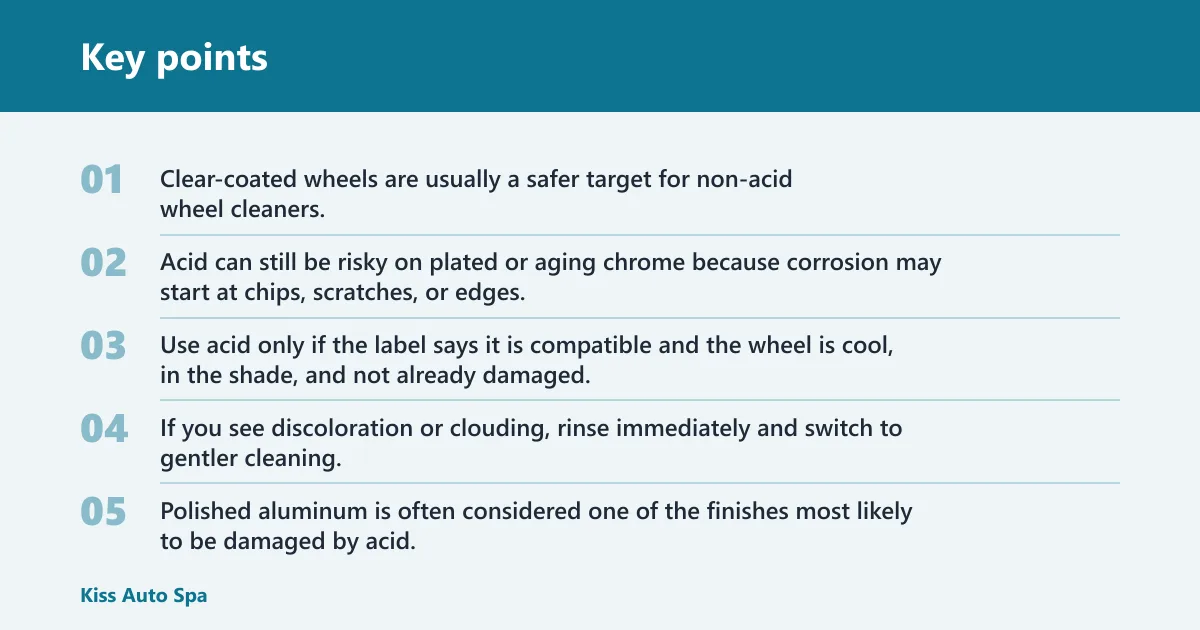
Clear-coated wheels are usually a safer target for non-acid wheel cleaners. Acid can be too aggressive if the clear coat is thin, damaged, or already compromised, and any sign of haze or dulling is a stop condition.
Chrome wheels
Chrome often tolerates a pH-balanced or other non-acid maintenance cleaner better than acid, especially for regular washing. Acid can still be risky on plated or aging chrome because corrosion may start at chips, scratches, or edges.
Use acid only if the label says it is compatible and the wheel is cool, in the shade, and not already damaged. If you see discoloration or clouding, rinse immediately and switch to gentler cleaning.
Polished wheels
Polished aluminum is often considered one of the finishes most likely to be damaged by acid. Can acid wheel cleaner damage polished aluminum wheels? Yes, it can discolor, etch, or dull them fast if the finish is not specifically acid-safe.
For polished wheels, a non-acid cleaner plus a soft brush is the safer path. If the wheel is heavily oxidized, professional polishing or a dedicated polish product is usually a better next step than acid.
Painted and powder-coated wheels
Painted and powder-coated wheels usually favor non-acid cleaning. A pH-balanced wheel cleaner is often the first pick, especially for regular brake dust, road film, and winter salt residue.
Do not assume stronger is better. A strong alkaline cleaner can still dull or mark a delicate coating if it sits too long, so dwell control matters here too.
Bare or uncoated aluminum
Bare or uncoated aluminum needs caution. It is not a blanket green light for acid, because uncoated aluminum can stain, pit, or oxidize when the chemistry is wrong or the dwell time is too long.
If the finish is truly bare and the contamination is severe, the label must explicitly allow that use. If the surface is polished, brushed, or already hazy, start with the gentlest compatible cleaner and a brush instead.
Anodized wheels
Anodized wheels are often sensitive enough that non-acid is usually the safer starting point. Acid can attack the appearance quickly if the finish is not compatible, and the damage may show up as dull spots or color change.
When in doubt, treat anodized wheels as high risk. If the cleaner label does not clearly support anodized finishes, do not use acid.
Matte or black chrome wheels
Matte finishes and black chrome demand restraint because any chemical unevenness can leave visible blotching. Non-acid is the better default, but even then, test a small area if the label gives that option.
If a cleaner leaves a haze or changes the sheen, stop immediately. The safest next step is often a soft brush and a rinse, not a stronger chemical.
What kind of brake dust are you removing?
Brake dust is not one thing. Routine buildup, baked-on deposits, and embedded ferrous contamination each respond differently, so a cleaner that works on one type may struggle with another.
Routine brake dust
Routine brake dust is the easy case. A non-acid cleaner, especially a pH-balanced wheel cleaner, is usually enough when the dust is fresh and the wheel has been maintained regularly.
If the wheel still feels gritty after the spray sits for the label’s dwell time, use a soft wheel brush. That is often faster and safer than reaching for acid.
Baked-on deposits
Baked-on deposits are where stronger chemistry starts to make sense. Acid wheel cleaner can help on compatible wheels, but only with short dwell and immediate rinsing if the surface starts to change color or look dull.
A stronger non-acid alkaline cleaner may also work here, but it is not automatically safer. Strong alkaline products can increase cleaning power, yet they can also raise surface risk on delicate finishes.
Embedded ferrous contamination
Embedded ferrous contamination is often the most stubborn type of brake dust. Some non-acid products are designed for this job and may change color as they react, but that does not make them universally safe for every finish.
Use finish compatibility as the gatekeeper. If the wheel is sensitive, a color-changing non-acid product still needs the same caution, rinsing discipline, and brush support as any other cleaner.
How dwell time changes the risk
Dwell time is one of the biggest safety variables. The label is the primary limit, and the cleaner should never dry on the wheel because drying concentrates residue and increases the chance of staining, haze, etching, or corrosion.
Safe dwell-time limits
A practical upper bound for many wheel cleaners is 3 to 5 minutes, but the label always wins. Acid products often need less time than that, and some should be rinsed far sooner if the surface is sensitive or the contamination starts to lift quickly.
-
Start on a cool wheel.
Work in the shade and spray only one wheel at a time. The guide recommends cleaning cool wheels in the shade because heat and direct sun shorten the safe working window. -
Watch the surface closely.
Set a timer for the label’s dwell time and stay near the wheel. If the product begins to dry, turn hazy, or leave an uneven film before the timer ends, rinse immediately. -
Rinse before drying.
Use plenty of water and flush the spokes, lug area, and barrel. The goal is to remove the chemistry before it concentrates on edges, trim, or coated surfaces.
Hot wheels, sun exposure, and drying risk
Hot wheels and direct sun make any cleaner less forgiving. Product flashes faster, residue sticks harder, and even a normally safe formula can leave marks if it dries before you rinse it off.
That is why cool wheels in the shade are the default recommendation. If you cannot cool the wheel first, wait rather than forcing a longer dwell.
When agitation matters more than stronger chemistry
If the wheel is safe for the finish but the grime is still there, use agitation before escalating chemistry. A soft brush reaches tight spokes and the barrel where cleaner alone may not move baked residue.
A common first-timer mistake is to spray a stronger bottle twice instead of brushing once. That often increases risk without solving the real problem.
Wheel cleaner decision matrix
This matrix turns the finish-first rule into a quick decision tool. Match the wheel finish to the contamination level, then choose the least aggressive cleaner that can still do the job safely.
| Finish | Typical risk | Preferred chemistry | Red flags | Brush or professional service? |
|---|---|---|---|---|
| Clear-coated | Moderate if the clear coat is damaged; lower when intact | non-acid | Haze, dull spots, drying before rinse | Brush first; professional service if staining remains |
| Chrome | Moderate to high if chipped or aged | non-acid | Clouding, corrosion at chips, uneven sheen | Brush first; professional service if corrosion is present |
| Polished | High | non-acid | Discoloration, etching, dulling | Brush only; professional polishing if oxidation is heavy |
| Painted or powder-coated | Moderate | non-acid | Softened gloss, streaking, residue in edges | Brush first if contamination is heavy |
| Bare or uncoated aluminum | High | non-acid unless the label explicitly approves acid use | Pitting, staining, oxidation, finish change | Brush first; professional help if the surface is already oxidized |
| Anodized | High | non-acid | Color shift, dull patches, etched look | Brush first; professional service if the finish is uncertain |
| Matte or black chrome | Moderate to high | non-acid | Blotching, sheen change, film lines | Brush first; professional service if the finish response is uneven |
Say your winter wheels have a gray salt film and light brake dust on clear coat. A pH-balanced non-acid cleaner is the right first move, and a soft brush on the spokes usually finishes the job without risking the coating.
Suppose a neglected set of compatible, acid-safe wheels has heavy orange-brown mineral buildup in the barrel. Acid wheel cleaner may be the better choice, but only with short dwell, immediate rinse, and a stop at the first sign of haze or discoloration.
Choose Acid wheel cleaner if… / Choose non-acid if…
Choose Acid wheel cleaner if… the wheel finish is explicitly acid-safe, the contamination is heavy and mineral-based, and you can control dwell time closely. It fits neglected wheels, oxidation, or baked-on brake dust better than routine maintenance. If the wheel is polished, anodized, matte, unknown, or already damaged, skip acid.
Choose non-acid if… the wheel is clear-coated, chrome, painted, powder-coated, polished, anodized, or you are not sure about the finish. It is also the better choice for routine washes, winter salt film, and most daily brake dust. If the grime is stubborn, switch to a soft brush or a stronger compatible non-acid formula before moving to acid.
Frequently asked questions
Is acid wheel cleaner safe on clear-coated wheels?
Sometimes, but only if the label explicitly allows that finish and the clear coat is intact. Clear-coated wheels are usually better served by non-acid maintenance cleaning because acid raises the risk of discoloration, etching, or dulling if it dwells too long or starts to dry.
When should I use a non-acid wheel cleaner instead of acid?
Use non-acid for routine cleaning, unknown finishes, and most coated wheels. It is also the safer choice when the wheel is hot, the day is sunny, or you expect to spend time brushing spokes and barrels. Acid belongs only on specific, acid-safe wheels with severe contamination.
Can acid wheel cleaner damage polished aluminum wheels?
Yes. Polished aluminum is one of the finishes most vulnerable to acid, and the damage can show up quickly as discoloration, haze, or etching. If the wheel is polished or already oxidized, a non-acid cleaner and soft brush are safer than trying to strip the finish with acid.
Are non-acid wheel cleaners always pH neutral?
No. Non-acid does not automatically mean pH-neutral. Non-acid products can be mildly alkaline or strongly alkaline, and stronger versions can still create surface risk if they are used on delicate finishes or left on too long.
How long can wheel cleaner safely dwell before rinsing?
Follow the label first. A quick guidance range is 3 to 5 minutes, but some acid products need less time, and any cleaner should come off before it dries on the wheel. Heat, sun, and overspray shorten the safe window.
What should I use for heavy baked-on brake dust?
Start with the least aggressive cleaner that still matches the finish, then use a soft wheel brush. If the wheel is compatible and the contamination is mineral-heavy, acid wheel cleaner can be the stronger option. If the finish is sensitive, a stronger non-acid cleaner plus agitation is usually safer.
Do I need a different wheel cleaner for chrome or powder-coated wheels?
Usually, yes. Chrome and powder-coated wheels are commonly better matched to a pH-balanced or other non-acid maintenance cleaner, especially for regular washing. The same product can still require brush agitation on heavy brake dust, and any sign of clouding or streaking means you should rinse and stop.