Wheel Cleaner vs Iron Remover: Which Should You Use?
Use wheel cleaner for road film, brake dust, and grime. Use iron remover when you see orange-brown specks or bonded brake dust, and use both for neglected wheels with mixed contamination. The wrong product wastes time and can leave corrosive brake dust on the finish. This guide shows how to match each product to contamination type, wheel material, and clear coat safety.
Wheel cleaner vs iron remover
| Factor | Wheel cleaner | iron remover | Winner |
|---|---|---|---|
| Main job | Removes road film, grease, tire residue, mud, and loose brake dust | Targets bonded ferrous contamination and embedded fallout | tie |
| Best first use | Routine washing and first-pass cleaning | After normal washing, or before decontamination and polishing | Wheel cleaner |
| Finish sensitivity | Safer starting point when the label matches the finish; pH-neutral is the safest default for unknown finishes | Useful only when contamination remains; finish approval still matters | Wheel cleaner |
| Clue that it will help | Visible film, greasy residue, loose dirt, muddy buildup | Orange or brown specks, rough feel after washing, brake dust fallout | tie |
| Workflow role | Prepares the wheel for inspection and rinsing | Finds and removes iron contamination that survives washing | tie |
Main job
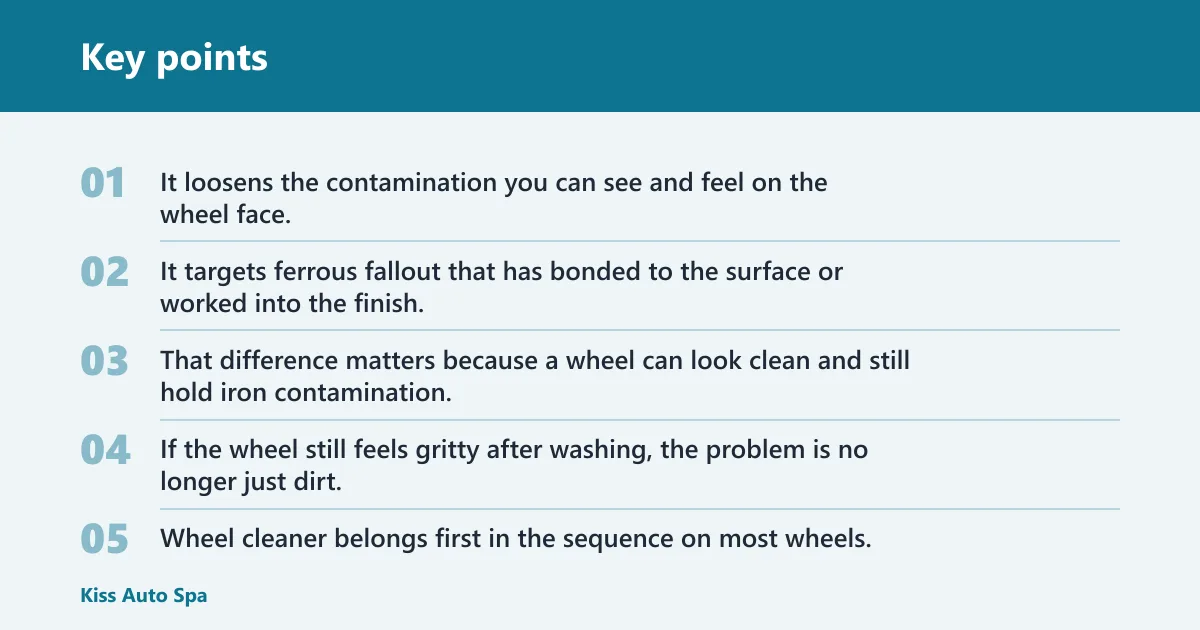
Wheel cleaner handles surface work. It loosens the contamination you can see and feel on the wheel face, including road grime and loose brake dust. Iron remover is narrower. It targets ferrous fallout that has bonded to the surface or worked into the finish.
That difference matters because a wheel can look clean and still hold iron contamination. If the wheel still feels gritty after washing, the problem is no longer just dirt.
Best first use
Wheel cleaner belongs first in the sequence on most wheels. It clears the loose layer that would block an iron remover from reaching embedded contamination. Iron remover adds value after that step, especially when the wheel has brake dust that did not rinse away.
A common first-timer mistake is spraying iron remover on a wheel packed with baked-on brake dust and salt without first rinsing away loose grit. The product can react with the top layer, but the wheel still needs the cleaning step underneath.
Finish sensitivity
Wheel cleaner is still not one universal safety category. A pH-neutral wheel cleaner is the safest starting point for unknown finishes, while alkaline and acid formulas need more caution and label approval. That matters most on chrome-plated wheels and polished bare aluminum.
Iron remover also needs finish awareness, ventilation, and PPE. Its job is contamination removal, not blanket compatibility.
What each product removes
Wheel cleaner removes the surface layer: road film, grease, tire residue, mud, and loose brake dust. Iron remover handles bonded ferrous contamination, including fallout from brake pads and rotors. Neither product removes damage, oxidation, curb rash, or etched stains that have already changed the finish.
Wheel cleaner
Wheel cleaner is a maintenance detergent. It can be pH-neutral, alkaline, or acidic, and typical dwell time is 1-3 minutes. It should not dry on the surface. On clear-coated alloy wheels, a pH-neutral or mild cleaner is usually the starting point.
Iron remover
iron remover is a ferrous-contamination treatment. It commonly uses sodium thioglycolate or ammonium thioglycolate, and typical dwell time is 3-7 minutes. The red, purple, or magenta bleed means the chemistry is reacting with accessible iron, not that the wheel is fully clean.
What neither product fixes on its own
Neither product removes damage, oxidation, curb rash, or etched stains that have already altered the finish. Acid wheel cleaners can help with mineral deposits and baked-on residue, but they are specialized tools, not the default answer for stubborn grime. Hydrofluoric acid is especially severe, so label caution matters.
How the chemistry differs
Wheel cleaner works as a maintenance detergent. It uses surfactants, alkaline builders, or acids to lift surface contamination so you can rinse it away. Iron remover works through thioglycolate-based chemistry that complexes iron and can change color as it reacts.
Why reaction color is not the same as full decontamination
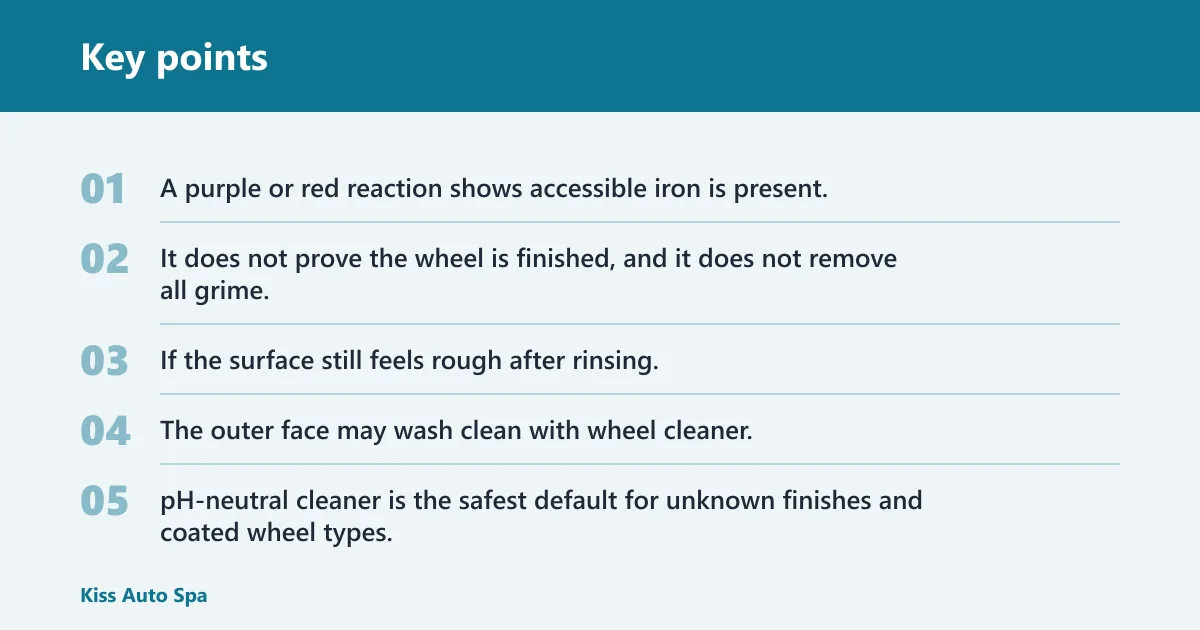
A purple or red reaction shows accessible iron is present. It does not prove the wheel is finished, and it does not remove all grime. If the surface still feels rough after rinsing, a second cleaning pass or a separate decontamination step may still be needed.
Picture a sedan that gets daily highway use. The outer face may wash clean with wheel cleaner, yet the spokes can still bleed purple after iron remover because brake dust fallout was embedded in the finish.
Wheel cleaner types
pH-neutral cleaner is the safest default for unknown finishes and coated wheel types. Alkaline wheel cleaner is better for grease and heavy road film, and may be diluted per manufacturer directions. Acid wheel cleaner is for mineral deposits and baked-on residue, not as a first upgrade.
Iron remover chemistry
Thioglycolate-based chemistry is common in iron removers. It is effective on brake dust fallout because brake dust contains tiny iron particles shed by brake pads and rotors, and iron is a ferrous metal that oxidizes. That is why these products can turn orange, purple, or magenta during use.
Which wheel finishes are safest?
Finish compatibility matters as much as contamination type. Clear-coated alloy wheels usually start with a pH-neutral or mild wheel cleaner on a cool surface. Chrome-plated wheels need label-approved chemicals and shorter dwell times, while polished bare aluminum is more sensitive to acid.
Clear-coated alloy wheels
Clear-coated alloy wheels are generally the most straightforward use case. Start with a pH-neutral or mild wheel cleaner, apply it only when the wheel is cool, and keep it wet through the dwell period. If brake dust remains after rinsing, iron remover can be the next step.
Chrome-plated wheels
Chrome-plated wheels need more caution. Compatibility depends on the label, and unapproved acids are a risk. Shorter dwell times are the safer approach, especially if the wheel finish is aging or has pitting.
Polished bare aluminum wheels
Polished bare aluminum is more sensitive to acid than a coated wheel face. Neutral cleaner is the safer default. If you need more cleaning power, stay with the least aggressive product that matches the contamination and the label instructions.
Do you need iron remover on dirty wheels?
Not every dirty wheel needs iron remover. Lightly driven daily-driver wheels often clean up with wheel cleaner alone, especially if the grime is mostly road film and loose brake dust. Iron remover becomes more useful when washing leaves behind roughness, specks, or visible fallout.
Lightly driven daily-driver wheels
If the wheel only has dust, film, and normal brake residue, wheel cleaner is often enough. The goal is routine maintenance, not full decontamination. Adding iron remover in that case may be unnecessary extra work.
Wheels that still feel rough after washing
Rough or gritty texture after a normal wash points toward bonded contamination. Embedded iron can make a wheel feel rough or gritty after washing. That is the point where iron remover adds value.
Visible orange or brown specks after cleaning
Orange or brown specks can be brake dust fallout or corrosion-related contamination. If those specks remain after wheel cleaner and rinsing, iron remover is the next logical step. If the finish is uncertain, spot-test first on a small area.
Wheel cleaning decision matrix
This matrix uses three inputs: contamination type, wheel finish, and surface condition. It shows when to stop at wheel cleaner, when to add iron remover, and when to wait until the wheel cools or a spot test is done.
| Contamination type | Wheel finish | Surface condition | Recommended sequence |
|---|---|---|---|
| Road film, mud, loose dirt | Clear-coated alloy | Cool, intact finish | Wheel cleaner only; rinse before it dries |
| Grease, tire residue, heavy road film | Powder-coated or painted | Cool, no visible staining | Wheel cleaner first, preferably alkaline if the label allows; add iron remover only if roughness remains |
| Loose brake dust | Clear-coated alloy | Cool, regular maintenance wash | Wheel cleaner first; stop if the wheel rinses clean and feels smooth |
| Orange or brown specks after washing | Clear-coated alloy or powder-coated | Cool, still gritty | Wheel cleaner, rinse, then iron remover; rinse again after bleed stops |
| Mixed road film plus embedded fallout | Chrome-plated, label approved | Cool, surface is intact | Wheel cleaner first, then iron remover with shorter dwell and close label checks |
| Unknown finish or hot wheel | Unknown or bare aluminum | Hot or untested area | Wait for cooldown, then spot-test a small area before choosing either product |
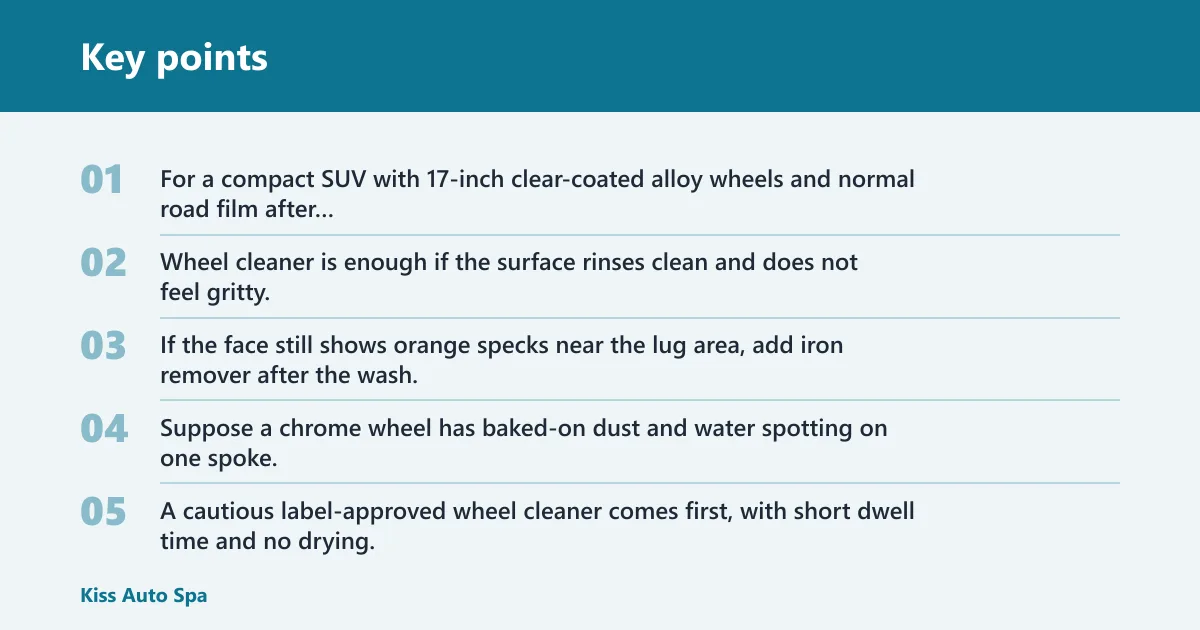
For a compact SUV with 17-inch clear-coated alloy wheels and normal road film after about a week of commuting, the example applies this approach. Wheel cleaner is enough if the surface rinses clean and does not feel gritty. If the face still shows orange specks near the lug area, add iron remover after the wash.
Suppose a chrome wheel has baked-on dust and water spotting on one spoke. A cautious label-approved wheel cleaner comes first, with short dwell time and no drying. If the finish is unknown or already pitted, stop and spot-test before moving to iron remover.
Choose Wheel cleaner if… / Choose iron remover if…
Wheel cleaner wins when the contamination is mostly surface grime and the finish is a normal coated wheel. iron remover wins when the wheel still shows fallout after washing, feels rough, or has visible orange or brown specks that point to bonded iron.
Choose Wheel cleaner if…
Choose Wheel cleaner if the wheel is clear-coated, powder-coated, or painted and only has road film, mud, tire residue, or loose brake dust. Choose Wheel cleaner if the wheel is hot, because you should wait for it to cool before any chemical step. Choose Wheel cleaner if you want the safest starting point on an unknown finish.
Choose iron remover if…
Choose iron remover if a normal wash leaves gritty texture behind. Choose iron remover if brake dust fallout is still visible as orange or brown specks. Choose iron remover if the wheel has mixed contamination and the first cleaning pass did not clear the embedded layer.
- Inspect the wheel when it is cool.
- Start with wheel cleaner unless the finish is unknown or the wheel is hot.
- Rinse thoroughly before the product dries.
- Check for roughness, specks, or residue.
- Add iron remover only if bonded contamination remains.
- Rinse again after the reaction stops.
Frequently asked questions
What is the difference between wheel cleaner and iron remover?
Wheel cleaner removes road film, grease, tire residue, mud, and loose brake dust from the surface. iron remover targets bonded ferrous contamination, including embedded brake dust fallout. One is a maintenance detergent; the other is a ferrous-contamination treatment for deeper cleanup.
Should I use wheel cleaner or iron remover first?
Use wheel cleaner first in most cases. It strips away the loose layer so iron remover can reach contamination that is actually bonded to the wheel. If the wheel is hot or the finish is unknown, wait for cooldown and spot-test before either product goes on the surface.
Can wheel cleaner remove brake dust?
Yes, wheel cleaner can remove loose brake dust. It is the first-pass cleaner for routine wheel washing. If brake dust has bonded or embedded into the finish, wheel cleaner may not remove it completely, and iron remover becomes the better follow-up.
Do I need iron remover for dirty wheels?
Not always. If the wheel is only dirty with film, grease, or loose dust, wheel cleaner is often enough. You need iron remover when the wheel still feels rough after washing, or when orange or brown specks remain that point to embedded brake dust fallout.
Will iron remover damage my wheels?
Iron remover is not automatically damaging, but finish compatibility still matters. Follow the label, use it on a cool surface, ventilate the area, and wear PPE. Do not leave it to dry. On questionable finishes, spot-test first, especially on chrome or polished bare aluminum.
Can I use both wheel cleaner and iron remover on the same wheels?
Yes. That is common on neglected wheels with mixed contamination. The safe order is wheel cleaner first, rinse, then iron remover if bonded iron remains. On heavily contaminated wheels, both products may be needed as separate steps rather than as a single replacement for each other.