How to Dilute Rinseless Wash Concentrate Correctly
Start with the label’s wash dilution, then dilute it about 2 to 4 times further for spray bottles and clay lube, and about 8 to 16 times further for a drying aid. Mixes that are too strong can leave residue, waste product, and reduce slickness instead of adding it. This guide shows how to convert any rinseless wash concentrate into working mixes for buckets, spray bottles, clay lube, and drying-aid use.
What you’ll need
- Measuring spoon, graduated bottle, or other marked measuring tool
- Mixing bottle, bucket, or pump sprayer with a fill line
- Clean water that matches the label and your local water quality
- Distilled water for hard-water areas or residue-sensitive mixes
- Microfiber towels for wipe-off and final drying
- Clean wash mitt or sponge for section-by-section washing
- Optional funnel for clean filling
How do you read a dilution ratio?
A dilution ratio tells you how much concentrate goes into a set amount of water. A common rinseless wash ratio cited is 1:256, and one guide says that equals 0.5 oz of product per gallon of water. If a label lists ounces per gallon instead, use that figure first.
Product labels vary by brand and product line, so forum shortcuts do not override the bottle. If one rinse-less wash calls for 1:256 and another calls for a different dose, mix each one by its own label. A quick way to think about it is simple: the smaller the product number, the stronger the mix.
Rinseless wash conversion table
This table turns common label ratios into practical container fills. For 1:256, the math is linear: about 0.5 oz per gallon, about 0.25 oz per 2 quarts, and about 1.5 oz for 3 gallons. For ratios not listed on the bottle, do not guess; use the manufacturer’s listed dose.
| Label ratio | 16 oz bottle | 32 oz bottle | 1 gallon | 3 gallons | Troubleshooting note |
|---|---|---|---|---|---|
| 1:256 | 0.0625 oz | 0.125 oz | 0.5 oz | 1.5 oz | Good starting point for bucket wash; too-strong mixes may leave residue, too-weak mixes may feel less slick. |
| 1:128 | 0.125 oz | 0.25 oz | 1 oz | 3 oz | Often used for waterless wash-style use; check the label before spraying on paint or trim. |
| 1:64 | 0.25 oz | 0.5 oz | 2 oz | 6 oz | Some labels use this for clay lube; do not assume it is safe for a wash bucket if the bottle does not say so. |
| 1:15 | 1.0 oz | 2.0 oz | 8.53 oz | 25.6 oz | Quick-detailer-style mixes can be much stronger; only use if the product label allows it. |
If you use the same mix in a spray bottle, keep the use case in mind. A bucket wash mix may work in a sprayer for pre-spray or pretreating, but a clay lube or quick-detailer mix needs the label to allow that task. Do not reuse one bottle for every job without checking the ratio first.
Can you use it for more than washing?
Sometimes, yes. Many products can be used beyond a bucket wash, but only within the label’s listed range. A rinseless wash may double as a quick-detailer-style wipe-down, clay lube, or drying aid, yet those uses do not share one universal ratio.
Use separate mixes for separate jobs. A quick-detailer dilution listed at 1:15 is much stronger than a waterless wash dilution at 1:128, and a clay lubricant dilution listed at 1:64 or 1:128 is different again. If the label does not name the task, leave that use out.
Bucket wash
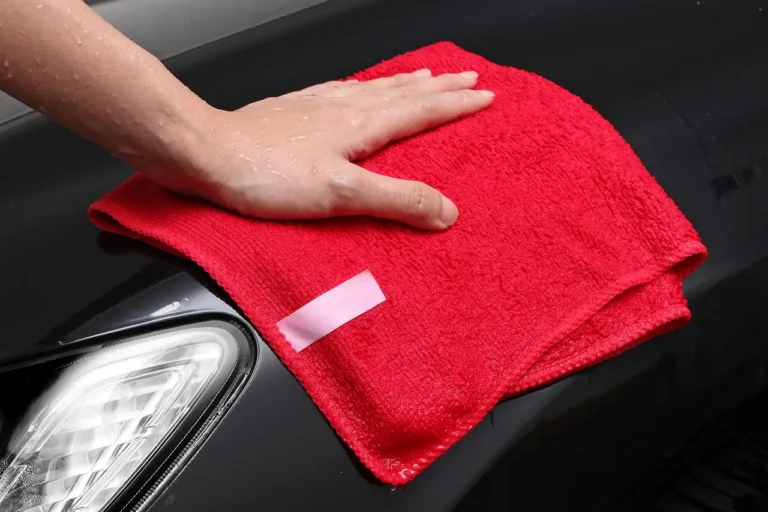
Use the bucket ratio on the bottle, a clean wash mitt or sponge, and microfiber towels for wipe-off. Work section by section. Straight-line passes help limit visible marring, and a fresh towel side keeps dirt from being dragged back across the paint.
Spray bottle pre-spray
A spray bottle or pump sprayer can hold the same dilution if the label allows spraying. That can help pre-wet a dirty panel or pretreat a section before the mitt touches it. Keep the bottle labeled so the mix is not mistaken for a different task.
Clay lube and drying aid
Clay lube and drying-aid use are label-dependent. A guide lists clay lubricant dilution at 1:64 or 1:128, and another lists quick-detailer dilution at 1:15. Do not assume those ratios transfer to every rinseless wash concentrate.
Why water type and temperature matter
Distilled water helps when minerals in tap water are likely to leave spotting or residue. That matters more in hard-water areas, and it matters even more if you pre-mix solution for storage. If your label says filtered water is fine, that still leaves room to choose distilled when spotting is a concern.
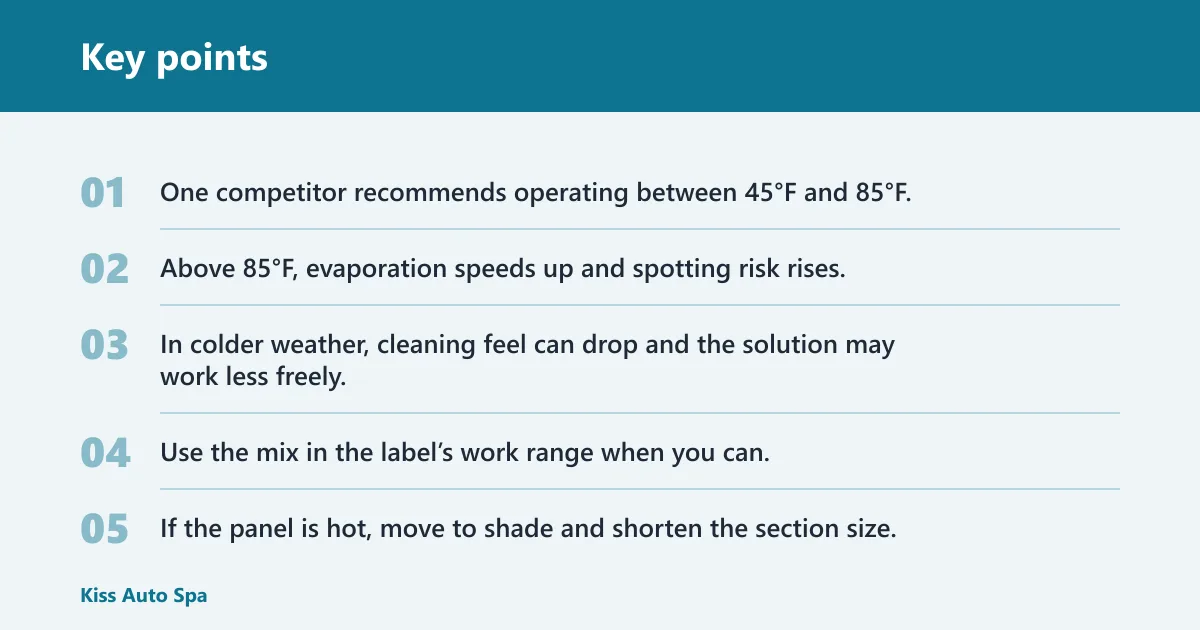
Temperature changes the way the mix behaves. One competitor recommends operating between 45°F and 85°F, and another page gives the same general range. Above 85°F, evaporation speeds up and spotting risk rises. In colder weather, cleaning feel can drop and the solution may work less freely.
Use the mix in the label’s work range when you can. If the panel is hot, move to shade and shorten the section size. If the weather is cold, let the product and water sit at a reasonable indoor temperature first. Warm water can help, but it does not replace the label.
Common mistakes
Guessing the dose is the biggest one. A mix that is too strong can leave residue, haze, or extra drag. A mix that is too weak can feel thin on the towel and may not give the lubrication the label expects. Measure every time.
Using the wrong water is another problem. Tap water may be fine for some products and not for others, especially where mineral content is high. Storage also matters: premixed solution should be checked against the label before long storage, while concentrate usually keeps better in its original bottle.
A common mistake is measuring the concentrate by eye and ending up with a mixture that is far too strong for a lightly soiled sedan. Suppose a 32 oz spray bottle gets filled with a wash ratio meant for a bucket, then sprayed on a dusty door. The result can be weak lubrication and a less consistent wipe.
Another common mistake is working too fast in heat. A 90°F hood can flash-dry a strong spray mix before the towel levels it. Move the car, shrink the working area, and re-wet the towel if the panel starts to dry early.
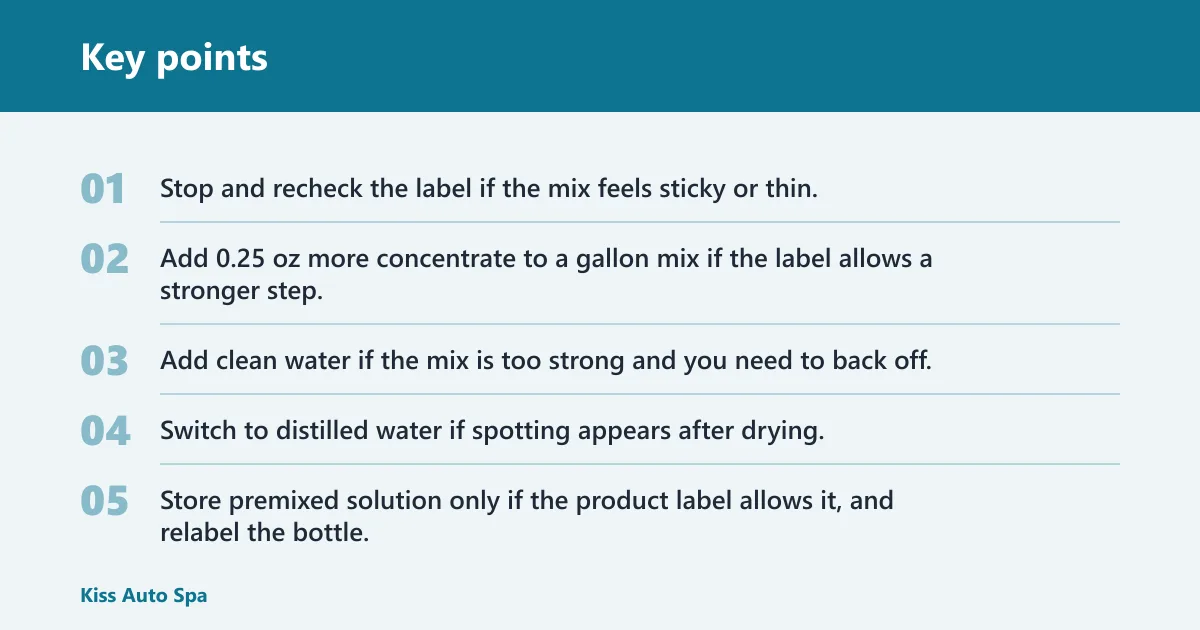
- Stop and recheck the label if the mix feels sticky or thin.
- Add 0.25 oz more concentrate to a gallon mix if the label allows a stronger step, then recheck the result.
- Add clean water if the mix is too strong and you need to back off.
- Switch to distilled water if spotting appears after drying.
- Store premixed solution only if the product label allows it, and relabel the bottle.
Frequently asked questions
How do I dilute rinseless wash concentrate correctly?
Start with the bottle’s wash ratio, measure the concentrate, then fill the container with water to the final mark. If the label gives ounces per gallon, use that number instead of ratio math. For a bucket wash, a clean mitt and microfiber towels finish the job.
What is the dilution ratio for rinseless wash?
There is no single universal ratio. A common rinseless wash ratio cited is 1:256, and one guide equates that to 0.5 oz per gallon. Many products differ, so the label or manufacturer guide should set the final mix, not a forum shortcut.
How much rinseless wash do I put in a gallon?
For a common 1:256 mix, use 0.5 oz per gallon. Some products list a different dose, and one workflow page gives 0.5–1 oz for 1–2 gallons of water. If your bottle gives a gallon-specific amount, use that figure instead.
Can I use rinseless wash as a quick detailer or clay lube?
Only if the label allows those uses. One guide lists a quick-detailer dilution at 1:15, and another lists clay lubricant dilution at 1:64 or 1:128. Do not move a bucket wash mix straight into those tasks without checking the product’s directions.
What happens if I mix rinseless wash too strong?
Too-strong mixes can leave residue, create extra wipe effort, and waste product. They may also leave the surface less pleasant to towel off. If that happens, dilute the batch with clean water, then retest on a small section before continuing the whole panel.
Do I need distilled water for rinseless wash?
Not always, but it is the safer choice in hard-water areas or when spotting is a concern. One guide specifically says to use distilled water for a quick-detailer dilution. If your local water is mineral-heavy, distilled water helps reduce residue and spotting risk.
What temperature is best for rinseless wash?
A practical work range is about 45°F to 85°F. Above 85°F, evaporation speeds up and spotting risk rises. In colder conditions, the mix can feel less effective and may wipe less freely, so keep the product and water closer to room temperature when possible.
Is rinseless wash the same as waterless wash?
No. A rinseless wash is normally used with a bucket, mitt, and microfiber towels, while a waterless wash is usually a spray-and-wipe product for lighter soil. Some products can do both, but the label should name the use and the dilution for each one.