Best Foam Cannon for a Pressure Washer at Home
For many home electric pressure washers, a bottle-fed foam cannon with an adjustable 1.1-mm orifice, a 1/4-inch quick-connect, and a washer rated around 1.4–2.0 GPM is a common choice; that setup usually makes usable foam without starving the pump. Pick the wrong orifice and you get weak suds, poor draw, or a pump that cycles too hard. This guide shows fit checks, pressure-washer limits, and which setup suits electric and gas units at home.
Choosing the right foam cannon for your setup
A common pick for most home setups is a 1/4-inch quick-connect foam cannon with an adjustable 1.1-mm orifice and a 1L bottle. It fits common wands, works well on typical electric washers, and gives enough capacity for a sedan or compact SUV without constant refills.
Top pick for electric pressure washers
Choose the adjustable 1.1-mm, 1/4-inch quick-connect model if your washer sits in the common home-use range and you want a simple setup. That pairing is the safest default for electric machines because it balances draw, foam output, and flow demand.
Best budget pick for first-time buyers
A basic foam cannon with a 1/4-inch quick-connect, a manual foam control knob, and a 1L bottle is enough for many first-time buyers. Skip extra metal trims and fancy packaging if the connector, orifice, and bottle match your washer.
Best pick for SUVs and trucks
For larger vehicles, pick a cannon with a 1L or larger bottle, a wider spray nozzle, and an adjustable soap dial. The extra capacity cuts mid-wash refills, which matters more when you cover more panels and wheel arches.
Best pick if you need adapters
If your washer uses a proprietary fitting or an M22 variation, buy for the adapter first and the cannon second. A good cannon with the wrong connector still fails at the wand, and adapter mismatch is one of the most common purchase errors.
Quick picks by washer type
The right foam cannon depends on washer output, connector type, and vehicle size. A small electric unit, a higher-flow gas washer, and a proprietary gun each point to different choices before brand enters the picture.
| Washer type | Best pick | Key spec | Mismatch warning |
|---|---|---|---|
| Electric washer under common home-use output | 1.1-mm orifice, 1/4-inch quick-connect, 1L bottle | Steady flow and easy setup | Too large an orifice can thin foam fast |
| Higher-flow washer with 1/4-inch quick connect | Adjustable cannon with wider spray and 1L+ bottle | Better coverage on SUVs and trucks | Low GPM can still limit foam even with high PSI |
| Proprietary fitting that needs an adapter | Cannon plus verified adapter for your gun or wand | Connector fit before orifice tuning | M22 variants and proprietary couplers often look similar but do not seat the same |
| Large-vehicle wash with longer sessions | 1L to larger bottle, adjustable fan pattern | Less refilling, wider coverage | Small bottles slow you down on trucks and three-row SUVs |
What should you buy for an electric pressure washer?
For an electric pressure washer, buy a foam cannon with a 1/4-inch quick-connect, an adjustable 1.1-mm orifice, and a 1L bottle. Electric units usually benefit from steady flow more than high headline PSI, so the fit matters more than the finish.
Why steady flow matters more than headline PSI
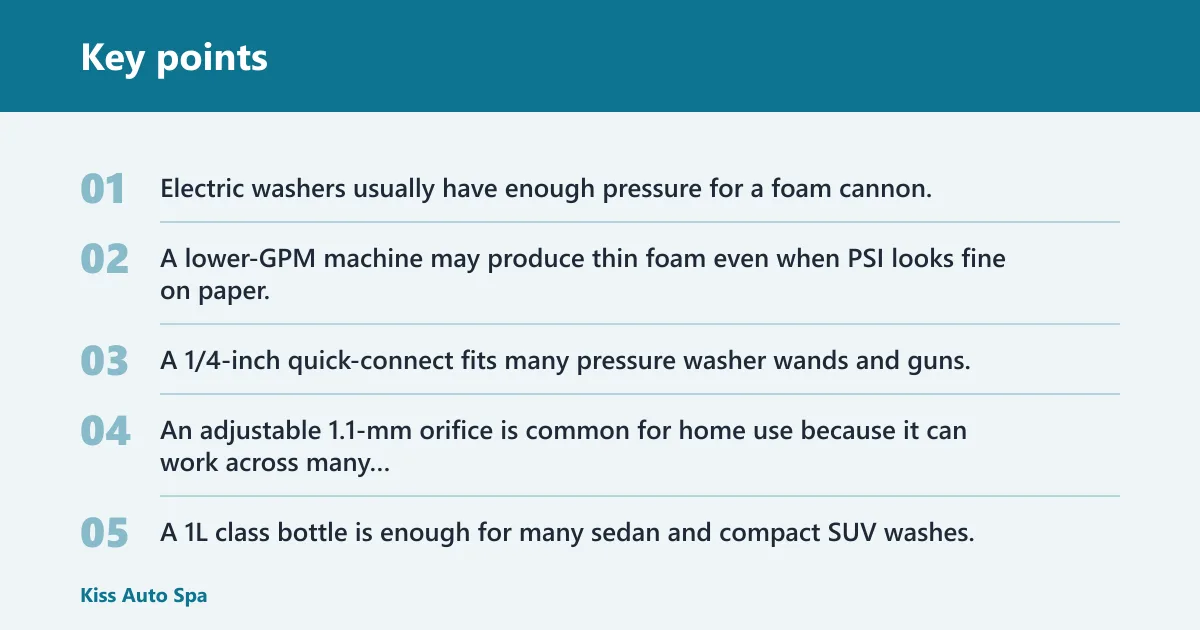
Electric washers usually have enough pressure for a foam cannon, but the water flow rate often controls how well the soap draws through the cannon. A lower-GPM machine may produce thin foam even when PSI looks fine on paper.
Which connector and orifice size usually fit best?
A 1/4-inch quick-connect fits many pressure washer wands and guns, which makes it a common starting point. An adjustable 1.1-mm orifice is common for home use because it can work across many electric machines without turning soap draw into a guessing game.
When a 1L bottle is enough
A 1L class bottle is enough for many sedan and compact SUV washes. It gives enough mix for a normal pre-soak, and it stays light in the hand. Bigger bottles help more when you wash a truck, a three-row SUV, or more than one vehicle in a session.
Say your electric washer is rated 1.8 GPM and you wash a midsize sedan. A 1L bottle, 1.1-mm orifice, and 1/4-inch quick-connect usually cover the car without constant refilling or a hose full of suds that never builds density.
Home setup compatibility matrix
This matrix matches washer output, connector type, bottle size, and scenario to a buy decision. It is the fastest way to separate a true fit from a product that looks right but performs badly on your machine.
| PSI band | GPM band | Connector type | Bottle size | User scenario | Buy recommendation | Mismatch warning |
|---|---|---|---|---|---|---|
| 1,200–1,700 PSI | 1.4–1.8 GPM | 1/4-inch quick-connect | 1L | Sedan, compact SUV, first-time buyer | Best fit for a basic adjustable cannon | Very large orifice settings can make foam watery |
| 1,700–2,300 PSI | 1.8–2.4 GPM | 1/4-inch quick-connect | 1L to 1.5L | SUV, crossover, weekend wash routine | Choose a cannon with adjustable foam and spray control | Low-flow units in this band may still underperform if GPM drops too low |
| 2,300–3,000 PSI | 2.2–3.0 GPM | 1/4-inch quick-connect or adaptered gun | 1.5L+ | Truck, large SUV, longer wash session | Use a higher-capacity bottle and a wider fan pattern | High PSI alone does not guarantee dense foam if the cannon orifice is too large |
| Any home PSI | Any usable GPM | Proprietary fitting with adapter | 1L+ | Washer with special gun or wand connector | Buy the adapter first, then the cannon | Wrong adapter often fails before foam output is even part of the problem |
Which features matter most?
Connector fit and orifice size matter most. After that, the foam control knob and spray nozzle decide how easy the cannon is to tune for a sedan, SUV, or truck. Build quality matters too, but only after the washer-to-cannon match is right.
1/4-inch quick connect and adapter fit
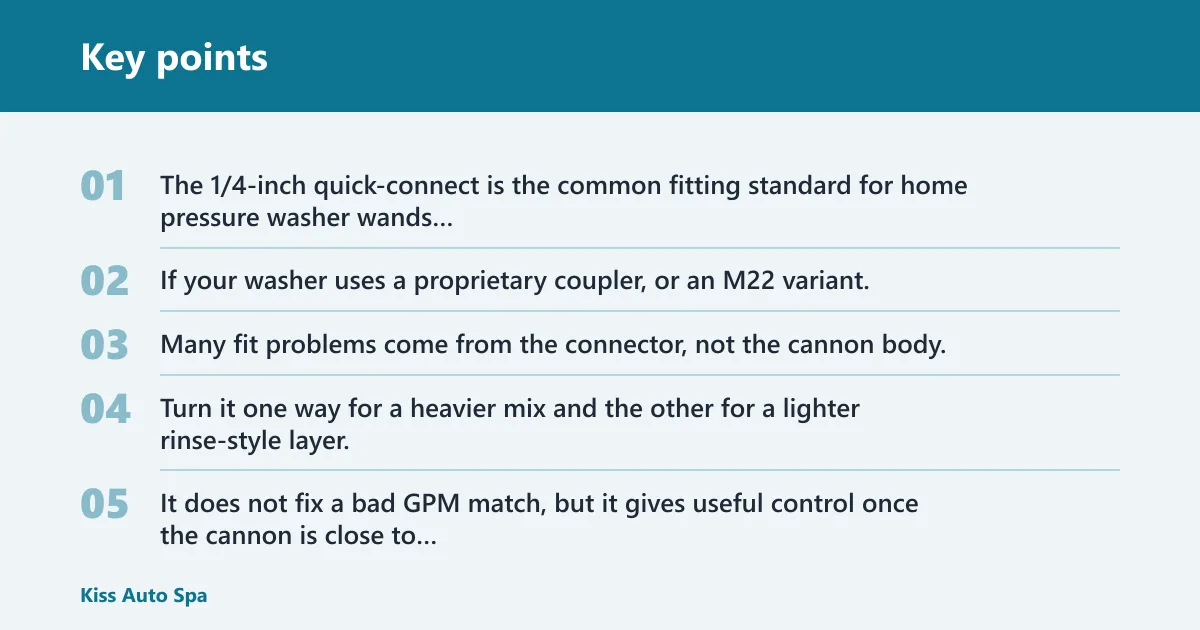
The 1/4-inch quick-connect is the common fitting standard for home pressure washer wands and guns. If your washer uses a proprietary coupler, or an M22 variant, confirm the adapter path before you buy the cannon. Many fit problems come from the connector, not the cannon body.
Adjustable foam control knob
The foam control knob changes soap draw. Turn it one way for a heavier mix and the other for a lighter rinse-style layer. It does not fix a bad GPM match, but it gives useful control once the cannon is close to the right size.
Adjustable spray nozzle
An adjustable spray nozzle changes fan width. A wider fan helps on SUVs and trucks because it covers panels faster. A tighter pattern can help concentrate foam on dirtier sections, but it can slow coverage on larger vehicles.
Orifice size and foam output
Orifice size should match washer output. Too small can starve the flow and make the cannon work harder; too large can thin the foam and reduce cling. That is why a 1.1-mm setup is such a common starting point for home machines.
How do PSI and GPM affect foam?
PSI sets pressure, but GPM drives the water volume that helps draw soap through the cannon. For home use, very high PSI is not the main target. A reasonable PSI range with enough GPM usually matters more than chasing a bigger number on the box.
PSI limits for home use
Most home foam cannons can handle common pressure washer PSI levels, but very high PSI is not the buying goal by itself. The cannon still needs the right connector and orifice, and your washer still needs stable flow.
GPM and soap draw
GPM is the practical flow requirement. If the washer does not move enough water through the cannon, foam output can look thin even with a solid PSI rating. That is the failure case many first-time buyers miss.
Why weak foam often means a mismatch
Weak foam often points to the wrong orifice, low flow, or a connector issue. It is not always the soap. A common first-timer mistake is blaming detergent when the real problem is a cannon sized for a different washer band.
What bottle size should you choose?
A 1L class bottle is the best default for home car washing. It is large enough for most single-vehicle jobs and small enough to handle easily. Larger bottles make sense when you wash bigger vehicles, use more soap, or prefer fewer refill stops.
1L class for most home washes
A 1L bottle keeps the cannon manageable and refills simple. For a sedan or compact SUV, it usually gives enough mix for a full pre-wash and a second pass on problem areas.
Larger bottles for trucks and longer sessions
Choose a larger bottle if you wash a truck, a large SUV, or multiple vehicles in one session. The extra capacity saves time when you do not want to stop and refill halfway through the job.
Refill convenience vs storage space
Larger bottles can be more convenient, but they also take more storage space and add more weight when filled. If your wash routine is short, the 1L class is usually the better tradeoff.
Pick the cannon around the washer first, then the vehicle. That order prevents most bad purchases. The right choice depends on PSI, GPM, connector type, bottle capacity, and whether you need an adapter.
Buy this if you wash a sedan
Buy a 1/4-inch quick-connect cannon with an adjustable 1.1-mm orifice and a 1L bottle. It gives enough capacity and control without adding extra setup steps.
Buy this if you wash an SUV or truck
Buy a cannon with a wider fan, a larger bottle, and confirmed flow compatibility for your washer. Bigger panels need coverage, and coverage matters more than a high foam peak that disappears too quickly.
Buy this if your washer has a proprietary fitting
Buy the adapter path first. Check whether your gun uses M22-14, M22-15, or another proprietary coupler before ordering the cannon. The wrong adapter can leave you with a nozzle that never locks in correctly.
Buy this if you want the lowest-cost start
Buy a basic foam cannon with a 1/4-inch quick-connect, a 1L bottle, and an adjustable dial. That is enough for many first-time buyers, as long as the washer output and connector are a true match.
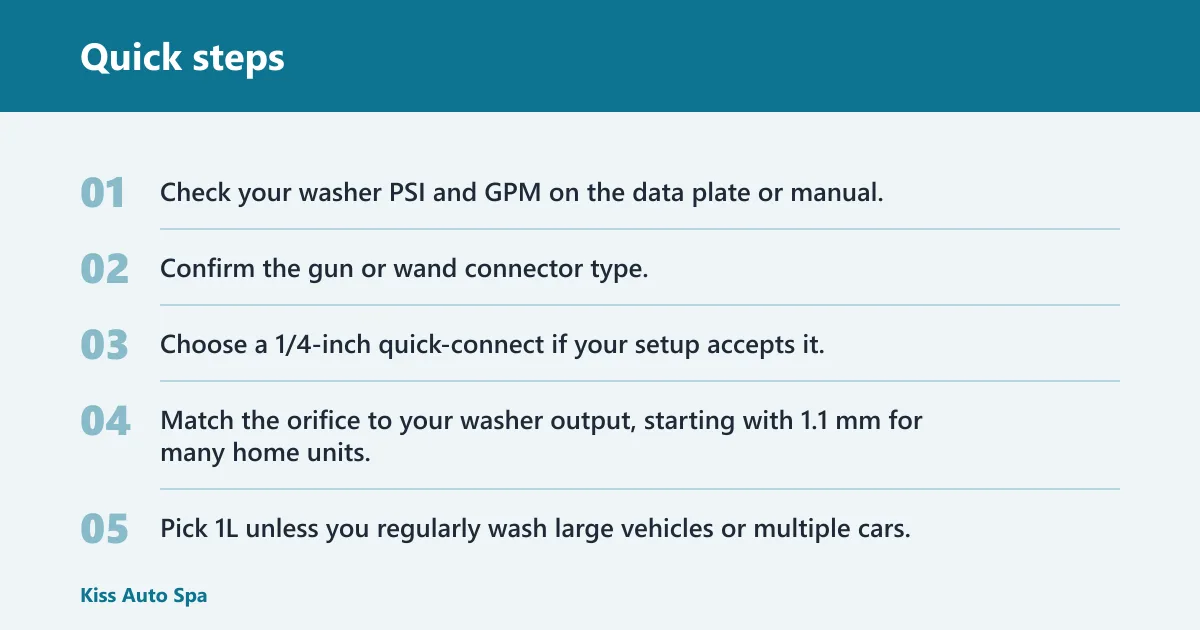
- Check your washer PSI and GPM on the data plate or manual.
- Confirm the gun or wand connector type.
- Choose a 1/4-inch quick-connect if your setup accepts it.
- Match the orifice to your washer output, starting with 1.1 mm for many home units.
- Pick 1L unless you regularly wash large vehicles or multiple cars.
- Use the foam knob and spray fan to tune coverage after the fit is right.
Suppose your washer is a compact electric unit with low flow and you buy a large-orifice cannon because it looks more premium. The foam can come out thin, the soap draw can feel weak, and the extra metal does nothing to fix the mismatch.
Frequently asked questions
What is the best foam cannon for a pressure washer at home?
The best home pick is a bottle-fed foam cannon with a 1/4-inch quick-connect, adjustable foam control, and a 1.1-mm orifice. That setup suits many electric washers because it balances flow, foam output, and easy connection without needing a special gun.
Which foam cannon works best with an electric pressure washer?
An electric pressure washer usually pairs best with a 1/4-inch quick-connect cannon and a 1L bottle. A 1.1-mm orifice is a common starting point because it works across many home-use flow rates without overloading the setup.
Do I need a foam cannon rated for high PSI?
Usually no. Home buyers should focus more on PSI and GPM match than on the highest pressure number listed on the box. A cannon rated for your washer band with the correct connector and orifice is more useful than a high-PSI label alone.
Will a 1/4-inch quick connect fit my pressure washer?
It fits many home pressure washer wands and guns, but not all. If your washer uses a proprietary connector or an M22 variant, you may need an adapter. Check the gun end before buying the cannon.
What bottle capacity is best for home car washing?
A 1L bottle is the best default for most home car washing. It is large enough for a typical sedan or compact SUV, and it is easier to handle than bigger bottles. Larger bottles help more on trucks and longer wash sessions.
How much PSI and GPM do I need for thick foam?
There is no single PSI number that guarantees thick foam. A practical home target is enough flow for the cannon to draw soap well, which is why GPM matters so much. Many foam cannons work best in the common home-use PSI range when flow and orifice are matched correctly.
Which foam cannon is best for beginners on a budget?
A simple 1/4-inch quick-connect cannon with a 1L bottle and adjustable soap control is the best budget starting point. It keeps setup simple and covers the basics without paying for features that do little if the washer fit is wrong.
What should I look for if my pressure washer has a proprietary fitting?
Start with the adapter, not the cannon. Confirm the exact connector style, including M22 variants if applicable, then buy a cannon that matches that path. If the fit is wrong, foam output and bottle size do not matter yet.