What Is the Best Glass Water Spot Remover for Cars?
For light mineral spots on automotive glass, start with a mild glass-safe cleaner. For heavier buildup, use a cerium-oxide glass polish with a dedicated pad. Done wrong, you can waste time, haze the glass, or scratch it. This guide covers how to choose by spot severity and glass type.
Top pick for treating surface mineral deposits
The best glass water spot remover depends on whether the marks are removable minerals or true etching. In this article, Type I means spots that are still mostly on the surface, while Type II means spots that are more bonded and harder to remove. For light Type I spots, Meguiar’s Water Spot Remover is the safest all-around choice because it is a 16 oz liquid, described as pH-neutral, and stated to be safe on clear coats and glass. For heavier buildup, a gel or a polish is usually the better match.
Start with the least aggressive product that matches the damage. If the spot still feels bonded after a short dwell and hand buff, move up in strength instead of repeating the same weak cleaner over and over.
What the top pick does well
Meguiar’s Water Spot Remover is built for light Type I water spots and light Type II spots. It is also described as safe on paint, glass, plastic, chrome, and metal, so it fits the common DIY case where spots sit on windshield glass and nearby trim at the same time.
Its value is control. A liquid with light hand buffing is easier to use on glass than a heavy abrasive paste, and it lowers the chance of residue on edges, seals, and adjacent panels.
Where the top pick falls short
It is not the right first move for etched glass. If the spot has already cut into the surface, a surface cleaner can remove residue around the damage but will not level the glass itself.
That is the key split this category often misses. Removable mineral film and true etching are different problems.
Glass spot decision matrix
This matrix ranks the main remover types by severity, compatibility, residue risk, and best use case. Use it to match the product to the problem before you buy.
| Remover type | Severity | Surface compatibility | Residue risk | Best use case |
|---|---|---|---|---|
| Liquid spot remover | Light spots | Glass, clear coat, nearby trim | Low to moderate | Routine mineral spots on windshield and side glass |
| Glass prep stripper | Light to moderate | Bare glass only | Moderate | Removing wax, road film, or prep residue before protection |
| Gel remover | Moderate to heavy | Glass, paint, metal | Moderate | Vertical panels and heavier mineral staining |
| Spray with wax | Light spots | Quick application on glass | Higher | Fast cleanup when finish protection matters less than speed |
| Glass polish with pad | Etched spots | Glass only, with care | Moderate to high | Damage that regular removers cannot clear |
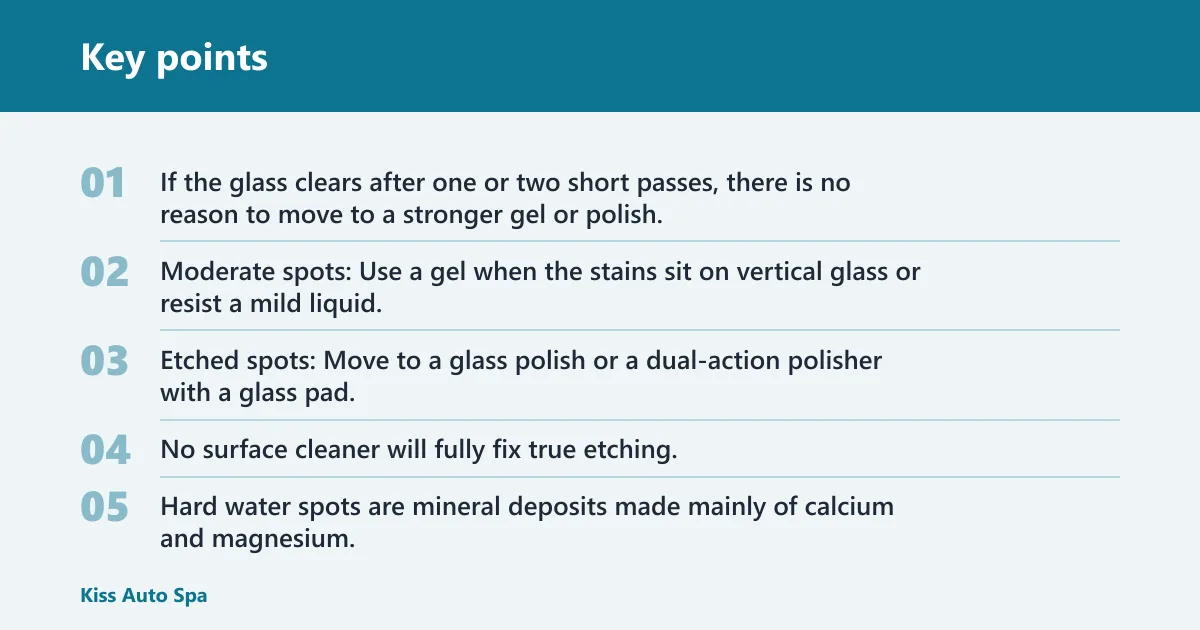
Light spots: Use a liquid remover first. If the glass clears after one or two short passes, there is no reason to move to a stronger gel or polish.
Moderate spots: Use a gel when the stains sit on vertical glass or resist a mild liquid. The thicker format helps it stay in place.
Etched spots: Move to a glass polish or a dual-action polisher with a glass pad. No surface cleaner will fully fix true etching.
What the matrix means in practice
Hard water spots are mineral deposits made mainly of calcium and magnesium. They can show up on glass, paint, chrome, and other metal trim. The visible range can run from light chalky marks to etched damage that may need polishing, so the product should match the level of damage.
Say your windshield has faint white rings after sprinklers hit it overnight. A liquid remover is the right starting point. Suppose the side glass has crusted edges and the marks return after wiping, a gel or glass prep stripper is the better next step.
Meguiar’s water spot Remover
Meguiar’s Water Spot Remover is a strong starting point for light to moderate spot removal because it is a 16 oz liquid and is described as pH-neutral and safe on clear coats and glass. It is aimed at Type I water spots and light Type II spots, so it fits the most common DIY cleanup case.
Best for light Type I spots
This product is best when the defect is still a surface deposit. It works with light hand buffing rather than heavy abrasives, which matters if the spots are on the windshield, mirror glass, or trim close to paint.
Use a microfiber applicator pad, keep the work area small, and stop before the product dries. Section-wise application gives you better control over dwell and cleanup.
Compatibility with glass and clear coat
Because it is stated to be safe on clear coats and glass, it is a practical option for vehicles where the spot crosses from the window edge onto painted trim or chrome. Meguiar’s is also described as safe on paint, plastic, chrome, and metal.
That broad compatibility matters more than brand recognition. It reduces the chance that a splash on adjacent material becomes a second repair job.
When to use a second application
Use a second application only when the first pass clearly softened the stain but did not remove it. Keep dwell brief and never let the product dry on the surface. A common approach is to let it dwell for about 30 to 60 seconds, then hand buff and rinse or wipe.
If the mark remains unchanged after two careful applications, the problem is probably not removable mineral film alone.
Invisible Glass 91411 stripper
Invisible Glass 91411 Stripper is a bare-glass prep product. Road Worthy Labs describes it as a product for a fresh rain repellent or ceramic coating, and the same page says it strips waxes and road film. That makes it useful when the real issue is leftover film or old protection, not mineral spotting.
Bare glass prep use
Use this when you want the glass stripped down for a fresh layer of protection or to remove old residue that interferes with bonding. It is a prep step, so it is most useful before a rain repellent or coating, or after an old layer has begun to smear.
It is not the first pick for etched spots. If the damage is in the glass itself, stripping wax will not level the surface.
Wax and road film removal
Because it strips waxes and road film, this product can solve a common failure case: a driver thinks the glass has stubborn spots when the real issue is old product buildup. Remove that film first, then judge whether mineral residue is still present.
That distinction saves time and avoids unnecessary polishing.
Best follow-up after stripping
After stripping, follow with the protection you actually want on the glass. If the surface still shows white rings or mineral shadows, move to a dedicated spot remover before adding rain repellent. A clean, bare surface gives the next product the best chance to bond evenly.
Chemical guys heavy duty water spot remover gel
A branded water spot remover is a gel for glass, paint, and metal that is intended for heavier mineral stain removal. The gel format matters on vertical glass because it clings better than a thin liquid, which helps with longer contact on stubborn spots.
Why gel matters on vertical glass
Gel stays where you place it longer than a spray or thin liquid. That makes it easier to control on windshield corners, side windows, and mirror housings where runoff can shorten dwell and leave uneven cleaning.
Use a microfiber applicator pad, work in small sections, and check the edge before wiping. If the gel starts to haze or dry, remove it at once.
Best for heavier mineral stains
This is the better choice when a mild liquid has already failed or when the spots are more visible and crusted. The heavier format suits mineral staining that needs a stronger contact patch before it lifts.
It still is not a cure for etched glass. Once the surface itself is altered, the next step is polishing, not more cleaner.
Where residue can be a concern
Gel products can leave residue if they are overapplied or left too long on hot glass. That is most likely on sunny panels, narrow trim lines, and textured edges where product can pool.
Work below 30C in shade, keep the section small, and wipe thoroughly. Better control usually means less cleanup.
Bling Sauce Hot Sauce Hard Water Spot Remover
Bling Sauce Hot Sauce Hard Water Spot Remover is positioned as the budget option in the comparison chart. It uses a spray formula with wax, which makes it attractive for quick application when you want fast coverage on affected glass.
Spray format and quick coverage
A spray can cover a wider patch quickly than a cream or gel. That is useful for light spots spread across several windows or for maintenance cleanup before a longer detail session.
Sprays are also easier to spread on large flat panes. The tradeoff is less control on vertical surfaces and a higher chance of overspray onto nearby trim.
Wax content and finish tradeoffs
The added wax can leave some protection behind, which may be useful if you want a quick glossed finish. The downside is that wax content can interfere with later coating prep or leave a film if the goal is bare glass.
If you plan to apply a rain repellent after cleaning, a wax-containing spray is usually not the cleanest route.
Best use case on minor spots
This is best for minor spots where speed matters more than deep correction. It fits quick touchups on side glass and upper windshield areas where the water marks are still mostly on the surface.
For heavier mineral staining, choose a gel or a stronger spot remover instead.
Which remover is safest for windshield glass and paint?
The safest broad-use choice for windshield glass and paint is Meguiar’s Water Spot Remover because it is stated to be safe on clear coats and glass, and also on paint, plastic, chrome, and metal. That makes it the best fit when the spot crosses multiple surfaces and you want the lowest practical risk.
Windshield glass
For windshield glass, start with a product that is safe on glass and does not rely on heavy abrasion. The windshield is the best place to avoid aggressive rubbing, especially near sensors, edges, black frit areas, tint strips, and aftermarket coatings.
If the spot is etched, move to polishing rather than escalating cleaner strength alone. Some laminated windshields can be polished with the right process, but the correction method needs to match the defect and the glass area.
Paint, chrome, and metal
Nearby paint, chrome, and metal trim change the choice. A liquid that is safe on those surfaces gives you more room to work along window edges without creating secondary damage.
That is also why a gel should be used carefully on trim joints. It may be right for the spot, but it still needs controlled application.
Coatings, sealants, and rain repellent
Some removers strip waxes or road film, which can be useful before a fresh coating or rain repellent. Invisible Glass 91411 Stripper is a clear example of that use case. The benefit is a cleaner bonding surface; the risk is that you may remove protection you wanted to keep.
If the goal is to preserve an existing sealant, choose a gentler spot remover and keep it localized.
How do you choose between a gel, cream, or spray?
Choose by control, residue risk, and where the spots sit. Gel is best for vertical or stubborn areas, cream or liquid is often best for controlled hand work, and spray is fastest for light cleanup. If you want the safest all-around starting point, pick the format that stays put without drying out.
Residue risk and dwell control
Residue risk rises when a product dries on the glass. That is why dwell time matters so much. A short 30 to 60 seconds example is often enough for a spot remover, but only if the product stays wet and is removed before it bakes on.
No heat gun. Keep it simple: apply, wait briefly, and wipe clean.
Ease of use on vertical panels
Vertical glass favors gel because it resists runoff. Sprays are easier to spread but less precise. Liquid formulas split the difference and are usually the best choice when the user wants manageable application with low risk of overspray.
Use a microfiber applicator pad for hand application, then buff with a clean microfiber towel. That workflow is common because it gives direct control and clear wipe-off.
Value and cost per use
Value is not only the sticker price. A concentrated gel that fixes stubborn spots in fewer passes can be cheaper per successful repair than a cheaper spray that needs repeated applications.
Bling Sauce Hot Sauce Hard Water Spot Remover is the budget pick, but budget only matters if it clears the mark well enough for your needs. If it does not, the low price becomes false economy.
How to choose the right path
-
Inspect the damage.
Check whether the marks sit on top of the glass or remain after cleaning. If they disappear with a cleaner and microfiber, the problem was surface mineral deposit. If they stay visible after two careful passes, suspect etching.
-
Match the formula type.
Use liquid for light spots, gel for vertical or heavier staining, spray for quick minor cleanup, and polish for etched areas. Do not move straight to polishing unless the defect clearly needs it.
-
Control dwell and drying.
Work section by section and keep the product wet. A short dwell, then hand buffing, prevents streaks and reduces the chance of haze or dried residue.
-
Escalate only if needed.
If the spot remains after two applications, step up to a stronger remover or a glass polish. For etched glass, a dual-action polisher with a glass pad is the next logical step.
Frequently asked questions
What is the best water spot remover for glass?
For most DIY cases, Meguiar’s Water Spot Remover is the best starting point for glass because it is a 16 oz liquid, described as pH-neutral, and described as safe on clear coats and glass. It handles light Type I and light Type II spots without forcing you into aggressive abrasion too early.
What is the best glass water spot remover for cars?
The best choice depends on severity, not brand name. Use a liquid remover for light spots, a gel for heavier vertical staining, and a glass polish for etched marks. If the spots are only on bare glass and you need prep before protection, Invisible Glass 91411 Stripper is the better fit.
Can a water spot remover also strip wax or coatings?
Yes, some products can. Invisible Glass 91411 Stripper is described as stripping waxes and road film, which is useful before a fresh rain repellent or ceramic coating. That same ability is a risk if you want to preserve the existing protection layer.
Do I need a glass polish or just a spot remover?
Use a spot remover if the mark is mineral film on the surface. Use a glass polish if the stain remains after careful cleaning and looks etched into the glass. A polish, often paired with a dual-action polisher and a glass pad, is the better answer for true damage.
How many applications does a stubborn water spot remover usually need?
Most stubborn spots need one to two careful applications, not endless repeats. If the first pass softens the mark, a second pass may finish it. If the spot does not change after that, the issue is likely etching or a bonded film that needs a different approach.