How Much Does It Cost to Hand Wash Your Car at Home?
Hand washing your car at home usually costs about $3 to $10 per wash in soap, mitts, water, and drying supplies, after a one-time setup of about $25 to $100. Skip the right tools and you can leave scratches, water spots, and waste money replacing cheap gear. This guide breaks down startup costs, per-wash costs, and the point where a commercial wash may cost less.
The real total depends on what you already own, how often you wash, and how long the supplies last. A car washed every week spreads tool costs across more washes than one cleaned only a few times a year.
Understanding startup and recurring car wash costs
Startup costs versus per-wash costs
Split the budget into two parts. Startup cost covers the buckets, grit guards, mitts, towels, hose nozzle, and wheel tools you buy once. Recurring cost covers soap, water, and replacement microfiber that wears out over time.
That split matters because a wash can look cheap on paper and still cost more over a year if you replace towels often or wash infrequently. The reverse can happen too: a higher startup can lower recurring cost if the tools last and the wash routine stays consistent.
Here is a realistic way to think about it. A basic setup can work with a pair of buckets, two grit guards, one wash mitt, a few drying towels, soap, and a nozzle. A higher-end setup adds more towels, a dedicated wheel brush, wheel cleaner, and extra microfiber so you rotate clean tools instead of washing one set constantly.
What supplies do I need to hand wash a car at home?
You need a wash bucket setup, a pH-balanced car soap made for clear coat and wax, a microfiber wash mitt, microfiber drying towels, a hose with an adjustable nozzle, and wheel-cleaning tools. The cheapest workable setup is simple. The better setup lasts longer, uses less product waste, and lowers the chance of marring paint.
Buckets, grit guards, and wash mitts
The two-bucket wash method uses one bucket for soap and one bucket for rinse water. Put a grit guard in the bottom of each bucket so dirt settles below the mitt instead of circling back onto paint. Wash the car panel by panel, and rinse the mitt before it returns to the soap bucket.
A microfiber wash mitt is preferred over a sponge because it holds suds and helps keep loose grit away from the paint surface. A sponge can trap debris on the face of the pad and drag it across the finish.
Soap, towels, hose, and wheel tools
Use a pH-balanced car wash soap, not dish soap. A common guide uses about 2 to 3 oz per gallon, which is generally enough for a bucket mix without making it overly slick or wasteful. Dish soap is made for kitchen grease, not clear coat care, and it can strip protection faster than a car soap.
Dry with microfiber drying towels. Use more than one if the car is midsize or larger. Avoid bath towels, chamois, and paper towels; they are more likely to leave lint, streaks, or drag dirt across the finish.
Use a hose with an adjustable nozzle for the pre-rinse and final rinse. Medium pressure is safer than close-range high pressure, because a narrow high-pressure stream can push grime around and make drying harder.
Wheel cleaner and a wheel brush should be separate from the body wash tools. Brake dust and wheel grime are abrasive enough that they should be handled before the paint, with a dedicated brush that never touches the bodywork.
Optional items that lower re-buy costs
- Extra microfiber mitts, so you can rotate clean ones and replace them less often.
- More drying towels, which lets you use each towel less aggressively and retire them later.
- A separate wheel bucket or brush holder, which keeps brake dust away from paint tools.
- A small measuring bottle, which helps you pour soap consistently instead of overusing it.
How does the two-bucket wash method reduce scratch risk?
The two-bucket method is one of the simplest ways to reduce scratch risk during a home wash. One bucket holds soap solution, the other holds rinse water. The mitt goes into the rinse bucket before it returns to the soap bucket, which helps keep dirt out of the clean wash mix.
-
Pre-rinse the vehicle.
Rinse loose dirt from top to bottom with a hose and adjustable nozzle. Medium pressure is enough for most home washes and keeps you away from the close-range blast that can move grime around.
-
Fill both buckets.
Mix car soap in one bucket at the label rate, and fill the second bucket with plain rinse water. Put a grit guard in the bottom of each bucket so sediment settles below the mitt.
-
Wash one panel at a time.
Start at the roof, then move down the vehicle in sections. Work panel by panel so soap does not dry on hot paint, and so you can rinse the mitt often enough to limit grit transfer.
-
Rinse and dry promptly.
After each section, rinse with clean water and dry with microfiber towels. Prompt drying matters because water spots form faster on warm panels and in direct sun.
Picture a midsize sedan washed in the driveway at noon. If the hood is hot and the soap flashes before rinsing, you get spots fast. Move that same wash into shade or onto cool panels, and the same amount of soap works far better with less cleanup afterward.
What does a home wash cost on a worksheet basis?
This worksheet separates one-time purchases from recurring per-wash cost. The numbers below are realistic budget ranges for common home-wash setups, using a two-year life for startup gear so the yearly cost is easier to compare across different wash habits.
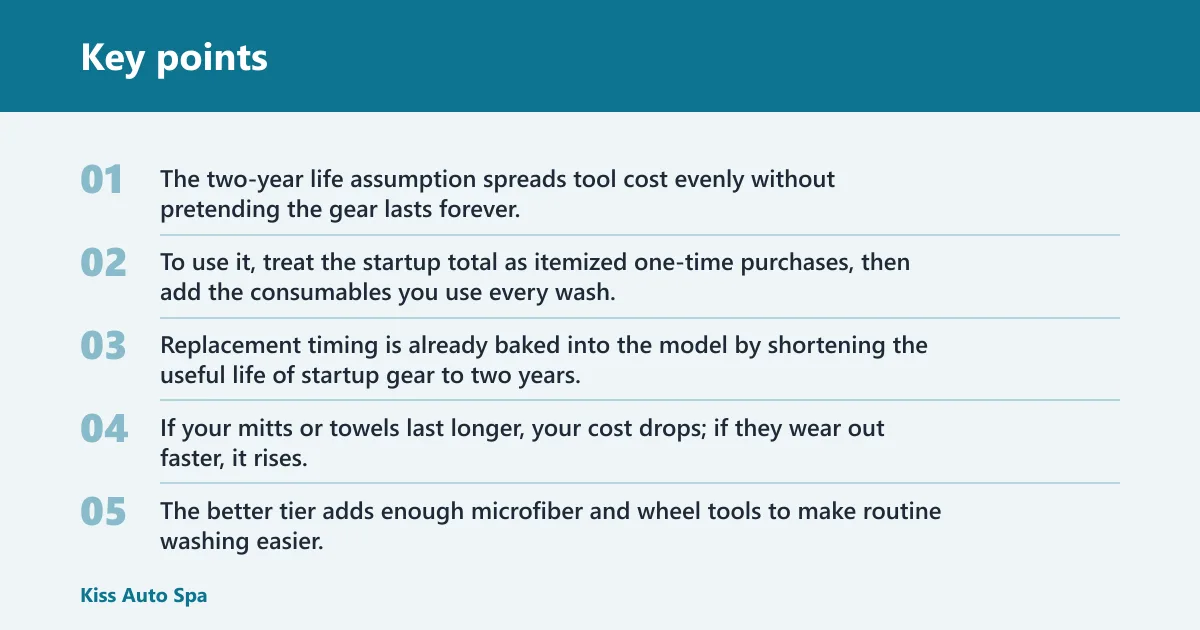
The formula is simple enough to verify: annualized cost per wash = (startup total ÷ 2 ÷ washes per year) + per-wash consumables. The two-year life assumption spreads tool cost evenly without pretending the gear lasts forever. That makes the table useful for comparing 12, 26, and 52 washes per year.
To use it, treat the startup total as itemized one-time purchases, then add the consumables you use every wash. Replacement timing is already baked into the model by shortening the useful life of startup gear to two years. If your mitts or towels last longer, your cost drops; if they wear out faster, it rises.
| Budget tier | One-time purchases | Startup total | Estimated per-wash consumables |
|---|---|---|---|
| Starter | 2 buckets, 2 grit guards, 1 mitt, 2 towels, soap, nozzle | $79 | $4.25 |
| Better | Better mitt, 4 towels, wheel cleaner, wheel brush, soap, nozzle | $118 | $3.50 |
| Low-maintenance | Extra towels, extra mitts, separate wheel tools, larger soap reserve | $170 | $2.75 |
Starter budget tier
The starter tier covers the bare minimum for a safe hand wash: buckets, grit guards, one mitt, a couple of drying towels, a hose nozzle, and soap. It is the lowest entry cost, but towels and mitts will wear faster if you wash often.
Better budget tier
The better tier adds enough microfiber and wheel tools to make routine washing easier. This is the most balanced choice for many owners because it lowers the chance of re-buying worn towels too soon.
Low-maintenance budget tier
The low-maintenance tier costs more up front, but it is built for owners who wash often and want enough microfiber on hand to rotate clean, dry towels. That usually lowers stress, reduces rushed drying, and stretches out replacement timing.
Yearly cost per wash comparison
To annualize startup cost, divide the startup total by 2, then divide again by the number of washes per year. Add the per-wash consumables after that. The table below shows how frequency changes the price of each wash.
| Budget tier | 12 washes/year | 26 washes/year | 52 washes/year |
|---|---|---|---|
| Starter | $7.54 | $5.77 | $5.01 |
| Better | $8.42 | $5.77 | $4.63 |
| Low-maintenance | $9.83 | $6.02 | $4.38 |
Is home washing cheaper than going to a car wash?
Home washing is often cheaper than paid detailing, but it is not always cheaper than a very low-cost self-service bay. The answer changes with wash frequency and with how much gear you already own. If you wash often, DIY usually pulls ahead. If you wash rarely, startup cost can blunt the savings.
For comparison, a guide lists a car wash in the USA at $5 to $15 at self-service bays, and a hand/manual car wash at $20 to $50. That means home washing can undercut a manual wash easily, but it may sit close to the bottom end of a self-service bay if you only wash a few times a year.
| Paid option | Price | How it compares |
|---|---|---|
| Self-service bay | $5 to $15 | DIY is cheaper only if your yearly cost per wash stays near the low end of your own range. |
| Hand/manual wash | $20 to $50 | DIY is usually cheaper if you already own the gear and wash more than a few times a year. |
| Basic hand wash and vacuum | $70 | This is a labor service, so it is far above a home wash per visit. |
| Hand wash with wax | $145 | Added labor and protection work push the price well beyond a DIY bucket wash. |
| Wash, clay, and seal package | $169 | Useful for paint correction prep, but much more expensive than a home wash. |
| Complete detail package | $285 | A detail package is a different service tier entirely. |
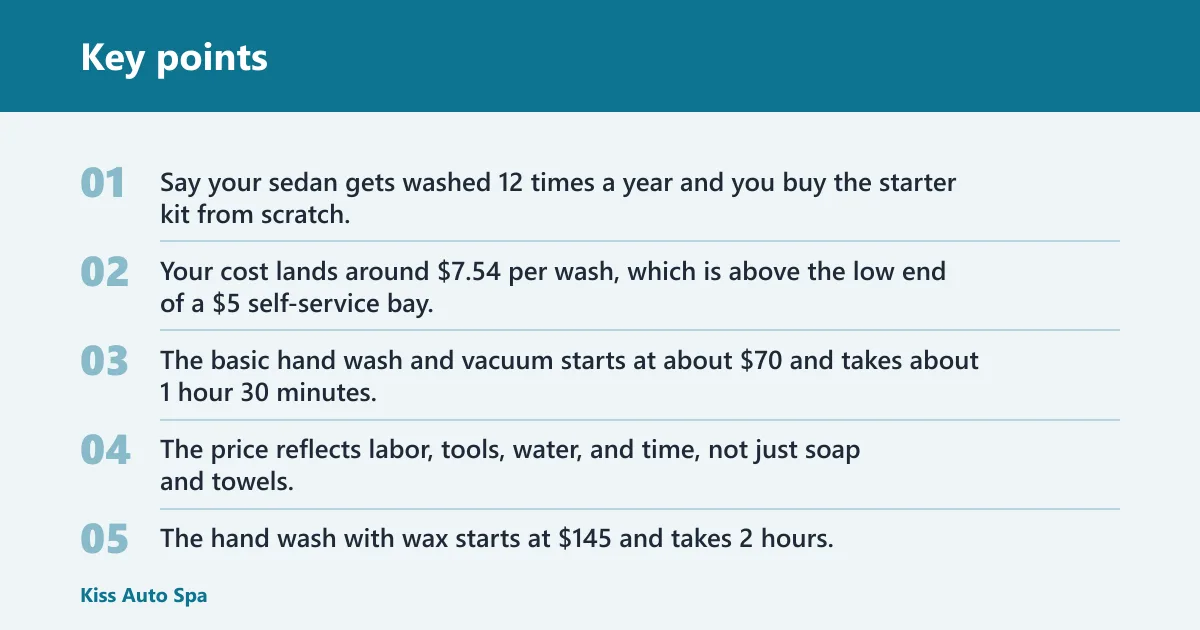
Say your sedan gets washed 12 times a year and you buy the starter kit from scratch. Your cost lands around $7.54 per wash, which is above the low end of a $5 self-service bay. If you wash weekly with the better kit, the cost drops to $4.63 per wash, which beats that low end and stays far below a hand wash service.
Compare basic hand wash pricing
The basic hand wash and vacuum starts at about $70 and takes about 1 hour 30 minutes. That single visit costs far more than even a fairly complete home setup spread across many washes. The price reflects labor, tools, water, and time, not just soap and towels.
The hand wash with wax starts at $145 and takes 2 hours. The wash, clay, and seal package starts at $169 and also takes 2 hours. Those services are useful when you want more than a rinse and towel dry, but they do not belong in the same cost bucket as a home bucket wash.
Compare detail package pricing
Detail pricing moves higher fast: interior detail package starts at $175, mini detail package starts at $185, exterior detail package starts at $185, complete detail package starts at $285, and extravagant detail package starts at $525. The complete detail package takes 3 hours. These are service prices, not home-wash costs.
When DIY stops saving money
DIY stops being the cheapest option when you wash rarely enough that startup cost outweighs your savings, especially if your only nearby option is a self-service bay at $5 to $15. If your own wash routine is occasional and your supplies sit unused, the annual cost per wash can creep above the bottom end of that range.
How much water and soap do you use when hand washing a car?
A home wash usually uses modest amounts of both, but the total depends on hose flow, bucket size, and how carefully you measure soap. A common soap guide uses about 2 to 3 oz per gallon. Water use changes more than soap use because the hose can run wastefully if you leave it open between steps.
Soap dilution and product use
Follow the label for dilution, then measure instead of guessing. The most common waste is pouring too much soap into the bucket because more suds looks better. More suds does not automatically mean a safer wash.
Use enough soap to keep the mitt lubricated. Use too much, and you spend more without getting a cleaner result.
Water use by wash habit
People waste the most water when they rinse continuously instead of in short bursts, or when they leave the hose running between panels. The two-bucket method helps, but a shutoff nozzle and a panel-by-panel order reduce waste further.
A common first-timer mistake is washing the entire car before drying any of it. On a warm day, that leaves the last panels with spots before the first ones are even dry. Working section by section avoids that problem and trims extra towel use.
When rinseless or waterless washing becomes the cheapest option
Rinseless or waterless washing becomes the cheapest option when water access is limited, the car is only lightly dirty, or you want to avoid the startup cost of buckets, hoses, and larger towel sets. For very occasional maintenance washes, that can beat a full bucket setup on total cost.
What affects paint safety during a home wash?
Paint safety depends mostly on dirt control, panel temperature, and drying habits. A careful home wash is generally safe for paint when you use clean microfiber, separate wheel tools, shade, and a rinse bucket. The biggest risk comes from dragging grit or drying a hot panel too slowly.
Shade and panel temperature
Wash in shade or on cool panels. Hot metal and glass make soap and rinse water dry too fast, which leaves spots and residue. If the hood or roof feels hot to the touch, wait before washing that section.
Wheel grime before body wash
Clean the wheels before the body. Brake dust and road grime are not the same as the light dust on paint, and wheel cleaner plus a dedicated wheel brush keep that debris away from your mitt and towels.
Drying without streaks or scratches
Dry with clean microfiber towels in light passes. Do not use bath towels, chamois, or paper towels. Those materials are more likely to leave lint or catch grit that should have been trapped in the rinse bucket.
Frequently asked questions
How much does it cost to hand wash a car at home?
Most home washes land around $3 to $10 per wash once you own the basic gear, but the first setup can run roughly $25 to $100. The total depends on how many microfiber towels you keep on hand, how much soap you use, and how often you replace worn items.
Is hand washing at home cheaper than going to a car wash?
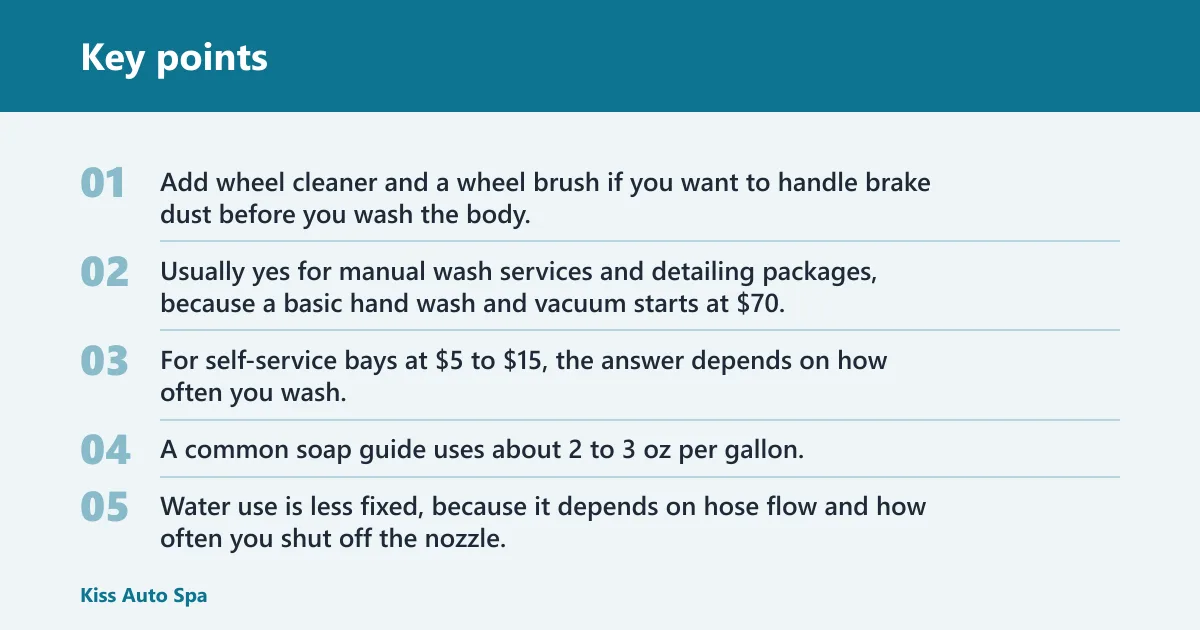
Usually yes for manual wash services and detailing packages, because a basic hand wash and vacuum starts at $70. For self-service bays at $5 to $15, the answer depends on how often you wash. Frequent DIY washing usually wins. Rare DIY washing can be close.
How much soap and water does a home car wash use?
A common soap guide uses about 2 to 3 oz per gallon. Water use is less fixed, because it depends on hose flow and how often you shut off the nozzle. Short rinse bursts and panel-by-panel washing keep both water and product use in check.
How often should I hand wash my car at home?
Wash as often as dirt, salt, pollen, or bird fallout builds up enough to matter. For cost planning, weekly washing spreads startup cost best, while monthly washing still works if you accept a higher cost per wash. Very occasional washing weakens the DIY savings.
Can I use dish soap to wash my car at home?
No. Use a pH-balanced car wash soap instead. Dish soap is made for kitchen grease, not automotive finishes, and it can strip protection faster than a proper car shampoo. A measured car soap also works better with microfiber mitts and the two-bucket method.
Does washing a car at home damage the paint?
It can, if you use dirty tools, a dry sponge, or a hot panel in direct sun. A two-bucket wash with grit guards, microfiber mitts, shade, and prompt drying is the safer approach. The method matters more than the fact that the wash is done at home.