How to Remove Baked-On Brake Dust From Rims Safely
Start with a cool wheel and a pH-balanced wheel cleaner; use a soft brush, then move to iron remover if dust stays bonded after one pass; stop scrubbing and refinish if pitting, staining, or clear-coat damage remains. Heavy rubbing can scratch the finish, stain the clear coat, or leave permanent pitting in the wheel face. This guide gives a severity-based ladder for washing, decontaminating, polishing, and deciding when refinishing is the safer move.
Heat and moisture turn loose brake dust into bonded stains
Brake dust is a mix of pad material, carbon, and fine metal shavings. Heat cycles help it bond to the wheel, and moisture can turn those particles into orange-brown staining or rust spots that cling harder over time. Front wheels usually collect the worst buildup because the front brakes do most of the stopping.
That matters because the right fix depends on what you are seeing. Loose film lifts with washing. Bonded dust needs chemical help. Staining that survives decontamination may be etching or clear-coat damage, which is a different problem.
Why heat makes dust bond harder
Hot brakes bake contamination into the finish. If the wheel is sprayed while hot, cleaner can flash too quickly and leave spotting. Always work on a cool-to-the-touch wheel in shade.
What you’ll need
- pH-balanced wheel cleaner
- Iron remover
- Soft wheel brush for faces and spokes
- Long barrel brush for the inner barrel
- Separate microfiber towels for drying
- Wheel sealant or ceramic protection for prevention
- Optional acid-based wheel cleaner for severe, known-safe finishes only
Brake dust severity matrix
| Severity level | Visible signs | Safe chemistry | Tools | Average dwell time | What not to use | Next escalation step |
|---|---|---|---|---|---|---|
| Fresh film | Gray haze, light brown film, no roughness | pH-balanced wheel cleaner | Soft wheel brush, microfiber towel | 1 to 3 minutes, per label | Acid cleaner, abrasive pad | Dry and apply protection |
| Bonded dust | Darker specks, rough feel, dust in lug holes and barrel | pH-balanced wheel cleaner, then iron remover | Soft wheel brush, long barrel brush | 2 to 3 minutes for iron remover | Steel wool, household cleaner | Repeat decontamination once |
| Etched staining | Orange or brown spots remain after wash and iron remover | Gentle polishing on safe finishes | Foam applicator, polish, microfiber towel | Work in short passes | More scrubbing, strong acid on unknown finish | Polish, then inspect under strong light |
| Finish failure | Pitting, flaking clear coat, dull patches, exposed base metal | Refinish or replace | Professional repair tools | Not a cleaning job | Any aggressive scrubbing | Stop and refinish |
How do you remove baked-on brake dust safely?
Start on a cool wheel with a pH-balanced wheel cleaner, then move to iron remover if bonded dust remains after the first wash. Use soft brushes for the face, spokes, and lug holes, plus a barrel brush for the inner wheel. If orange staining remains after decontamination, do not scrub harder; decide whether polishing or refinishing is the next step.
- Rinse loose grit first. Flush the wheel face, barrel, and lug holes before touching the surface. This lowers the chance of dragging abrasive grit across the finish.
- Apply pH-balanced cleaner. Spray a generous, even coat on the cool wheel and follow the label dwell time. Do not let it dry on the wheel.
- Agitate with soft brushes. Use a dedicated soft wheel brush on the face and spokes, then a long barrel brush behind the spokes. Keep the wheel tools separate from paint wash tools.
- Rinse and inspect. If the dust is still bonded, move to iron remover. Many iron removers turn purple as they react with embedded particles, and a common dwell time is two to three minutes.
- Clean the deep areas. Work the barrel, lug holes, and spoke backs again with the barrel brush. A common first-timer mistake is ignoring the inner barrel, where heavy dust usually hides.
- Dry with microfiber. Use a dedicated microfiber towel for wheels so you reduce water spotting and avoid carrying grit back to the paint.
- Protect the finish. Apply wheel sealant or ceramic protection after the wheel is fully dry. That helps dust rinse off more easily on the next wash.
Picture a dark painted wheel that looks brown after a highway drive. One wash and one iron-remover pass clear the face, but the barrel still looks gray. That usually means the contamination is embedded, not that the wheel needs harder scrubbing.
Can you use wheel acid on baked-on brake dust?
Acid-based wheel cleaner has a place, but it is not first-line for unknown finishes. It can help on heavy buildup when the wheel finish is known to tolerate it, yet strong acid-based cleaners can damage clear coat, polished aluminum, and chrome. Use it only with strict label control and short dwell time.
- Confirm the finish first. Check whether the wheel is painted, clear-coated, powder coated, polished aluminum, chrome, machined or diamond-cut, or ceramic coated. If the finish is uncertain, do not start with acid.
- Try safer chemistry first. Use pH-balanced cleaner and iron remover before considering stronger chemistry. That is the safer path for nearly every finish.
- Keep dwell very short. If an acid product is the only remaining option, follow the label exactly and rinse immediately after the stated dwell time. Do not let it dry.
- Stop on sensitive finishes. Avoid acid on polished aluminum without clear coat, chrome, and any wheel showing dulling or pitting. If staining remains, switch to polishing or refinishing instead of another chemical pass.
Which finishes are at risk?
Polished aluminum without clear coat should avoid acid and strong alkaline cleaners. Chrome can haze or discolor. Clear-coated, painted, and some powder-coated wheels are more forgiving, but they still need cool-wheel application and prompt rinsing. Ceramic-coated wheels should be cleaned gently with pH-balanced cleaner and a gentle wash.
How do you know it’s etched damage, not dirt?
Removable contamination moves with washing, decontamination, or gentle polishing. Permanent damage does not. If dark or orange spots remain after iron remover, the finish may already be stained, etched, or failing. At that point, more scrubbing usually makes the problem worse.
Signs of removable contamination
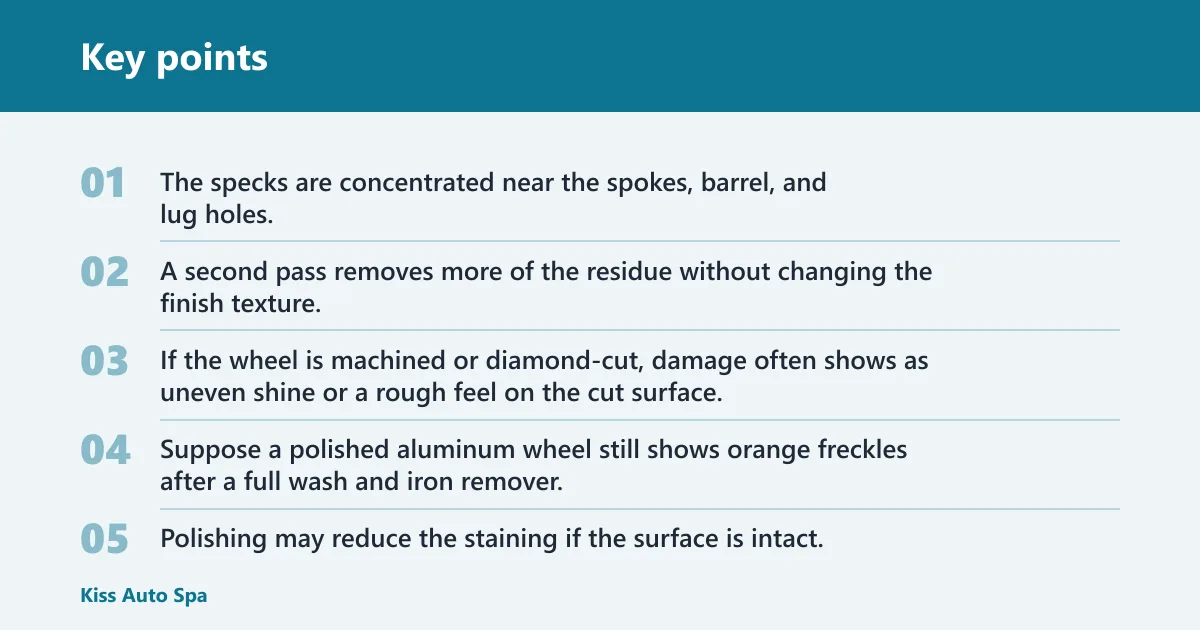
The wheel feels smoother after cleaning. Color fades after iron remover. The specks are concentrated near the spokes, barrel, and lug holes. A second pass removes more of the residue without changing the finish texture.
Signs of permanent staining
Pitting, dull patches, white haze, flaking clear coat, or color that stays in the same spot after cleaning all point away from simple contamination. If the wheel is machined or diamond-cut, damage often shows as uneven shine or a rough feel on the cut surface.
Suppose a polished aluminum wheel still shows orange freckles after a full wash and iron remover. Polishing may reduce the staining if the surface is intact. If the freckles remain as pits, the real fix is refinishing, not another round of aggressive chemicals.
How do you remove brake dust from wheels without scratching them?
Use the least aggressive tool that clears the defect. Soft wheel brushes, a long barrel brush, and dedicated microfiber towels are the safe baseline. The wheel must be cool, the cleaner must match the finish, and every towel that touches the wheel should stay off the paint.
- Choose separate tools. Keep wheel brushes and towels apart from wash mitts used on body panels. That cuts the chance of dragging brake grit into the paint.
- Let chemistry do the work. Give pH-balanced cleaner its full label dwell time, then use iron remover only if bonded dust remains. Do not scrub harder during the dwell.
- Use light pressure. Let the brush tips contact the surface. Heavy force can mar soft clear coat and polished finishes.
- Inspect under bright light. If the staining is still there after two passes, stop and reassess the finish. More pressure is not a safe next step.
Common mistakes
- Spraying cleaner on a hot wheel.
- Letting wheel cleaner dry on the surface.
- Using acid on polished aluminum or chrome without confirming compatibility.
- Scrubbing with abrasive pads or steel wool.
- Using the same towel on wheels and paint.
- Ignoring the barrel, where heavy dust often lives.
- Treating etched spots as if they were loose dirt.
For severe contamination, wheel removal can help because you can reach the barrel and the back side of the spokes. If you remove a wheel, support the car correctly, follow the vehicle’s torque spec when reinstalling, and retorque after driving if the manufacturer calls for it.
Frequently asked questions
How do I remove baked on brake dust from rims?
Use a cool-wheel wash with pH-balanced cleaner first, then iron remover if the dust stays bonded. Clean the face, spokes, lug holes, and barrel with soft brushes. If orange staining remains after that, stop scrubbing and decide whether polishing or refinishing is needed.
What is the safest way to clean brake dust off rims?
The safest route is a cool wheel, pH-balanced cleaner, soft brushes, and a dedicated microfiber towel for drying. That combination is safe for painted, clear-coated, powder-coated, and many OEM wheels. It avoids the finish risk that comes with harsher chemistry.
How do I clean brake dust off aluminum rims safely?
Check whether the aluminum is polished bare metal or coated. Polished aluminum without clear coat should avoid acid and strong alkaline cleaners. Start with pH-balanced cleaner, then use iron remover if needed, and keep dwell time short with a full rinse afterward.
Why does brake dust turn orange or brown?
Those red-orange specks can be embedded iron from heat and moisture exposure. Brake dust is made of pad material, carbon, and fine metal shavings, and the metal can rust after heat cycles. Iron remover helps because it dissolves embedded particles that soap cannot remove.
When is brake dust actually wheel damage instead of dirt?
If dark or orange spots remain after wash and iron remover, the issue may be etched staining, pitting, or clear-coat failure. A rough texture, flaking, or a dull patch that does not change after cleaning points to damage. At that stage, polishing or refinishing is the next step.