Waterless Wash Spray vs Concentrate: Which Should You Buy?
Buy ready-to-use spray if you wash less than about twice a month. Buy concentrate if you clean often, because the lower per-bottle cost only pays off after repeated mixes. Picking the wrong format can mean more expense, extra prep, or a bottle you rarely open. This guide compares cost, setup friction, and risk so you can match the format to your washing habit.
| Decision factor | Waterless wash spray | concentrate | Winner |
|---|---|---|---|
| Ownership cost | Higher cost per ounce, because water is already included | Lower cost per wash after dilution | concentrate |
| Setup friction | Single bottle, grab-and-go convenience | Measure, dilute, and store mixed solution | Waterless wash spray |
| Storage space | Usually sold in 16–26 oz sizes | Often sold in 1L, 32 oz, or gallon refills | Waterless wash spray |
| Frequency fit | Better for occasional touch-ups | Better for repeated use | concentrate |
| Risk tolerance | Lower mixing risk, simpler routine | More setup steps, but still usable if you follow the label | Waterless wash spray |
Waterless wash spray vs concentrate
Waterless wash spray and concentrate do the same basic job on light contamination, but they trade convenience against ownership cost. The spray is ready to use; the concentrate needs water and measuring. That difference matters more than the marketing name on the label.
Waterless wash spray is a ready-to-use bottle. It is the simpler buy for quick touch-ups, cramped storage, and drivers who do not want to measure anything before cleaning.
Concentrate is a product you dilute before use. The upside is lower cost per wash; the downside is extra setup, plus the chance of mixing errors if you rush or skip the label instructions.
What each format
Waterless wash spray is the single-bottle option. It suits a panel-by-panel spray-and-wipe routine, and it is easy to keep in the trunk for fast cleanup after dust, pollen, or a light fingerprint layer.
Concentrate is the refill format. It works best when you plan to wash often enough that the savings from dilution matter more than the extra minute or two spent measuring and mixing.
The real tradeoff
The tradeoff is simple: convenience versus cost per wash. Spray cuts the steps at the moment you start cleaning, while concentrate spreads the product cost across more uses.
That cost difference only matters if you actually wash often. If a bottle sits for months, a lower per-wash price does not help much.
Who each format fits best
Choose spray if you want a compact bottle, minimal setup, and a low-risk routine for quick maintenance. Choose concentrate if you have regular wash habits, enough storage for a refill bottle, and a willingness to mix before each use or into a smaller working bottle.
Which is cheaper per wash?
Concentrate is usually cheaper per wash because you are not paying for a fully diluted bottle every time. Spray can still make sense when you use it rarely, value speed above all else, or want a small bottle you can keep in the car without carrying extra gear.
How bottle size changes value
Sprays commonly come in about 16–26 oz bottles, which makes them easy to store but also means you are buying a finished mix in a smaller package. Concentrates are often sold in 1L, 32 oz, or gallon refills, so the same purchase can cover many more washes after dilution.
The label size alone does not tell you the value. The relevant number is how many usable washes come out of each container.
Why concentrates usually win on cost
Once you buy a concentrate, water becomes the cheap part of the process. The active product is spread across more washes, so the cost per wash drops as long as you mix correctly and do not waste solution.
A common first-timer mistake is comparing bottle prices instead of wash count. A $15 ready-to-use spray can be less economical than a higher-priced refill if the refill makes many more washes.
Where sprays can still make sense
Sprays still make sense for people who wash infrequently, keep only one small bottle, or want a simple backup for dust emergencies. In those cases, the premium for convenience may be worth more than the savings from dilution.
Say your car gets a light dusting once every few weeks and you keep a bottle in a hallway closet. A ready-to-use spray is often the cleaner fit, because the process stays simple enough that you will actually use it.
How many washes does a concentrate make?
A concentrate can make anywhere from a few washes to many more, depending on bottle size and mix ratio. The useful way to judge it is to divide the total liquid you can make by the amount you use per wash, then compare that result with the spray bottle price.
Simple dilution calculator
Use this basic formula:
Wash count = total mixed liquid ÷ liquid used per wash
If the label gives a mix ratio like 5 ml concentrate into 500 ml water, that means every 505 ml of finished mix uses 5 ml of concentrate. If your full working batch is 505 ml and one wash uses about 1 panel’s worth at a time, the batch count depends on how much you spray per vehicle, so the label’s ratio matters more than the bottle name.
- Check the bottle size of the concentrate.
- Check the label mix ratio.
- Calculate how much finished solution one batch makes.
- Estimate how much solution you use for one car.
- Divide the batch by that per-car amount.
Example wash count by container size
PROKLEAR WFC is labeled a “Waterless-Rinseless Foam Wash Concentrate.” PROKLEAR recommends just 5ml for one car and says to mix 5ml into 500ml water in a foam sprayer. That gives you a concrete example of how little product may be needed per wash when the label is followed exactly.
That does not mean every concentrate works the same way. Different brands use different dilution rates, so the only honest way to compare them is to look at the labeled mix ratio and the bottle size together.
Waterless wash cost table
The right format depends on how often you clean, how much storage you have, and how much setup you will tolerate. These examples use simple ownership logic rather than invented lab prices, because actual cost per wash depends on the product label and your dilution habits.
| Use case | Recommended format | Estimated cost per wash | Operational tradeoff |
|---|---|---|---|
| Apartment dwellers | Waterless wash spray | Higher | Less storage and no mixing; pays a convenience premium |
| Weekly detailers | concentrate | Lower | Needs measuring, dilution, and a place to store refill product |
| Ceramic-coated cars | concentrate | Lower | Choose a coating-safe formula and verify additives before use |
| Occasional touch-up users | Waterless wash spray | Higher | Fastest grab-and-go choice for dust and fingerprints |
Apartment dwellers
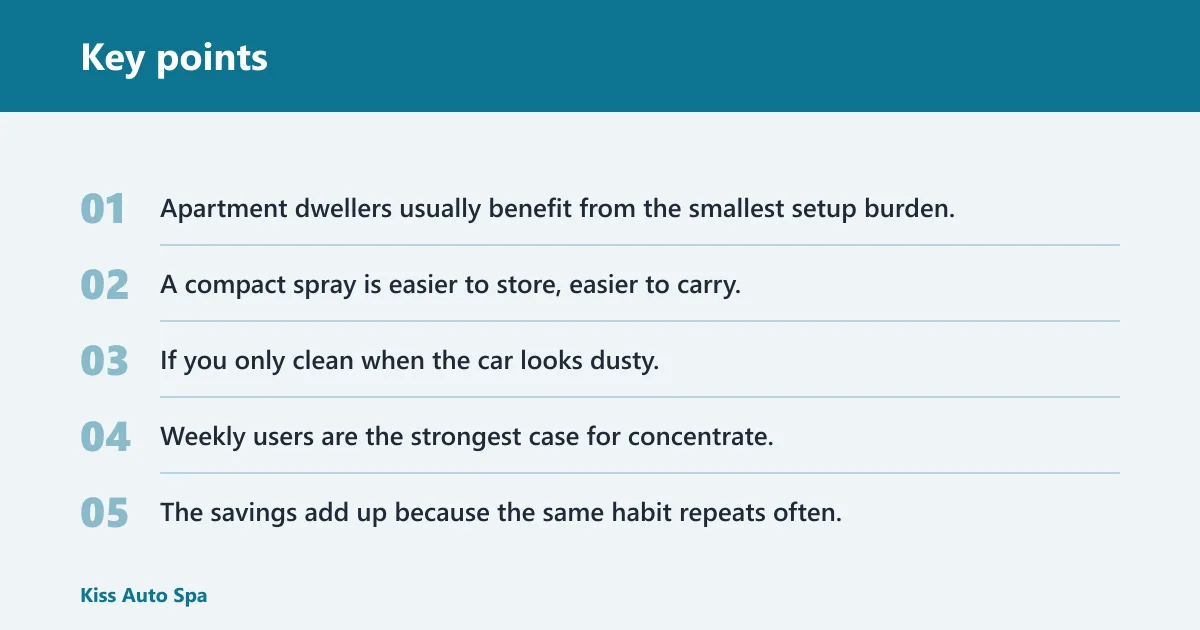
Apartment dwellers usually benefit from the smallest setup burden. A compact spray is easier to store, easier to carry, and less likely to become a half-used bottle of mixed solution in a closet.
If you only clean when the car looks dusty, the cheaper per-wash math of concentrate may never matter enough to justify the added steps.
Weekly detailers
Weekly users are the strongest case for concentrate. The savings add up because the same habit repeats often, and the extra minute spent mixing becomes routine rather than friction.
Suppose you wash every Saturday and have a dedicated shelf in a garage or utility closet. A refill bottle usually makes more sense than buying repeated ready-to-use sprays.
Ceramic-coated cars
Protected cars need a formula choice, not just a format choice. Some products add wax or SiO2, which may be fine on some finishes but may not match every coating-care preference, so coating-safe labeling matters more than marketing language.
For coated paint, pick the format that fits your routine, then verify that the formula is compatible with your protection layer. The wrong additive profile can leave a maintenance detail feeling off, even if the wash itself is gentle.
Occasional touch-up users
Occasional users tend to value speed and storage more than refill economics. A small bottle in the trunk or closet is often the most practical choice when the car only needs dust removal now and then.
If the product will sit unused for long stretches, concentrate savings can be theoretical rather than practical.
Can you mix concentrate for a foam sprayer?
Yes, many concentrates can be mixed for a foam sprayer if the label allows it and the ratio is followed exactly. A foam sprayer can help spread the product evenly, but it does not change the need to work panel by panel on light dust only.
When a foam sprayer helps
A foam sprayer helps when you want even coverage and a controlled working batch. It is useful for measured dilution, especially when the label gives a small dose like 5ml into 500ml water.
That setup is still not a license to spray the whole vehicle and forget it. The safest routine is small sections, clean towels, and immediate wiping.
When a spray bottle is better
A spray bottle is better when you want the simplest possible routine or need a bottle that fits in a door pocket or trunk organizer. It also keeps the process more portable for quick touch-ups away from home.
For many drivers, the choice is less about output and more about convenience at the moment the car needs attention.
Mixing and label-check basics
Check whether the label says waterless, rinseless, or foam-compatible before mixing. Do not assume a concentrate belongs in every sprayer type, and do not exceed the recommended ratio because stronger is not automatically safer.
PROKLEAR says its WFC is pH neutral and “No need of Rinsing,” and it recommends 5ml for one car mixed into 500ml water in a foam sprayer. That is a useful example of how specific the label can be, but it is still only one product’s guidance.
Can waterless wash handle heavy dirt?
No. Waterless wash is for light dust, pollen, and quick touch-ups only, and heavy contamination is the point where you should stop. Mud, baked-on dirt, road salt, sand, ash, and grit raise scratch risk fast, especially on lower panels, rocker areas, and wheel arches.
Heavy contamination threshold
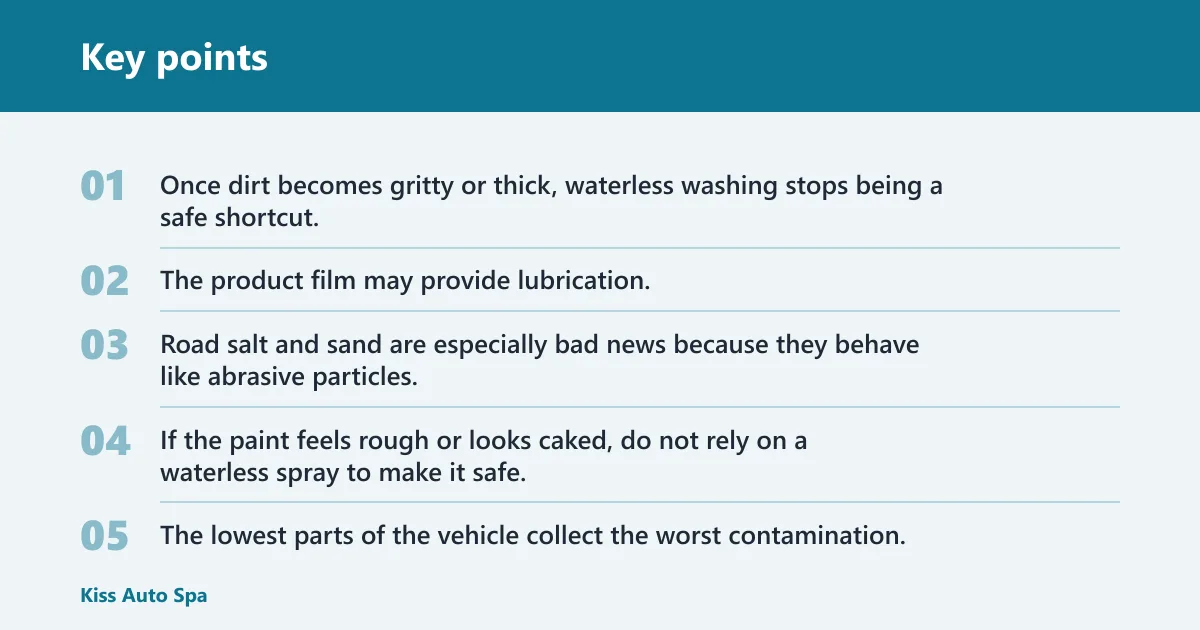
Once dirt becomes gritty or thick, waterless washing stops being a safe shortcut. The product film may provide lubrication, but it is not a substitute for removing bonded debris in a more thorough wash process.
Road salt and sand are especially bad news because they behave like abrasive particles. If the paint feels rough or looks caked, do not rely on a waterless spray to make it safe.
Risk zones on the vehicle
The lowest parts of the vehicle collect the worst contamination. Rocker panels and wheel arches usually carry more grit than upper doors or the roof, so those areas are the first ones to rule out for waterless washing.
Use the cleanest sections first, and stop if the towel starts dragging or picking up obvious debris.
When to switch to rinseless or bucket washing
Switch to rinseless when the car has moderate grime and water access is limited; a common rule of thumb is that it uses about 1–2 gallons of water. Rinseless uses a bucket with roughly 1–2 gallons of water, which sits between waterless and traditional washing in both water use and cleaning power.
Real Tested Gear frames waterless washing as suitable for light dirt and no hose access, while rinseless uses only 2 gallons of water. That is the clearest boundary: light dust for waterless, more substantial grime for rinseless, and full washing when the vehicle is heavily soiled.
Protection layer compatibility
Waterless wash can be compatible with wax, sealant, and ceramic coating, but compatibility varies by formula. Some products add wax or SiO2, which may appeal to drivers who want a maintenance boost, while others are designed to stay neutral and focus on safe cleaning.
That means the right question is not “Is waterless wash safe?” but “Is this specific formula safe for this specific protection layer?”
Wax and sealant finishes
Many waterless formulas are fine on waxed or sealed paint when used correctly. The real issue is whether the product leaves behind extra gloss agents, wax, or slicking additives that fit your maintenance goal.
If you want a clean maintenance wash with minimal residue, a more neutral formula is often the cleaner choice.
Ceramic coating safety
Ceramic-coated cars deserve the most caution because some formulas are sold as coating-friendly and others are not. Choose a product that clearly states coating compatibility if the car has a coating you want to preserve.
Waterless wash can work on ceramic-coated paint, but the label matters more than the bottle style. The format alone does not guarantee compatibility.
Lubrication chemistry in plain terms
Surfactants loosen dirt, and lubricants reduce friction between the towel and the paint. That is the basic reason waterless products can work on light contamination without a hose.
Not all formulas encapsulate dirt equally well. Some are better at suspending loosened particles so the towel can lift them away with less drag, while weaker formulas can feel grabby and leave more streak risk if the towel is dirty.
Choose Waterless wash spray if…
Choose waterless wash spray if you wash less than about twice a month, have limited storage, or want the fastest start-to-finish routine. It is also the better pick if you want a small bottle for trunk storage, quick touch-ups, or simple use without measuring.
Choose concentrate if you clean often, want the lower per-wash cost, or are willing to mix before use. It also fits drivers who keep the product at home, have room for a larger refill, and want the better value over repeated washes.
Frequently asked questions
Waterless wash spray vs concentrate: which is better?
Neither is universally better. Waterless wash spray is better for convenience, fast touch-ups, and small storage spaces. Concentrate is better for repeated washing because it usually lowers cost per wash, as long as you are willing to measure, mix, and follow the label.
Is waterless wash concentrate cheaper per wash?
Usually yes. A concentrate spreads the active product across more finished solution, so the cost per wash is typically lower than a ready-to-use spray. The savings matter most when you wash regularly and use the product often enough to beat the convenience premium of spray.
Can a waterless concentrate be mixed with a foam sprayer?
Yes, if the label allows that format and the ratio is followed. A foam sprayer can make dilution and application more controlled, but it does not change the basic rule: use it on light dust only, work panel by panel, and avoid overdoing the strength.
Is waterless wash safe on ceramic coating?
Sometimes, but compatibility varies. For coated paint, the safer choice is a formula that clearly states coating-safe use. Some products add wax or SiO2, which may be fine for some maintenance goals, but the label should match the coating and the finish you want to maintain.
Do I need multiple microfiber towels for waterless wash?
Yes, multiple clean microfiber towels are the safer approach. One towel should lift dirt, and another should buff the surface clean. A single towel can load up with debris quickly, which raises streak risk and can drag grit back across the paint.
Can waterless wash handle heavy dirt and mud?
No. Mud, baked-on dirt, road salt, sand, ash, and grit are stop signals. Those contaminants make scratching more likely, especially on lower panels, rocker areas, and wheel arches. At that point, rinseless or a full wash is the better move.
What is the difference between waterless and rinseless wash?
Waterless wash is for light dust and quick touch-ups without a hose or bucket. Rinseless uses a bucket with roughly 1–2 gallons of water and handles more moderate grime. They are related, but they are not the same method and should not be used interchangeably.
Which waterless wash is best for apartment dwellers?
Apartment dwellers usually do best with a ready-to-use spray because it is compact, simple, and does not require mixing gear. If you wash often enough to justify a refill bottle, concentrate can still win on cost, but only if you have room for the extra storage and the routine to match.