Why Does My Car Smell Like Gas Inside?
A gasoline smell inside usually points to a fuel-system problem, a vapor leak, or outside fumes entering the cabin. If it is strongest during start-up, idling, or right after refueling, treat it that way first. Ignoring it can mean fire risk, hard starts, rough running, and a repair bill that grows when the leak reaches hoses, seals, or the charcoal canister. This guide explains how to tell fuel vapor from liquid fuel and cabin contamination by when the odor appears, where it is strongest, and what to check first.
How gas odor enters your car’s cabin
The timing tells you a lot. If the odor appears after refueling, a vapor issue is more likely. If it shows up at start-up or idle, look harder at injectors, seals, or fuel pressure regulation. If it is strongest while driving or with the heat on, an exhaust leak or cabin-entry path may be bringing fumes inside.
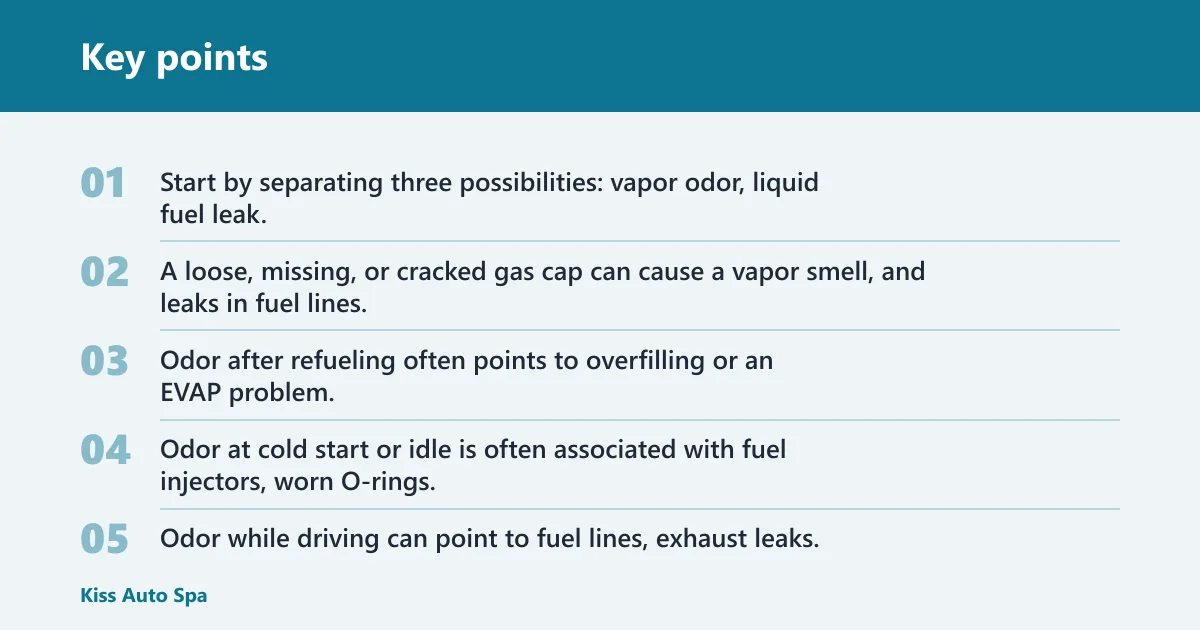
Start by separating three possibilities: vapor odor, liquid fuel leak, and outside fumes entering the cabin. A loose, missing, or cracked gas cap can cause a vapor smell, and leaks in fuel lines, injectors, or the engine bay can also cause a stronger odor and a higher safety risk.
What the timing of the smell tells you
Odor after refueling often points to overfilling or an EVAP problem. Odor at cold start or idle is often associated with fuel injectors, worn O-rings, or a fuel pressure regulator issue. Odor while driving can point to fuel lines, exhaust leaks, or cabin airflow drawing outside fumes in.
Say your car smells like gas for five minutes after a fill-up, then the smell fades. That pattern fits a vapor event better than a steady liquid leak. Suppose the smell returns every time you top off the tank and is strongest near the rear of the car. That points first to the gas cap, EVAP components, or an overfilled tank pushing fuel into the evaporative system.
Why the cabin can smell even when the leak is outside
The cabin can pull odor in from outside. HVAC intake paths, rear-seat openings, trunk pass-throughs, and gaps around the rear cargo area can move vapor or exhaust smell into the passenger area. That is why a cabin odor does not always mean the leak is inside the cabin itself.
Check whether the smell is stronger at the vents, in the trunk, or near the back seat. If the odor changes when the fan speed changes or when the heat is on, cabin-entry paths deserve attention along with the fuel system.
Gas smell matrix
| Timing pattern | Likely cause | First check | Escalation level |
|---|---|---|---|
| After filling up | Overfilled fuel tank, loose gas cap, EVAP vapor escape | Gas cap seals tightly and clicks into place; confirm you stopped at the nozzle click rule | Moderate if faint and brief; high if it keeps returning |
| Cold start | Fuel injector seals, fuel pressure regulator, raw fuel near engine bay | Look for odor strongest under the hood and around injector bases | High if the smell is sharp or persistent |
| Idle or stop-and-go traffic | Injector O-rings, fuel pressure regulator, rich running | Check for odor near the engine bay and listen for rough idle | High if the odor does not fade quickly |
| Driving with heat or HVAC on | Exhaust leak, cabin-entry path, EVAP vapor pulled into intake | Notice whether the smell changes with fan speed or vent setting | High if fumes are strong inside the cabin |
| Persistent smell with no visible leak | EVAP fault, charcoal canister crack, purge or vent valve issue | Plan a smoke test to find hidden vapor leaks | High if the smell repeats or gets stronger |
Why does my car smell like gas inside after filling up?
A smell after filling up often points to the fuel tank area, not the engine bay. Overfilling can push fuel into EVAP components, and a loose, missing, or cracked gas cap can let vapor escape. If the odor fades quickly, the issue may be brief vapor release; if it keeps returning, inspect the EVAP system and cap first.
Overfilled tank and EVAP vapors
Stopping at the pump click matters. The nozzle-click rule is the cutoff for refueling because topping off can force liquid fuel into the EVAP system. That can affect the charcoal canister and related lines, and the smell may show up soon after you leave the station.
A strong odor that starts after a fill-up and then disappears after a short drive often points to excess vapor rather than a large leak. If the smell gets stronger in warm weather or after a full tank, inspect the cap seal and the rear of the car first.
Gas cap issues
The gas cap should seal tightly and click into place. A loose or missing gas cap is a common cause of gas smell in cars, and a cracked or faulty cap can let vapors escape even when the tank itself is not visibly leaking. Replace a damaged cap rather than trying to clean it back into service.
If the cap looks fine but the odor keeps coming back after each refuel, move on to the EVAP system. A smoke test is often used to find hidden leaks that do not leave wet spots.
Why does my car smell like gas when I start it or idle?
Start-up and idle odors often point to the engine bay. Leaking fuel injectors, worn injector seals, or a faulty fuel pressure regulator can cause a raw fuel smell when the engine first fires or sits at idle. If the odor is strongest near the hood, treat it as an engine-bay fuel issue first.
Fuel injectors and worn seals
Leaking fuel injectors are cited as a source of gas odor. Worn O-rings or injector seals can let fuel vapor or liquid fuel escape around the injector body, and the smell may be strongest at start-up or idle because fuel pressure is present while engine demand is low.
Look for odor around the top of the engine and the fuel rail area. A sharp gasoline smell near the hood, especially when cold, is more concerning than a faint odor that disappears after a minute.
Fuel pressure regulator faults
A fuel pressure regulator fault can cause rich running or leakage, and that can add to a gas smell in the cabin. Rich running means more fuel than the engine can burn cleanly, so raw fuel odor may show up at idle, during acceleration, or right after starting.
If the engine also idles rough, stalls, or feels lazy on tip-in, the odor is more likely tied to a fuel delivery problem than to a cabin contamination issue. That deserves a mechanic-level inspection.
Why does my car smell like gas while driving?
Odor while driving raises the odds of a leak or exhaust issue. Fuel lines run from the fuel tank to the engine, and cracked fuel lines or hoses can create a gas smell. Exhaust system leaks can also let fumes enter the cabin, especially if the smell changes with speed, load, or HVAC use.
Fuel lines and hidden liquid leaks
Fuel lines can crack, loosen, or wear out. A leak under the car may not leave an obvious puddle if it is small or if fuel is evaporating before you park, but it still creates a fire hazard. Any wetness under the car, on the frame, or near the tank needs prompt inspection.
If the smell is stronger after a long drive, look for lines near the tank, underbody connections, and the engine bay. Hidden leaks often need a lift and a close visual inspection to find.
Exhaust leaks and cabin airflow
An exhaust leak can let unburned fuel fumes enter the cabin. That matters when the smell appears while driving or when heat is on, because the HVAC system can pull outside air and fumes into the passenger area. Muffler, pipe, or gasket damage can all matter here.
If the odor smells more like exhaust than raw fuel, do not ignore it. Exhaust fumes can mix with gasoline odor and make the source harder to spot.
Why does my car smell like gas but no leak?
No visible leak does not rule out a fuel problem. EVAP system faults can let vapors escape without a liquid drip, and the charcoal canister can crack, leak, or wear out. Hidden vapor leaks are common in no-leak odor cases, especially after refueling or during temperature changes.
EVAP system parts to inspect
The EVAP system controls fuel vapor containment. It includes the charcoal canister and purge and vent components. If a purge valve sticks open or a vent valve fails, vapors can move where they should not, and you may smell gas even though the ground stays dry.
A smoke test is the common way to locate hidden EVAP leaks. It helps find faults that do not show up during a basic visual check.
Cabin-entry paths and fuel-soaked materials
Odor can also cling to materials that absorbed fuel vapor. Rear-seat cushions, trunk liners, and trim around pass-through openings can hold smell after a spill or vapor event. That is a cabin contamination issue, but it should be treated only after you rule out an active leak.
Check the trunk, rear seat area, and HVAC intake path for odor concentration. If the smell is strongest in the back of the cabin, the source may be outside the cabin and entering through openings or duct paths.
What should I check first if my car smells like gasoline?
Start with the fastest checks that separate harmless residue from a real fuel-system problem. Confirm the gas cap, look for recent overfilling, check for wet spots under the car and under the hood, and note exactly when the smell appears. If the odor is strong or persistent, stop treating it like a cleanup issue.
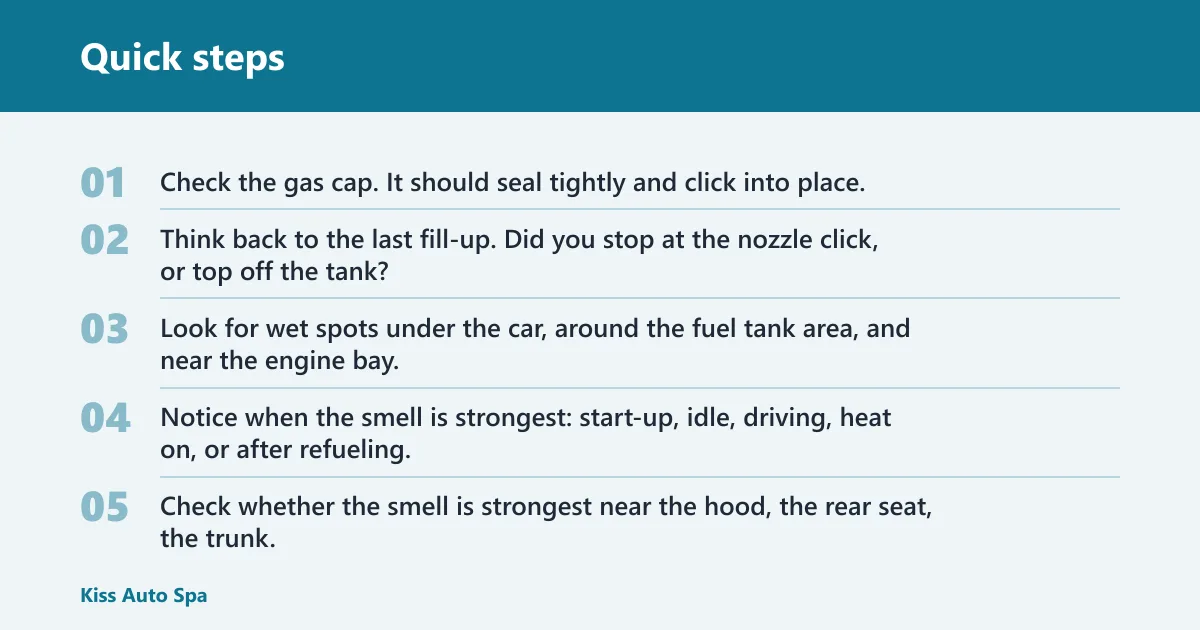
- Check the gas cap. It should seal tightly and click into place.
- Think back to the last fill-up. Did you stop at the nozzle click, or top off the tank?
- Look for wet spots under the car, around the fuel tank area, and near the engine bay.
- Notice when the smell is strongest: start-up, idle, driving, heat on, or after refueling.
- Check whether the smell is strongest near the hood, the rear seat, the trunk, or the vents.
- If no liquid leak is visible, plan a smoke test for the EVAP system.
Red flags that mean stop driving
Stop driving if the gas smell is strong and persistent, if you see fuel dripping or a wet patch, if the odor gets stronger in the cabin while moving, or if the engine starts running rough along with the smell. A strong gas smell is dangerous and should not be ignored.
Also stop if the smell is paired with a hot underhood odor, visible smoke, or a check-engine light combined with rough idle. Do not assume the car is safe because the ground is dry.
Frequently asked questions
Why does my car smell like gas inside the cabin?
That usually means vapor or fumes are entering the cabin from outside, or a fuel component is leaking near the engine bay or underbody. The key question is when it happens. Heat on, idle, start-up, and right-after-refuel odors point to different checks, so timing matters more than the smell alone.
Why does my car smell like gas inside when I start it?
Start-up odor often points to fuel injectors, worn seals, or a fuel pressure regulator issue. A raw fuel smell near the engine bay is more concerning than a faint cabin odor. If the smell is strongest only for the first minute, note whether it repeats every cold start.
Why does my car smell like gas inside when idling?
Idling can make a fuel delivery problem easier to notice because airflow is low and raw fuel odor lingers near the hood. Fuel injectors and fuel pressure regulator faults are common checks here. If the smell grows at stoplights but fades when driving, inspect the engine bay first.
Why does my car smell like gas inside while driving?
While driving, a fuel line leak or exhaust leak becomes more likely, especially if the smell changes with speed or gets stronger when the heat is on. Exhaust fumes can enter the cabin through airflow paths, so the source may be outside the passenger area even when the odor is inside.
Is it safe to drive if my car smells like gas?
If the smell is strong, persistent, or joined by rough running or visible wet fuel, do not keep driving. A faint odor right after refueling is less urgent, but it still needs a check if it returns. Fuel odors are a warning, not something to ignore.