Is Ammonia-free Glass Cleaner Safe for Tinted Car Windows?
Ammonia-free glass cleaner is often considered safe for tinted car windows, but only if the film maker allows it and the label says tint-safe. Wrong cleaner or rough wiping can haze the film, leave streaks, or damage adhesive at the edges. The simple rule is plain: check the label, match it to the film, then spot test before full use.
Ammonia-free enough for tint?
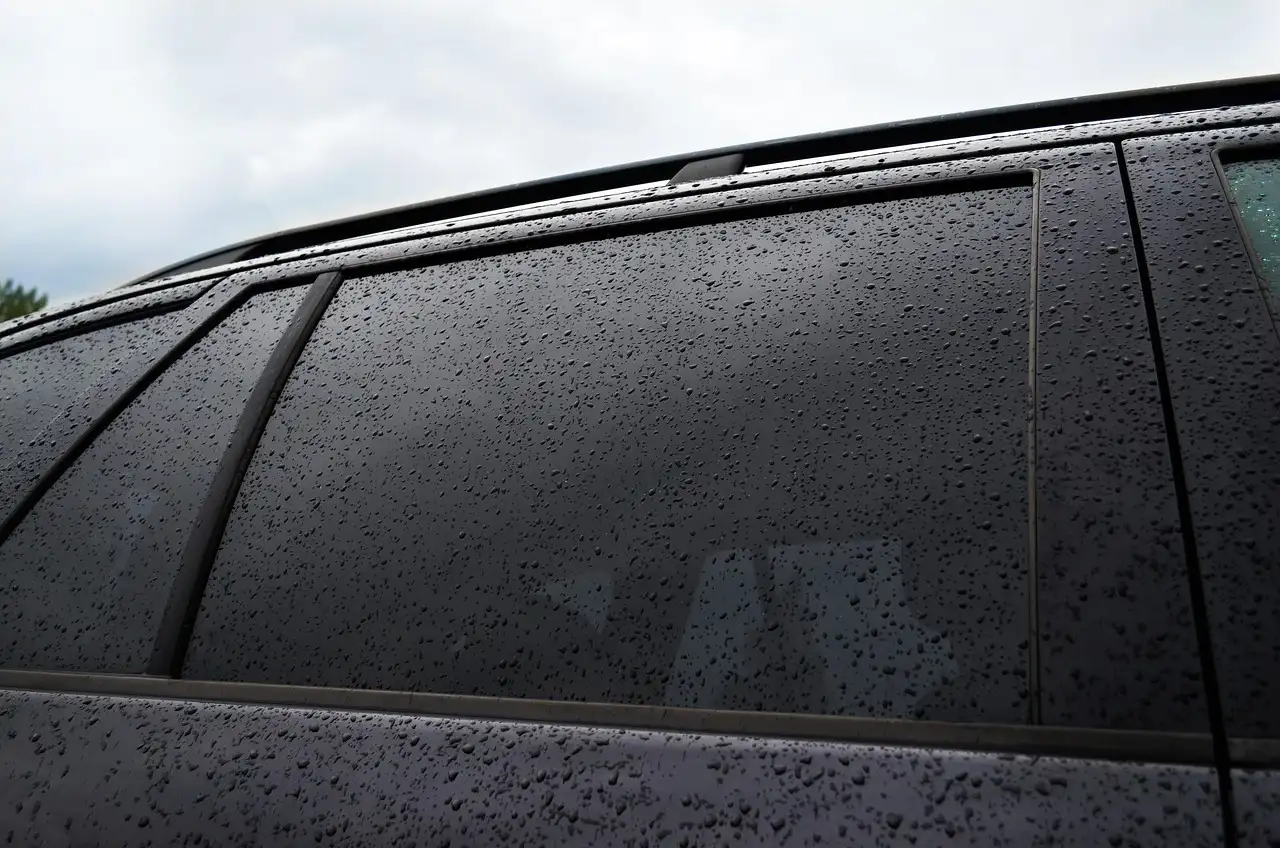
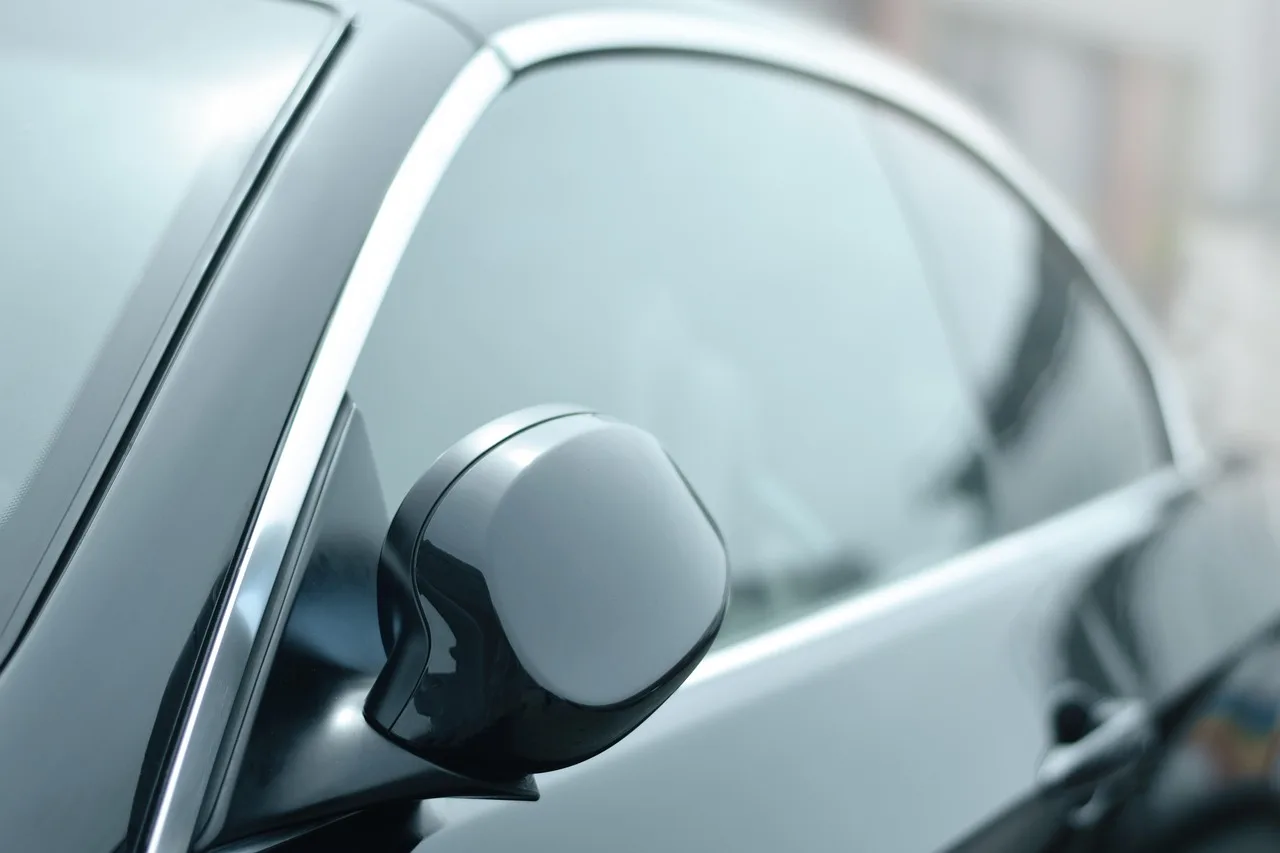
Ammonia-free is the starting point, not the full answer. Tinted automotive glass should be cleaned with a product labeled tint-safe, since different types of tint or film may react differently to chemicals or wiping pressure.
A product can be ammonia-free and still miss the mark if the label says nothing about tint, or if it includes other ingredients that are harsh on film or residue-prone on glass. The safer rule is simple: ammonia-free plus tint-safe language plus a spot test.
What ammonia-free tells you
Ammonia-free cleaners are commonly positioned for automotive glass because they help remove fingerprints, light oily haze, and everyday road film without the harshness many people want to avoid on film. Some glass cleaners are marketed as ammonia-free.
That claim matters, but it only answers part of the question. It says nothing about the exact tint type, the age of the film, or whether the bottle is also safe for coated, dyed, or poorly installed film.
Why factory tint and aftermarket film are not the same
Factory tint is built into the glass, while aftermarket tint is a film bonded to the inside of the window. That difference matters because the film can be the weak point. A cleaner that is fine on bare glass may still cloud, bubble, or lift edges on older or damaged film.
Say your rear door glass has factory tint and the side windows have aftermarket film from a previous owner. A bottle that is acceptable for one may still deserve a spot test on the other, especially if the film is aging or the edges already show lift.
What ingredients should you avoid?
Avoid ammonia on tinted windows unless the film maker specifically allows it. Also avoid cleaners that include methanol, abrasive additives, or anything that can leave a heavy film behind. Those ingredients can increase the chance of haze, smears, or edge problems on sensitive tint.
Older tint, damaged tint, and poorly installed film need extra caution. If the window already has bubbling, scratches, or cloudy patches, a stronger product can make the problem easier to see and harder to fix.
Ammonia and methanol
Ammonia is the most common ingredient people are told to avoid on tinted glass. Methanol comes up often too. Good Stuff says its Glass Cleaner is ammonia- and methanol-free, and also suitable for tinted automotive glass. CleenU says its glass cleaner is ammonia-free and fast-drying with low residue, though it also says it is not for electronic screens and coated eyeglass lenses.
Those label details matter because they show how narrow the safe-use claim can be. Do not assume every ammonia-free bottle has the same compatibility.
Abrasive additives and residue-heavy formulas
Skip products with abrasive additives or any cleaner that leaves a waxy, oily, or heavy residue. Tinted glass does not need scrubbing grit. It needs a thin, even application that can lift road film and greasy haze without grinding it into the surface.
Foaming glass cleaner can help here because foam stays where you place it. Sprayway Glass Cleaner, for example, is listed by Walmart as ammonia-free with streak-free foaming action. That kind of spray control can reduce overspray on trim and film edges.
Tint safety checklist
Use this checklist before you spray. Every answer should be yes. If one answer is no, choose another product or test a hidden area first.
| Check | Yes / No | Why it matters |
|---|---|---|
| Film type is known | You know whether the window has factory tint, dyed film, ceramic film, or another aftermarket film. | |
| Bottle explicitly says tint-safe | “Ammonia-free” alone is not enough if tint-safe is missing from the label or product page. | |
| Ammonia and methanol are absent | These ingredients are common red flags for tinted windows and residue control. | |
| No abrasive additives | Abrasives can scratch film or make haze harder to remove. | |
| Spot test passed | A small hidden area stayed clear after use and wipe-down. | |
| Towel is clean glass microfiber | Dedicated glass microfiber lowers lint, streaks, and residue transfer. | |
| Surface is cool | Cool glass slows evaporation and gives you more working time. | |
| No edge bubbling or haze after 24 hours | Delayed problems often show at film edges after the cleaner has dried. |
Use the checklist as a decision rule, not a formality. If the bottle is vague, the film is old, or the window has any visible edge issues, choose a different cleaner and test again on a small section.
Can you use one cleaner inside and outside?
Yes, many ammonia-free glass cleaners are used on both interior and exterior automotive glass, but the technique should change. Interior glass, especially the windshield, is where streaks and smears show up most often. Exterior glass usually has more road film and more dust, so it may need a slightly different wipe pattern.
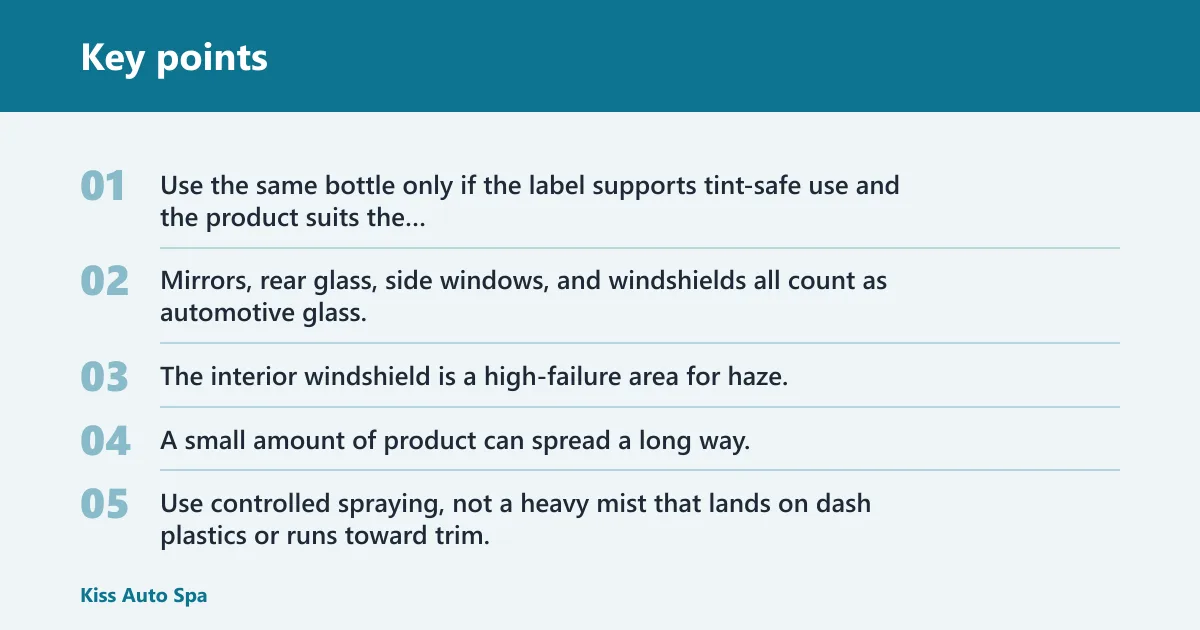
Use the same bottle only if the label supports tint-safe use and the product suits the surface. Mirrors, rear glass, side windows, and windshields all count as automotive glass, but the contamination level is rarely the same.
Interior windshield rules
The interior windshield is a high-failure area for haze. A small amount of product can spread a long way, and the angle makes missed residue easy to see in bright light. Use controlled spraying, not a heavy mist that lands on dash plastics or runs toward trim.
Work in small sections. A clean microfiber towel should handle the first wipe, then a second dry towel or a dry section of the same towel should finish the pass. That extra dry step matters on interior glass because it removes the thin film that causes smears.
Exterior glass, mirrors, and rear glass
Exterior windows, mirrors, and rear glass often carry road film and greasy haze. Those surfaces usually tolerate a little more product than interior glass, but the same tint-safe rule still applies to film on side and rear windows. If the back glass has embedded defroster lines plus tint, keep the spray light and the pressure gentle.
Suppose the front side windows are covered in fingerprints while the rear glass has a dusty film from a week of driving. The cleaner may be the same, but the front side glass likely needs a lighter spray and more attention near the edges.
How do you avoid streaks and haze?
Streak prevention comes from three habits: spray lightly on cool glass, use a clean glass microfiber towel, and finish with a dry pass. That combination works better than adding more product. Too much liquid can leave a faint film that looks clean at first and hazy later.
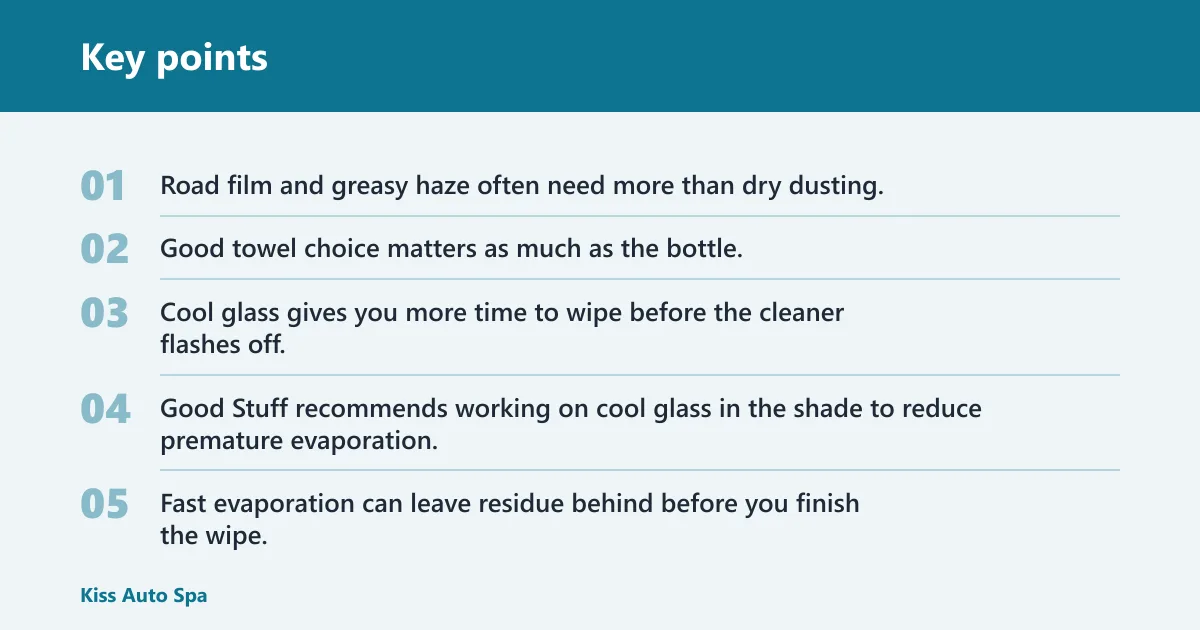
Road film and greasy haze often need more than dry dusting, so the goal is controlled cleaning rather than heavy saturation. Good towel choice matters as much as the bottle.
Spray lightly on cool glass
Cool glass gives you more time to wipe before the cleaner flashes off. The same source recommends working on cool glass in the shade to reduce premature evaporation, and that advice fits tinted windows well. Fast evaporation can leave residue behind before you finish the wipe.
Keep the spray off hot panels and direct sun when possible. Heat makes streaks more likely because the cleaner dries before you can level it out.
Use a clean glass microfiber towel
A dedicated automotive glass microfiber towel is the right tool here. A waffle weave microfiber towel is specifically recommended by Good Stuff for the cleanest finish. The woven pattern helps trap lint and move residue off the glass instead of dragging it around.
Use separate towels for glass and for paint or interior trim. A towel that has seen dressings, interior protectants, or dirty panels can smear glass even if it looks clean at a glance.
Finish with a dry pass
A dry follow-up pass reduces streaks and haze. After the first wipe, turn the towel to a dry side or use a second dry towel to buff away the last thin film. This is especially useful on the inside of the windshield and near the top edge of side windows, where residue likes to hide.
A common first-timer mistake is soaking the towel until it drips. That usually creates more streaks, not fewer. Light spray, then a controlled wipe, gives a cleaner finish.
Which labels and towels should you trust?
Trust labels that say tint-safe in plain language, not bottles that only say ammonia-free and leave the rest unclear. Also trust dedicated glass microfiber, especially waffle weave, because it reduces lint and helps the final buff. Foaming glass cleaner fits well when you want better spray control on vertical glass.
When the packaging is vague, do not guess. If the product is meant for tinted automotive glass, the label should say so.
What tint-safe label language looks like
Useful label language is direct. Walmart lists Invisible Glass 92164 as ammonia-free and tint-safe in a 22 fl oz spray. Walmart also lists Sprayway Glass Cleaner as ammonia-free with streak-free foaming action. Rain-X 630018 is presented as safe for tinted windows, and HOPE’S Perfect Glass Automotive Glass Cleaner is stated to be safe for tinted windows.
Those examples show the difference between a general cleaning claim and a tint-specific claim. If the bottle only mentions glass, mirrors, or streak-free results, that does not automatically tell you it is safe for film.
Where foaming glass cleaner fits
Foaming formulas can be helpful on glass because they cling instead of running. That can reduce overspray on door panels and make the wipe more predictable on vertical windows. The benefit is control, not magic. You still need the right towel and a light hand.
Foam is useful when you are cleaning side glass or rear glass with road film. It can also help on the interior windshield if you keep the amount small and buff dry afterward.
Frequently asked questions
Is ammonia-free glass cleaner safe for tinted car windows?
Usually, yes, but only if the bottle is also labeled tint-safe and the film maker allows it. Ammonia-free is the baseline, not the whole decision. Older, coated, poorly installed, or damaged film can still react badly, so a spot test and a dry follow-up wipe are still smart.
What ingredients should I avoid on tinted windows?
Avoid ammonia unless the tint maker specifically approves it. Also avoid methanol when possible, plus abrasive additives that can scratch or haze film. If the label is vague about tint use, treat that as a warning sign and choose a product that states tint-safe use more clearly.
Can I use the same glass cleaner inside and outside my car?
Often yes, if it is tint-safe and meant for automotive glass. The technique should change by surface. Interior windshield glass usually needs less product and a dry finish, while exterior glass may deal with more road film and dust. Mirrors and rear glass fit the same general rule.
What towel should I use so glass cleaner does not streak tinted windows?
Use a clean automotive glass microfiber towel, with waffle weave as the best-known pattern for a cleaner finish. It helps lower lint and residue transfer better than generic cloths. A second dry towel or dry side is useful for the last pass, especially on the inside of the windshield.
How do I clean tinted windows without leaving haze or residue?
Work on cool glass in the shade, spray lightly, and wipe with a clean glass microfiber towel. Finish with a dry pass to remove the last film. If haze still shows up, the problem is often too much product, a dirty towel, or a cleaner that is not truly tint-safe.
Will glass cleaner damage window film or cause bubbling?
It can, if the cleaner is wrong for the film or if the film is already weak at the edges. Damage may show as haze, bubbling, fading, or edge lift rather than an immediate visible failure. That is why the tint-safe label, the film type, and a spot test all matter.
Which glass cleaners are labeled tint safe?
Examples include Chemical Guys CLD30016, Chemical Guys CLD_202_16, Rain-X 630018, Sprayway Glass Cleaner, HOPE’S Perfect Glass Automotive Glass Cleaner, and Invisible Glass 92164. Good Stuff also says its Glass Cleaner is suitable for tinted automotive glass, and Walmart lists Sprayway as ammonia-free with streak-free foaming action.