How to Do a Rinseless Wash in Winter
Use a rinseless wash in winter only when the vehicle has light road film, not packed salt, mud, or slush. In practice, that means a cool panel, manageable contamination, and a fast dry-down. Manufacturer directions and winter-car-care guidance generally emphasize using the label dilution first and shortening work sections in cold, windy conditions.
Winter rinseless wash basics
What changes in cold weather
Cold weather shortens working time. Panels can flash-dry faster in wind, and a damp edge can streak or freeze before you finish a large section. Winter guidance from wash-product makers and detailing retailers commonly recommends washing on a mild day, often around or above 40°F, and keeping the car out of direct sun when possible so the surface does not dry unevenly.
Winter grime is different from summer dust. Road salt leaves a gritty film, slush traps sand, and heavier debris can hide sharp particles. A rinseless wash can handle light dust through moderate road film, but it is the wrong tool when the vehicle is coated with caked winter buildup.
When this method fits and when it does not
Use this method when the paint still looks dusty or hazy after winter driving and the surface feels smooth rather than abrasive. Do not use it first on heavy salt buildup, heavy bugs, packed slush, or mud. Those conditions call for a touchless pre-wash or another method before any contact wash.
For example, a sedan with a thin salt haze on the hood and doors after a short commute can be a rinseless candidate if the paint is cool and the lower panels are not caked. If the rear bumper has gritty slush packed into seams, stop and switch to a stronger pre-wash instead of forcing mitt contact.
What you’ll need
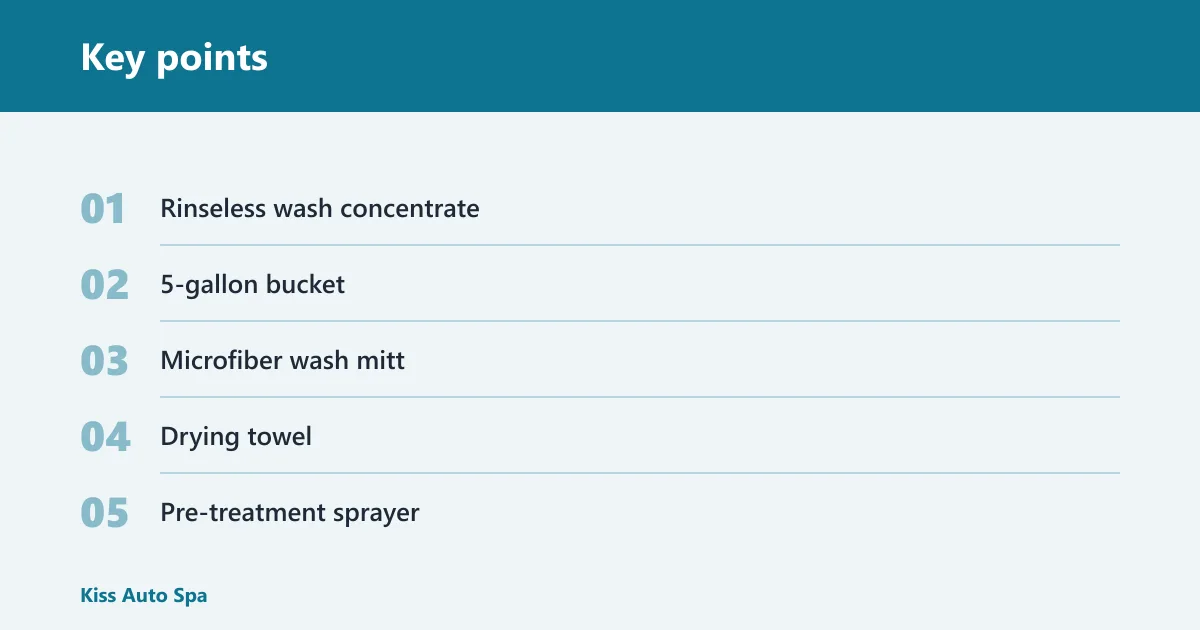
- Rinseless wash concentrate with the label dilution ratio. Product labels vary, so use the manufacturer’s instructions first.
- 5-gallon bucket filled with about 2–3 gallons of water, plus a grit guard.
- Microfiber wash mitt or high-pile microfiber towel with soft fibers.
- Drying towel in plush or twist-loop microfiber.
- Pre-treatment sprayer loaded with the same wash dilution as the bucket mix.
- Two or more clean microfiber towels for switching to fresh faces often.
- Separate towels for wheels, lower rocker areas, and paint.
Rinseless concentrate and dilution
Use the manufacturer’s dilution ratio first. Many rinseless products use a labeled dilution in the neighborhood of about 256:1, while some brands give capful or ounce-based directions for a bucket mix. For winter, the safest rule is simple: follow the bottle, because dilution is product-specific, not universal.
Most rinseless concentrates can be used both as the wash solution and, at the same dilution, as a pre-treatment sprayer for heavier winter film. That pre-spray helps soften salt and road grime before contact. Compatibility is often listed for ceramic coatings, PPF, matte paint, and glass, but product-specific exceptions still matter, so check the bottle.
Bucket, grit guard, and water amount
A 5-gallon bucket does not need to be filled to the top. About 2–3 gallons is enough for a full vehicle on many rinseless products, and that leaves room to rinse the mitt against the grit guard. The guard helps settle dirt below the wash zone so you can keep the clean solution cleaner.
Wash media and drying towels
Use a microfiber wash mitt or a high-pile microfiber towel with soft fibers. Move the mitt in straight lines with very light pressure. Change to a clean side or face often so you are not dragging winter grit across the paint. For drying, choose a plush or twist-loop microfiber towel and dry each panel immediately after washing with a blotting or light gliding motion.
Winter wash decision table
| Contamination level | Ambient temperature range | Panel size | Dwell time | Pre-spray? | Drying order | Recommended process |
|---|---|---|---|---|---|---|
| Light dust or faint road film | About 40°F or warmer; cool shade preferred | Half panel or smaller | Minimal; do not let solution sit | Yes | Wash and dry each section immediately; roof and upper panels first | Proceed with rinseless wash. Stop if the mitt drags grit. |
| Moderate salt film or winter grime | About 40°F or warmer, only if the panel stays cool | Quarters on large panels; halves on smaller panels | Very short; just enough to loosen film | Yes | Upper panels first, lower doors and rocker areas last | Proceed only if the film is loose, not gritty. If the solution turns dirty fast or the surface feels abrasive, switch to a touchless pre-wash. |
| Heavy slush, mud, heavy bugs, or packed salt | Any winter condition | Do not contact wash | Do not dwell | No | Touchless cleaning first, then reassess | Do not use rinseless as the first step. Use a touchless pre-wash or another method first. Hard stop if grit keeps dragging. |
Is a rinseless wash safe in freezing temperatures?
Not automatically. A rinseless wash is safest when the panel is above freezing, the surface is cool, and the vehicle can be dried fast enough to avoid water trapped in seals, locks, or jambs. Below freezing, the main risk is frozen moisture in seams, not the soap itself.
Temperature limits and wind exposure
Above about 40°F is a common winter target in manufacturer and retailer guidance, but that is a practical guideline rather than a universal rule. Wind matters because it accelerates evaporation and makes flash-drying more likely even when the air temperature seems workable. If the panel starts to dry before you finish, shrink the section immediately.
Indoor garage versus outdoor washing
An indoor garage gives you more control over wind and drying. Outdoor mild-day washing works when the paint stays cool and the sections stay small. Apartment or HOA winter washing is usually best only when you can keep the work contained, limit spray drift, and move the car back inside or under cover as soon as each panel is dry.
How to avoid frozen seals and locks
Keep moisture away from door seals, handles, mirror bases, and keyholes. After the paint is dry, open and close each door once to clear drips from the edge, then wipe the jambs with a dry microfiber towel. If the forecast is below freezing, skip heavy water around the lower edges and do not leave wet buildup in creases.
How do you do a rinseless wash in winter?
Start with a contamination check, then wash the cleanest upper panels first and the dirtier lower panels last. Use the product’s dilution, pre-spray each section if needed, and keep each section small enough to wash and dry before it flashes. If the mitt starts to drag grit, stop and switch methods.
- Inspect the paint, wheel arches, and lower doors for grit, packed slush, or bugs.
- If you feel abrasive debris or see caked buildup, stop and use a touchless pre-wash.
- Mix the bucket at the label dilution, using about 2–3 gallons in the 5-gallon bucket with a grit guard.
- Fill the sprayer with the same dilution.
- Pre-spray the first panel until it is evenly wet.
- Wipe one small section with light pressure and straight-line passes.
- Limit large panels to halves in cold weather; use quarters if wind or sun speeds drying.
- Dry the section right away with a plush or twist-loop towel.
- Flip to a clean towel face or switch towels before the next section.
- Move from roof and upper panels down to the lower panels and rocker areas last.
Do not guess at dilution if the product label is available. If the mix is under strength, add only what the label supports; many concentrates already specify a precise bottle cap or ounce-based dose per gallon, so “one capful per gallon” is product-dependent, not a universal winter rule.
Can you use it on salty winter roads?
Yes, if the salt is a thin film and the surface still wipes clean without grinding. No, if the vehicle carries a gritty crust or packed residue. Salt alone is not the only issue. Salt plus sand, slush, and dirt creates the abrasive mix that makes contact washing risky.
Salt film versus caked road grime
Light salt haze can usually be handled with a pre-spray and a small panel section. Caked lower-body grime should not be touched first with a mitt. The lower doors, rocker panels, and rear bumper usually hold the worst winter debris, so keep those areas for last and break them into smaller sections than the hood or roof.
When to stop and switch to a touchless pre-wash
Stop if the mitt keeps snagging, if the rinseless solution turns visibly dirty too fast, or if the lower panels still feel gritty after the pre-spray. That is the point where a touchless pre-wash makes more sense than repeated contact. On winter roads, forcing a wash through grit is more likely to mar the finish than to clean it well.
Picture a compact SUV with a clean roof but gritty rear doors after a slushy commute. The roof can be washed and dried as a single panel, but the rear doors should be split into halves, pre-sprayed, and checked after each pass. If the lower half still feels sandy, skip it and pre-wash instead.
Common mistakes
Working too large a section is the most common winter error. A hood or door that takes too long will flash-dry, streak, or freeze at the edges before you finish.
Letting the mitt stay dirty is another problem. Fold to a fresh face often, and swap towels before they start leaving dust trails. Skipping the contamination check is worse, because winter grit is not always obvious until the mitt drags across it.
Do not use circular motions or heavy pressure. Do not leave water sitting in jambs, around mirrors, or in door handles if freezing weather is coming. After the main panels are done, wipe those areas dry so seals and locks are not left damp.
Frequently asked questions
What should I do differently when washing a car in cold weather?
Work on smaller sections, dry each one immediately, and keep the car out of direct sun if possible. Cold weather shortens drying time, so streaks set fast while water trapped in seams can freeze. In practice, that means tighter panel control and less dwell time, especially near seams and trim.
How much water do I need for a rinseless wash?
A full vehicle typically uses 2–3 gallons of mixed solution. Put that in a 5-gallon bucket, not a brim-full bucket, so there is room for the mitt and the grit guard. Top up only if the panel count or towel load requires more solution.
Do I need to rinse after a rinseless wash in winter?
Usually no. The product is designed to be wiped off and dried, so a rinse is not normally part of the process. Follow the label if it calls for a different step, and add a rinse only if your conditions or product instructions specifically require it.
Can I use a rinseless wash indoors or in a garage in winter?
Yes. A garage gives you better control over wind and flash-drying, and that helps in winter. Keep the floor dry enough to prevent slips, work one panel at a time, and open doors only after the exterior is dry so you do not leave moisture in the seals and jambs.
What dilution should I use for a winter rinseless wash?
Use the manufacturer’s dilution ratio first. Some products are mixed by a precise ounce or capful measurement, while others give a different bottle-to-water ratio. Winter conditions do not change that rule; the label remains the final word.