Why Is My Foam Cannon Watery and Not Making Thick Foam?
Start by checking washer output, then the nozzle orifice, soap ratio, and water quality; watery foam often means one of those factors is off. Thin foam wastes soap and leaves dirt on the paint because the suds break before they can sit on the panel. This guide shows how to isolate each variable and fix the one causing weak foam.
What you’ll need
- Foam cannon with an adjustable nozzle
- Pressure washer rated in PSI and GPM
- foam cannon-specific soap
- Measuring cup or marked mixing bottle
- Clean water source for a quick comparison test
- Optional: smaller or larger orifice/nozzle for the cannon
- Optional: filter or softened water for hard-water comparison
Baseline test order
- Check the washer’s PSI and GPM.
- Confirm the cannon orifice size.
- Start with the soap maker’s dilution.
- Compare your usual water to softened or filtered water.
- Change only one variable, then spray the same panel again.
Why is my foam cannon spraying watery soap?
Watery spray usually means the cannon is not drawing enough air or concentrate into the stream. The main variables are washer output, nozzle orifice, soap dilution, and water quality, and each one can fail alone. Fix the most likely one first so you do not chase the wrong variable.
Diagnosis
A foam cannon attaches to a pressure washer and mixes soap, water, and air through a nozzle. If the mix is too wet, the spray looks clear or sudsy but collapses fast on the panel. That can come from low flow, a mismatch between washer and orifice, weak soap, or hard water.
Quick test
Start with the washer and cannon settings you already use, then spray one door or fender panel at the same distance. If the foam is thin, repeat with one change only: a different water source, a different orifice, or a slightly stronger mix. That keeps the result easy to read.
Fix
PSI affects spray force and atomization. GPM affects soap draw and foam volume, and it often limits real-world output more than PSI alone. The soap dilution ratio can be too weak, or in some setups too concentrated to draw well. Water hardness can flatten suds and shorten cling.
What to check first
- Verify washer specs. Check the washer label or manual for PSI and GPM. A cannon that works on one machine may look weak on another because the second unit has lower flow, even if the pressure number is similar.
- Inspect the nozzle orifice. Make sure the cannon’s orifice matches the washer output. A mismatch can reduce foam density or make the spray too watery, especially on low-GPM electric washers.
- Review the soap ratio. Start with the soap maker’s recommended dilution, then adjust from there. Too much water weakens foam, but too much soap can also draw poorly and leave a thin stream.
- Compare your water. If possible, test with softened or filtered water. Hard water can make the foam look thin and break faster, even when the cannon and soap are fine.
How do you diagnose the problem?
Use one variable at a time. Change the washer, nozzle, soap ratio, or water source separately, then spray a panel and compare cling, coverage, and how long the foam stays put. That isolates the bad variable fast and keeps you from overcorrecting with more soap.
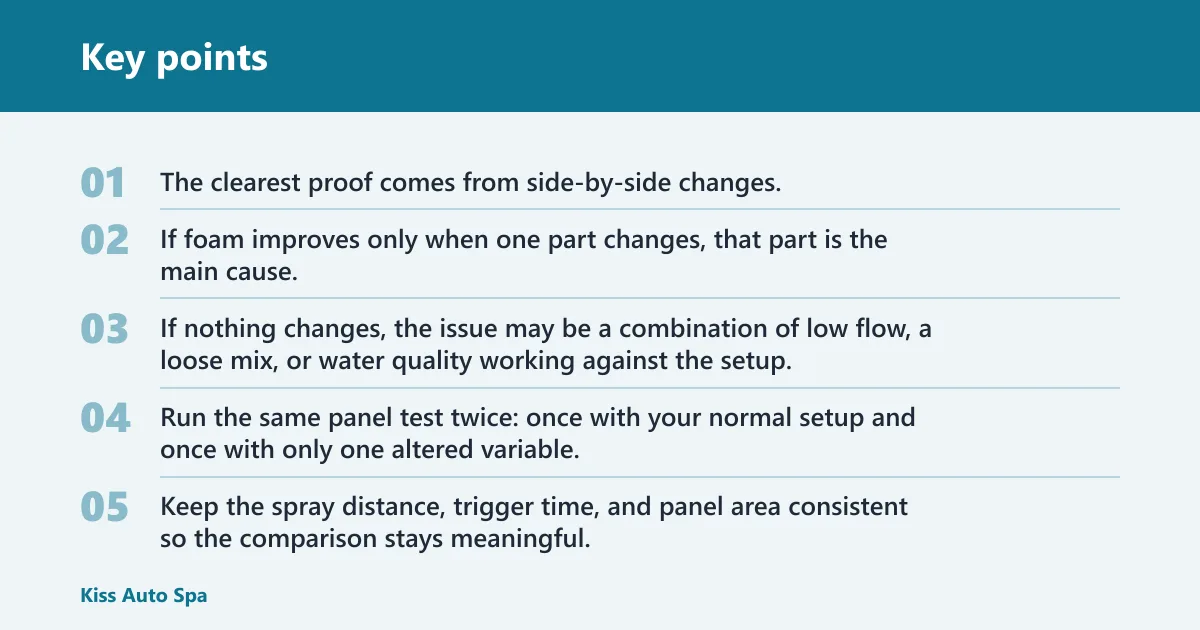
Diagnosis: the clearest proof comes
The clearest proof comes from side-by-side changes. If foam improves only when one part changes, that part is the main cause. If nothing changes, the issue may be a combination of low flow, a loose mix, or water quality working against the setup.
Quick test: run the same panel test
Run the same panel test twice: once with your normal setup and once with only one altered variable. Keep the spray distance, trigger time, and panel area consistent so the comparison stays meaningful. Small setup changes are easier to read than big recipe changes.
Fix: treat the weakest result
Treat the weakest result as the starting point. If the foam gets better with a smaller orifice, keep that change and then fine-tune the soap. If it gets better with softer water, keep the water source constant before adjusting anything else.
Foam cannon troubleshooting matrix
| Symptom | Likely cause | Quick test | Fix | Best variable to test next |
|---|---|---|---|---|
| Watery spray with little cling | Soap ratio too weak | Double the soap concentration in one fill and spray the same panel | Use a stronger mix, then recheck | Soap ratio |
| Good foam for a few seconds, then fast breakup | Hard water | Repeat with softened or filtered water | Increase concentration or switch water source | Water source |
| Foam looks fine on one washer, thin on another | PSI/GPM mismatch | Compare the two washer ratings side by side | Use the cannon setting and orifice that fit the lower-flow machine | Washer output |
| Spray is strong but not foamy | Orifice too large for the washer | Swap to a smaller orifice if the cannon supports it | Match nozzle size to washer output | Orifice size |
| Foam is dense only at very close range | Pressure is adequate but flow is low | Check whether the washer has low GPM | Use a cannon setup suited to that flow rate | GPM rating |
| Soap solution stays in the bottle but does not draw well | Too concentrated for the machine | Cut the mix with more water in one-step changes | Back off the concentration and retest | Soap concentration |
| Foam improves after switching soap brands | Soap chemistry, not the cannon | Use a foam cannon-specific car wash soap | Choose a high-foaming, pH-balanced formula | Soap type |
| Foam looks streaky or airy | Adjustable nozzle set too open | Close the nozzle slightly and spray again | Fine-tune the nozzle until the mix thickens | Nozzle adjustment |
Common first-timer mistake
Say your cannon makes thick foam on one electric washer but turns watery on another washer with different output. The usual mistake is blaming the soap first. In many cases, the second washer needs a different orifice, or the mix must be adjusted to suit the new GPM and PSI pairing.
Does nozzle size affect foam thickness?
Yes. The orifice or nozzle size controls how much mixture moves through the cannon, so a mismatch can reduce foam density. If the nozzle is too large for the washer’s output, the cannon may spray fast but draw less concentrate. If it is too small, the pattern can become harsh or unstable.
Diagnosis: the nozzle is one
The nozzle is one of the easiest parts to overlook because the spray can still look strong even when the foam is weak. A poor match usually shows up as either fast watery output or a choppy spray pattern. The exact best size varies by cannon and washer.
Quick test: read the size stamped
Read the size stamped on the nozzle if available, then compare it with the washer’s rating. If the machine is low-flow, try the smaller orifice first. Keep the spray distance and panel the same so the foam comparison stays fair.
Fix: pSI and GPM both matter
PSI and GPM both matter. PSI shapes spray force and atomization, while GPM strongly affects soap draw and foam volume. A cannon that works with one washer may need a different orifice on another because the flow rate changed even when the pressure spec still looks acceptable.
When a nozzle change helps
- Check the current orifice. Read the size stamped on the nozzle if available, then compare it with the washer’s rating. If the machine is low-flow, a smaller orifice often helps the cannon build denser foam.
- Swap one size at a time. Change only one nozzle size per test, then spray the same panel at the same distance. That keeps the result easy to read.
- Retune the bottle mix. After a nozzle change, adjust soap dilution in one increment and recheck. A practical starting change is 1 to 2 ounces of soap per bottle fill, then spray again and compare cling.
Picture a low-flow electric washer that makes decent foam with one cannon insert and weak suds with another. The fix is usually not “more soap forever.” It is a better orifice match, followed by a small dilution adjustment if needed.
Can hard water make a foam cannon less foamy?
Yes. Mineral content can reduce suds, make foam look thin, and shorten cling. Hard water is easy to miss because the cannon, soap, and washer may all be fine. Temperature can matter too: colder wash water often slows lather formation, while very warm water can change how quickly foam breaks.
Diagnosis: hard water can make
Hard water can make a good setup seem weak because minerals interfere with surfactant performance. The foam may look airy, drain quickly, or leave gaps on the panel. If the same soap works better with another water source, water quality is part of the problem.
Quick test: use the same soap first
Use the same soap first, then repeat the spray with softened or filtered water if available. If the foam improves right away, the water supply is affecting the result. Keep the other variables fixed so the change is easy to see.
Fix: calcium and magnesium
Calcium and magnesium in hard water interfere with surfactant performance. The result is foam that looks airy, drains fast, or leaves gaps on the panel. Even a strong, concentrated formula can look weaker if the water supply is hard enough.
Mix changes that can help
- Use the same soap first. Keep the product constant so you can see whether water quality is the issue.
- Increase concentration in about 1-ounce steps. Add 1 ounce of soap per fill, then retest. A harder water supply often needs a stronger mix than the label baseline.
- Try cleaner water. If the foam improves with softened or filtered water, the water supply is part of the problem.
Common mistakes
Do not assume foam cannon-specific soap automatically solves everything. Many soaps are pH balanced and high foaming, and some are ceramic-infused or designed for coated paint, but the cannon still depends on the washer, the orifice, and the water. Many products are also described as concentrated, which helps only when the machine can draw the mix well.
Do not chase one variable too hard. A stronger soap mix can help, but an oversized nozzle or a low-GPM washer can still leave you with weak foam. Do not judge the setup by scent or gloss alone; a berry-scented or glossy formula can still foam poorly if the dilution or hardware is off.
How do I make thick foam with a foam cannon?
Use a foam cannon-specific soap, start at the maker’s dilution, and tune the cannon to the washer’s PSI and GPM. Thick foam comes from a balanced setup, not from soap alone. If the spray is still watery, change one variable at a time and retest before adding more product.
Diagnosis: thick foam depends
Thick foam depends on the whole system working together: washer, orifice, soap, and water. If one part is off, the rest can only do so much. The strongest-looking foam usually comes from the best match, not the most soap.
Quick test: test the spray
Test the spray on one panel using the current washer setup, then make only one change, such as a smaller orifice or a slightly stronger mix. Keep the test area and distance the same. That shows whether the change actually improved cling.
Fix: thick foam comes
Thick foam comes from a balanced setup, not from soap alone. If the mix is still watery, change one variable at a time and retest before adding more product. Ideal output varies by cannon and washer, so the best setup is the one that fits your machine.
If that didn’t work, try this next
- Adjust the soap first. Start with the recommended dilution, then add 1 ounce of soap per bottle fill and recheck foam density.
- Adjust the nozzle next. Move to a smaller orifice if your washer is low-flow or if the foam stays thin after the soap change.
- Compare water quality last. Test with softened or filtered water, since hard water can erase the gain from the first two changes.
What PSI and GPM do I need for a foam cannon?
There is no single perfect PSI or GPM number for a foam cannon, but both specs still matter. PSI influences spray force and atomization, while GPM often controls how much soap the cannon can draw and how much foam volume it can build. A washer with weak flow can make watery foam even if the pressure number looks fine.
Diagnosis: electric washers and gas washers
Electric washers and gas washers can behave differently at the same nominal PSI because flow and delivery differ. Match the cannon and orifice to the washer’s real output, not just the pressure label.
Quick test: compare the washer’s PSI
Compare the washer’s PSI and GPM against the cannon’s current setup, then spray the same panel with no other changes. If the foam is thin, try a smaller orifice before increasing soap too much. That keeps the test controlled.
Fix: there is no universal PSI
There is no universal PSI or GPM number. The best setup depends on the cannon and washer working together, with flow often doing more to shape foam than pressure alone. Match the cannon to the machine instead of chasing a fixed number.
What soap dilution makes the thickest foam?
The thickest foam is often reported with the strongest mix the washer can still draw cleanly. Manufacturer ratios vary by product, so start there and move in small steps. Too much water weakens foam, but too much soap can also reduce draw and leave you with a heavy-looking bottle and thin spray.
Diagnosis: if the mix is too
If the mix is too weak, the spray runs off too fast. If it is too strong, the cannon may struggle to draw it. The right dilution is the strongest mix your washer can still pull through the cannon cleanly.
Quick test: for a practical adjustment, change
For a practical adjustment, change the mix by 1 ounce at a time per bottle fill, spray the same panel, and compare cling. That keeps the test controlled and prevents overconcentrating the bottle too fast.
Fix: there is no universal number
There is no universal number. The best dilution is the strongest one your washer can still draw without turning the spray watery. Start with the soap label, then increase concentration in 1-ounce increments per bottle fill until the foam clings better and stays dense longer.
Frequently asked questions
Why is my foam cannon only spraying watery soap?
The fastest explanation is a mismatch in one of four places: washer output, nozzle orifice, soap dilution, or water quality. Start with the washer’s GPM and PSI, then check the cannon insert, then the mix, then the water source. Changing two things at once makes the result hard to read.
Does the foam cannon nozzle size affect foam thickness?
Yes. The orifice controls mixture flow through the cannon, so the wrong size can make the foam thin. A larger orifice can be too open for a low-flow washer, while a smaller one often helps a weak setup build thicker foam and better cling.
Why does my foam cannon work on one pressure washer but not another?
Different PSI and GPM ratings change how the cannon draws soap and air. One washer may push the same cannon into a good foam pattern, while another leaves it watery. In that case, the usual fix is a different orifice size or a stronger dilution, not a new cannon.
How do I know if my soap is too thin for a foam cannon?
If the spray looks clear, runs off fast, and does not hold on the panel, the mix is probably too weak for that washer and nozzle combination. Increase concentration in 1-ounce steps, spray the same area again, and stop when the foam clings without turning the stream heavy or sluggish.