Paint Sealant for Older Cars with Faded Paint: Is It a Good Idea?
Paint sealant is a good idea on older cars only if the clear coat is intact and fading is light. If you see chalky oxidation, peeling, or exposed base coat, correction or repainting should come first. Skip that step and you can lock in dullness, waste product, and trap defects under a short-lived finish. This guide explains how to judge the paint, when sealant makes sense, and when to choose polishing, wax, ceramic coating, or repainting instead.
Can you seal faded paint?
Yes, but only when the paint is still structurally sound. If the surface is mostly light dullness and the clear coat still reflects cleanly, sealant can add gloss and improve water behavior. If the fade is really oxidation or failure, sealant will cover the symptom without fixing the cause.
That difference matters because older outdoor-kept vehicles often look “faded” for more than one reason. Some have a tired but intact clear coat. Others have UV-related oxidation, swirl marks, or an active clear coat problem that sealant cannot solve.
Think of sealant as a protective layer, not a repair product. It can help preserved paint look sharper and stay easier to wash, but it does not remove defects, fill them permanently, or rebuild failed clear coat.
2-minute inspection checklist
Use this quick check before you buy anything or start sealing. If the paint passes the first two checks and fails only on minor gloss, sealant can still make sense. If it fails on chalking, peeling, or exposed color coat, stop and move to correction or repainting.
- Clear coat intact? Pass if the surface looks continuous and does not peel or flake. Fail if edges lift, blister, or shed.
- Oxidation mild? Pass if the finish is dull but not chalky. Fail if the panel looks cloudy, dry, or powdery after washing.
- Color even after cleaning? Pass if the paint looks uniform. Fail if some panels are much flatter, hazier, or visibly worn.
- Test spot improves? Pass if a small, least-aggressive polish restores gloss. Fail if polishing barely changes the look.
- Stop and repaint? If the clear coat is peeling, flaking, or exposing base coat, protection is the wrong next step.
When faded paint is still a good candidate
If the finish is dull after washing, but the surface still feels solid and the color is even, sealant can be appropriate after prep. The best candidates are garage-kept older cars, or daily drivers with light weathering and only shallow cosmetic loss.
Look for these signs:
- Gloss is muted, but the surface is not chalky.
- The clear coat still looks continuous, not peeling.
- Defects are limited to light haze or minor wash marks.
- After cleaning, the paint still responds to polish in a test spot.
When fading means oxidation
Oxidation is UV-related clear coat breakdown that often looks chalky or cloudy. Once the paint reaches that stage, washing alone will not restore it, and a quick spray detailer will not restore chalky oxidation either. In many cases, correction is needed before any protectant goes on.
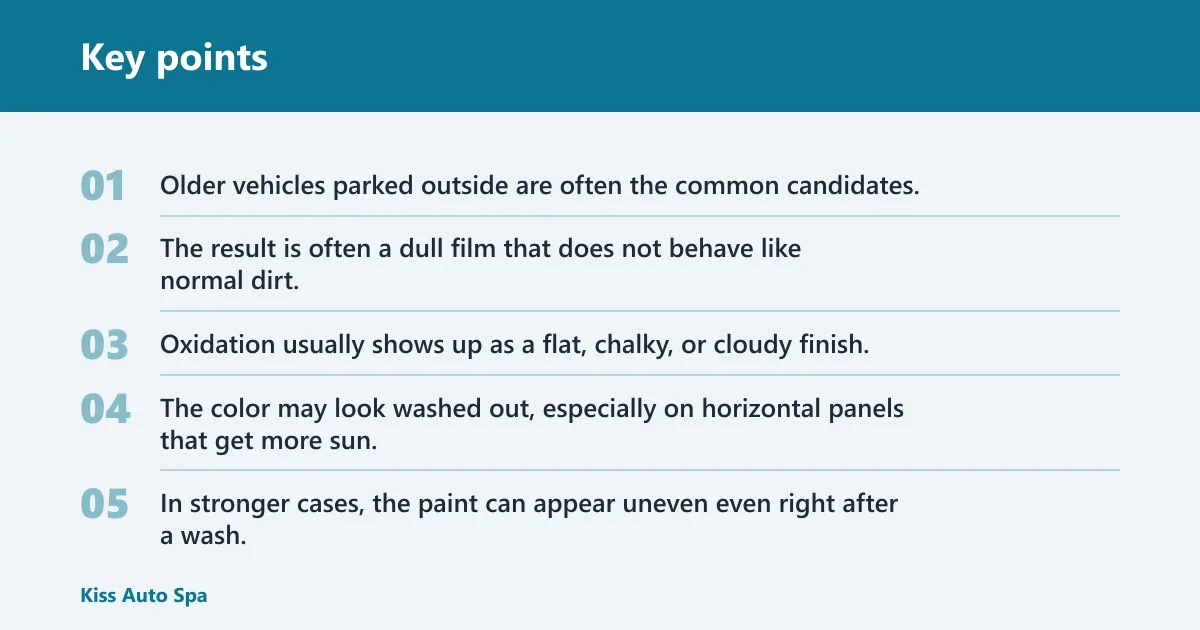
Older vehicles parked outside are often the common candidates. Harsh sun, road salt, construction dust, bird droppings, and automatic car washes all make the surface work harder and age faster. The result is often a dull film that does not behave like normal dirt.
How oxidation looks on older paint
Oxidation usually shows up as a flat, chalky, or cloudy finish. The color may look washed out, especially on horizontal panels that get more sun. In stronger cases, the paint can appear uneven even right after a wash.
That look is different from ordinary grime. Dirt sits on top. Oxidation is a change in the clear coat itself, so protection alone cannot reverse it.
Why correction usually comes first
Paint correction uses machine polishing or compounding to restore gloss before protection. A test spot should start with the least aggressive polish and a soft foam pad. If that is not enough, then step up methodically based on paint thickness and defect severity.
That order matters because older clear coat may already be thin. Too much cut can create more trouble than it solves. The goal is to remove the damaged top layer only as far as needed, then protect the restored surface.
Older paint protection options
For older paint, the right protection depends on condition first and product second. Synthetic sealants are often used when the surface is already in decent shape because they typically outlast wax and are simpler to maintain. Carnauba wax still has a place for a warmer look, but it usually needs more frequent reapplication. Ceramic coatings can last longer on properly prepared paint, but prep still comes first and real-world durability depends heavily on exposure and washing. Manufacturer guidance commonly frames wax as the shortest-lived option, sealants as the middle ground, and ceramic coatings as the longest-lasting when paint is properly cleaned, decontaminated, and corrected before application.
Carnauba wax still has a place. It is easier to apply and can give a warmer look, but it usually needs more frequent reapplication. That can be fine for garage-kept cars or owners who do not mind regular upkeep.
Paint sealant versus wax
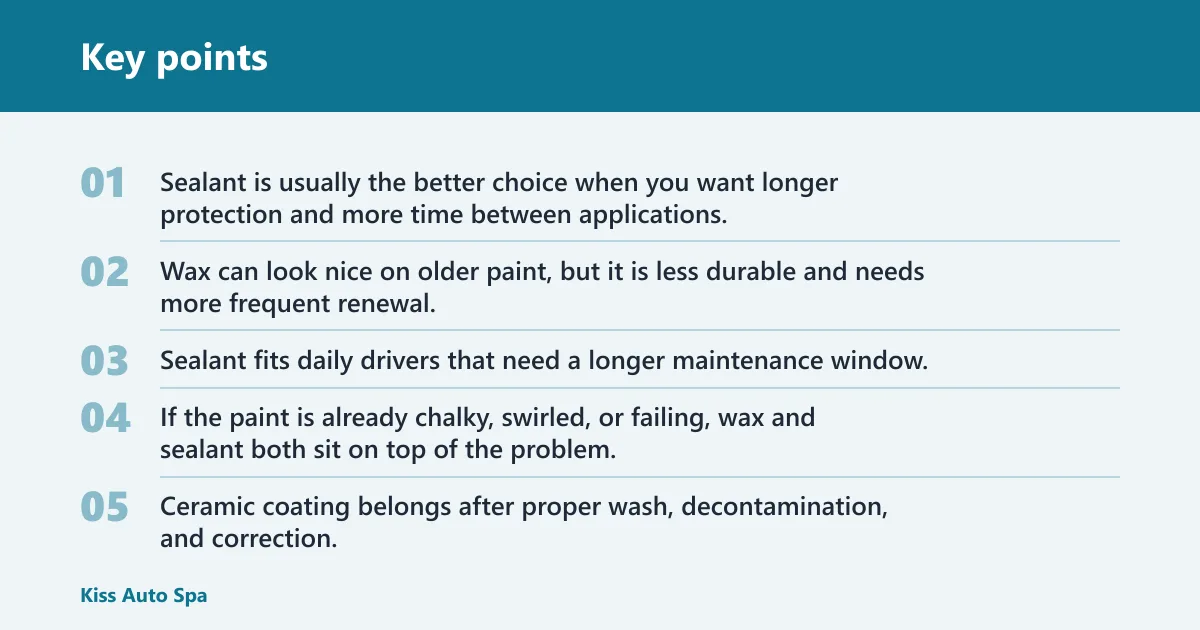
Sealant is usually the better choice when you want longer protection and more time between applications. Wax can look nice on older paint, but it is less durable and needs more frequent renewal. Sealant fits daily drivers that need a longer maintenance window.
Neither product repairs defects. If the paint is already chalky, swirled, or failing, wax and sealant both sit on top of the problem.
Where ceramic coating fits
Ceramic coating belongs after proper wash, decontamination, and correction. It gives stronger durability and easier washing on sound paint, but it is not a force field. It will not fix oxidation, hidden swirls, or clear coat failure.
For a neglected older car, ceramic coating is the right long-term option only after the surface has been restored enough to justify it. On compromised paint, coating over defects can preserve the wrong look for a long time.
How to prep before sealing
Good prep matters more on older paint than on fresh paint because aging clear coat already has less margin for error. A proper wash removes loose dirt, but bonded contamination still interferes with bonding and appearance. That is why decontamination and clay treatment are often the next step before sealing, waxing, correction, or coating.
A clean-looking panel can still feel rough. Tar, sap, road film, and fallout can sit on the surface and keep protection from bonding evenly.
-
Wash the car thoroughly.
Use a pH-appropriate shampoo and a clean wash mitt. Rinse well so loose grit does not get dragged back across aging clear coat. -
Inspect the paint in direct light.
Check for chalking, cloudiness, swirl marks, and peeling edges. What you see here decides whether you can move straight to protection or need correction first. -
Decontaminate bonded residue.
Use iron removal or a clay treatment when the surface still feels rough after washing. Clay treatment is recommended before wax, sealant, paint correction, or ceramic coating when bonded contaminants are present. -
Test a small correction area.
Start with the least aggressive polish and a soft foam pad. If one pass improves gloss enough, stop there instead of reaching for a heavier compound. -
Apply protection only after restoration.
Once the surface is clean, smooth, and visually sound, add sealant, wax, or coating as appropriate. Protection should be applied only after the surface is restored.
A test spot should prove two things before you seal: the paint can be improved without heavy cutting, and the surface still has enough clarity to justify protection. For example, if a dull hood responds to light polishing but still looks cloudy or chalky after cleaning, the issue is beyond simple sealing and needs more correction first.
Say your roughly 15-year-old sedan has a flat hood and dull roof, but the clear coat is still intact and the paint is not chalky. A clay treatment and light polish may bring back enough gloss that sealant becomes a smart next step. If the hood still looks cloudy after that, the finish needs more correction before protection.
Should You Seal It?
This decision table gives the simplest rule: seal intact clear coat with only light dullness, correct the surface first if oxidation or swirls are present, and repaint when the clear coat is failing. Sealant helps preserve a surface that is still there. It cannot rescue a surface that has already broken down.
| Paint condition | Visible symptoms | Recommended prep | Is sealant appropriate? | Expected result |
|---|---|---|---|---|
| Light dullness | Muted gloss, even color, no chalkiness | Wash, decontaminate, then seal | Yes | Better shine, slicker wash behavior, more durable protection than wax |
| Mild oxidation | Some cloudy or faded areas, clear coat still intact | Wash, clay, light correction, then seal | Sometimes, after correction | Improved gloss if correction removes the damaged top layer |
| Heavy oxidation | Chalky, cloudy, dry-looking paint | Correction first; repaint may be needed | No, not by itself | Sealant may trap the faded look under a shiny film |
| Swirl-heavy paint | Fine circular scratches, haze in sunlight | Test spot, then polish if safe | Not until corrected | Uncorrected swirls can remain visible under sealant |
| Clear coat failure | Peeling, flaking, exposed base coat | Repaint or panel repair | No | Protection cannot fix failed clear coat |
When correction beats protection
Correction beats protection whenever the defect is in the paint itself. Swirl marks and micro-marring are microscopic surface defects that dull the finish by scattering light, and they can remain visible under sealant if you do not correct them first. The same is true for oxidation that has gone beyond simple dullness.
Clear coat matters here. It is the top protective layer on modern paint, and its condition limits how much correction is safe. If the layer is still intact, a careful polish may restore enough clarity to justify sealant. If it is failing, no protectant can reverse that.
Swirl-heavy paint and micro-marring
Swirl-heavy paint usually comes from improper washing, dry wiping, or poor towel choices. The scratches are often fine enough to miss in shade and obvious in sun. Sealant can add shine on top, but it will not erase the lines that are already there.
A common first-timer mistake is sealing a panel that looks “okay” indoors and then seeing every wash mark bloom in direct light. The problem was not the sealant. The problem was uncorrected micro-marring under the sealant.
Clear coat failure and repainting
Clear coat failure is the irreversible stage where the top layer peels. At that point, the finish is beyond polishing and beyond sealant. Repainting or panel repair is the practical answer.
Trying to protect failing clear coat can slow down contamination, but it will not restore adhesion or clarity. If the surface is flaking, the priority is repair, not protection.
How long sealant lasts on a daily driver
On a daily driven older car, sealant usually lasts longer than wax, but the real-world result depends on product, exposure, wash method, and how often the car sits in sun, salt, or dirty rain. There is no single number that fits every car. A garaged older car can keep its protection longer than a commuter parked outside every day.
Frequent automatic washing, harsh chemicals, and rough towels shorten durability. Careful hand washing and gentle drying help keep the protective layer working as intended. In everyday use, a realistic durability range is often several months for sealant on a well-kept driver, shorter if the car lives outside or goes through aggressive washes, and longer only when prep and maintenance stay consistent.
What shortens durability
- Frequent automatic car washes with harsh brushes
- Strong detergents that strip protection quickly
- Long exposure to harsh sun and winter salt
- Dirty drying towels that add new micro-marring
How to maintain the finish
-
Wash gently.
Use a clean mitt, two-bucket method if available, and plenty of rinse water. Safe washing matters for long-term paint condition because new swirls undo the benefit of sealant. -
Dry with clean towels.
Pat or glide with soft microfiber instead of dragging debris across the panel. This reduces the chance of adding micro-marring back into the finish. -
Refresh protection as needed.
Reapply sealant when water behavior weakens or the surface stops feeling slick. Do not wait for the paint to look bad again.
Suppose a garage-kept coupe gets washed by hand twice a month and parked away from the sun. Sealant will usually hold up better there than on a commuter that sees road salt, weekly tunnel washes, and long outdoor parking. Same product, very different outcome.
Frequently asked questions
Can you put paint sealant on faded car paint?
Yes, if the fade is mostly light dullness and the clear coat is still intact. If the paint is chalky, peeling, or oxidized in a serious way, sealant should wait until correction or repainting addresses the real problem. The surface has to be sound first.
Will paint sealant make old paint look better?
It can improve gloss, slickness, and water beading, but only on paint that still has a usable surface. It will not remove oxidation, repair swirls, or rebuild failed clear coat. Any visual improvement depends on what is already left in the finish.
Do I need to polish before using paint sealant on an older car?
Not always. If the paint is clean, smooth, and only slightly dull, washing, decontamination, and sealant may be enough. If you see haze, swirl marks, or oxidation, do a test spot with the least aggressive polish and a soft foam pad before sealing.
Is paint sealant better than wax for an old car?
For most daily driven older cars, yes, if durability matters. Sealant usually lasts longer than wax and gives a slicker, more water-repellent finish. Wax still makes sense when you want easier application and do not mind reapplying more often.
Does sealant hide swirl marks and oxidation?
No. It may add shine over them, which can make the finish look a little better in shade, but the defects remain. Swirl marks scatter light, and oxidation is commonly treated as a change in the clear coat itself rather than something to cover up. Those problems need correction, not coverage.
What kind of protection is best for neglected paint?
The best protection depends on how far the paint has gone. For light dullness, sealant after washing and decontamination is reasonable. For oxidized or swirl-heavy paint, correct first. For clear coat failure, repainting is the right move before any protectant is considered.